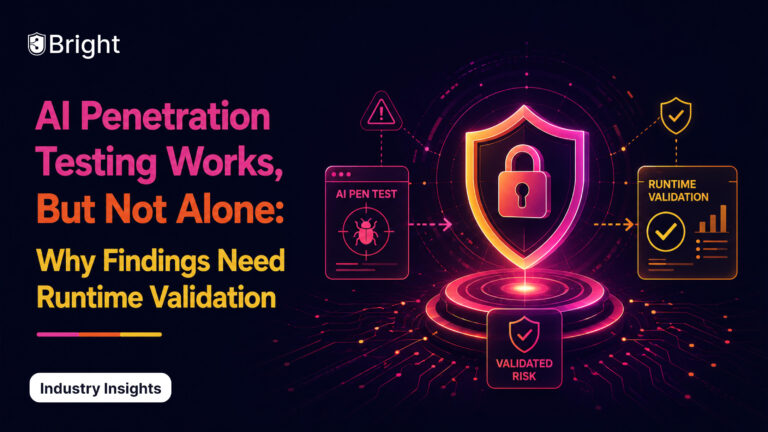

Why Finding Vulnerabilities Isn’t the Problem Anymore
Table Of Contents
- Introduction
- The Problem Isn’t Detection Anymore
- Where Most AI Pentesting Tools Stop
- Why Developers Don’t Need More Security Alerts
- How Bright STAR Closes the Detect-to-Remediate Gap
- How Bright STAR Approaches The Problem Differently
- Conclusion
Introduction
For years, application security teams have been trying to solve the same problem: how do you test more applications without hiring more people?
That’s one of the reasons AI pentesting has taken off so quickly. Whether it’s an AI pentest tool, a pentest AI platform, or the latest generation of AI-powered scanners, the promise is always similar. Point the tool at an application, and it will uncover vulnerabilities in minutes instead of days.
And to be fair, these tools have become surprisingly good at finding things that look suspicious.
They can spot patterns associated with SQL injection. They can identify parameters that resemble cross-site scripting vulnerabilities. They can analyze responses at a scale that would be impossible for most human teams.
But here’s the question security leaders are starting to ask: What happens after the vulnerability is found?
Because that’s usually where progress slows down.
The industry talks a lot about vulnerability discovery. It talks far less about vulnerability remediation. Yet if you ask most AppSec teams where they spend the majority of their time, the answer usually isn’t “finding vulnerabilities.”
It’s figuring out how to fix them.
The Problem Isn’t Detection Anymore
A few years ago, discovering vulnerabilities was often the hardest part of application security.
Today, that’s no longer true.
Most organizations already have scanners. Many run SAST, DAST, dependency scanning, API security tools, and now AI pentesting platforms as well. The challenge isn’t a lack of findings. In many cases, it’s the exact opposite.
Security teams are drowning in findings.
One customer we spoke with described their situation perfectly. Every new security tool they purchased successfully found more vulnerabilities. The problem was that their remediation backlog kept growing anyway.
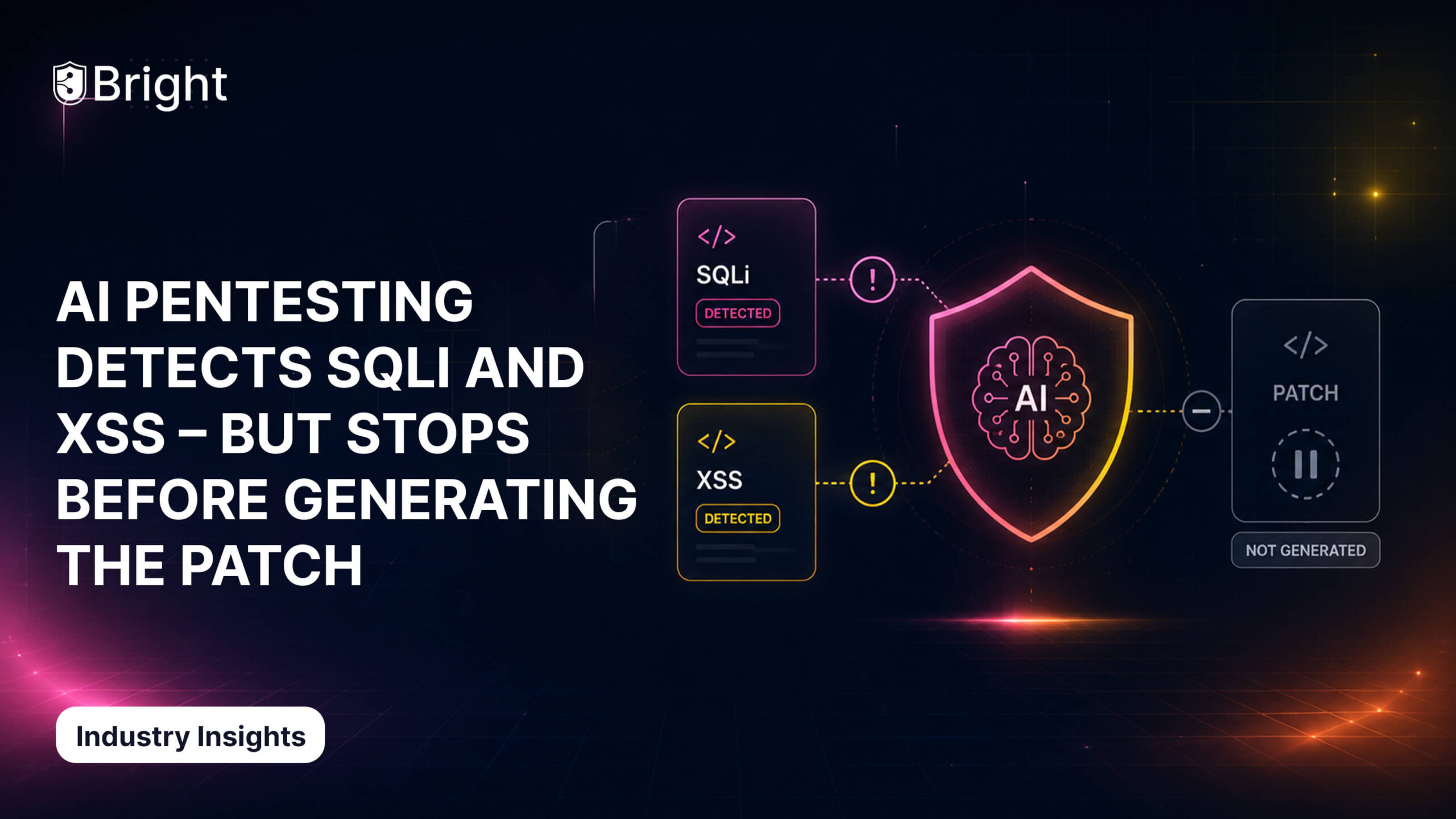
Nothing was actually getting fixed faster. That’s because detection and remediation are two very different workflows. Finding a potential SQL injection vulnerability might take seconds.
Understanding the root cause, updating the code, testing the fix, creating a pull request, reviewing the change, and deploying it safely can take days or even weeks. The scanner’s job ends at detection. The developer’s job starts there.
Where Most AI Pentesting Tools Stop
This is where many AI pentesting tools reveal their biggest limitation.
Let’s say an AI scanner identifies a potential XSS vulnerability in an application.
The report often looks impressive. You’ll get a severity score, references to common weaknesses, technical descriptions, and sometimes even an explanation of how the issue could be exploited.
But after reading the report, the developer still has the same questions:
Where exactly is the vulnerable code?
What’s the safest way to fix it?
Will the fix impact functionality?
How can I verify that the vulnerability is actually gone?
Most tools don’t answer those questions. Instead, they hand the problem to engineering and move on. From a security perspective, that’s a dangerous handoff because the vulnerability still exists until somebody fixes it. A report doesn’t reduce risk. Remediation does.
Why Developers Don’t Need More Security Alerts
One of the biggest misconceptions in AppSec is that more findings automatically improve security.
In reality, developers don’t wake up in the morning hoping for more security tickets.
They’re already balancing feature requests, customer issues, production incidents, technical debt, and release deadlines.
Adding another vulnerability report to the pile rarely changes priorities. What developers actually need is context.
They need to understand why an issue matters, where it exists, and how to resolve it without introducing new problems.
This is one reason many organizations are rethinking how security tools fit into development workflows. The goal is no longer to generate more alerts. The goal is to remove as much friction from remediation as possible.
How Bright STAR Closes the Detect-to-Remediate Gap
One of the problems in modern application security is that vulnerability management often stops where it should start.
A scanner finds a SQL injection or XSS vulnerability, makes a report, and creates a ticket. Then security teams have to depend on developers to look into the issue, find the root cause, make a fix, check the change, and finally put it into production.
In theory, this process seems simple. In practice, it often causes delays, miscommunication, and growing remediation backlogs. This is exactly the gap Bright STAR was made to fix. By seeing vulnerability detection as the final goal, Bright STAR helps organizations move from finding to fixing as quickly as possible.
When a confirmed vulnerability is found, the goal is not just to tell developers. The goal is to advise on how to fix it speed up making fixes, and make sure those fixes can be checked before the issue is considered solved.
For development teams, this means spending time looking into security issues and more time making meaningful improvements. They do not have to jump between vulnerability reports, documentation pages, issue trackers, and code repositories.
Instead, developers get security information within the workflows they already use every day. For security leaders, the value is just as significant. Measuring success is no longer about counting findings or making reports.
Success becomes easier to measure because teams can focus on what matters: reducing open vulnerabilities, improving fix speed, and lowering overall application risk. As AI pentesting, pentest AI platforms, and AI pentest tools keep getting better, the organizations that achieve the security results will be those that make the whole process better, not just finding vulnerabilities.
Bright STAR helps close that process by linking detection fixing, checking, and developer workflows into one process. The result is an efficient and effective way to manage vulnerabilities and reduce application risk.
How Bright STAR Approaches The Problem Differently
At Bright, we’ve spent a lot of time talking with both security teams and developers. One thing became obvious very quickly. Neither side wanted another dashboard. Neither side wanted more alerts. What they wanted was a faster path from discovery to resolution.
That’s the idea behind STAR.
Instead of treating vulnerability detection as the finish line, STAR treats it as the starting point. When an issue is identified, the objective isn’t simply to document it. The objective is to help move that issue toward remediation as quickly as possible.
For developers, that means spending less time interpreting security findings and more time implementing fixes. For security teams, it means focusing on risk reduction rather than report generation.
The outcome is a workflow that feels much closer to modern software development and much less like traditional security operations.
Conclusion
AI pentesting is absolutely changing application security.
The ability to analyze applications quickly and uncover potential vulnerabilities at scale creates real value. Most security teams would not want to go back to a world without that capability.
But finding vulnerabilities is no longer the bottleneck.
Fixing them is.
The organizations that improve their security posture over the next few years won’t necessarily be the ones running the most scans. They’ll be the ones that can move from detection to remediation with the least amount of friction.
That’s why the conversation is shifting. The future of AppSec isn’t just about finding SQL injection and XSS vulnerabilities faster.
It’s about helping developers eliminate them faster, too. And that’s the problem Bright STAR was built to solve.