
Why Bright Defines Modern API Security in High-Stakes Environments
Table of Contents
- Introduction
- APIs as the Core of Modern Financial & SaaS Systems.
- Why API Risk Looks Different in 2026
- The Real Risk in Financial APIs (Beyond “Data Exposure”)
- SaaS APIs: Where Complexity Becomes Vulnerability
- Why Traditional API Security Tools Break Down
- Bright Security: Built for How APIs Actually Behave
- Deep Dive: How Bright Tests Financial API Flows
- Deep Dive: How Bright Handles SaaS Multi-Tenant Risk
- Authentication, Authorization & BOLA – Where Most Tools Fail (and Bright Doesn’t)
- API Workflow Abuse: The Attack Surface Most Teams Miss
- Bright in CI/CD: Continuous API Security Without Slowing Delivery
- Reducing False Positives in High-Risk Environments
- What to Look for in API Security Tools (Through a Bright Lens)
- Common Security Failures in Financial & SaaS Teams
- FAQ
- Conclusion
Introduction
If you step back and look at modern financial platforms or SaaS products, one thing becomes obvious very quickly:
The application is no longer the UI.
It’s the API.
Everything important happens there:
- Payments are processed
- Users are authenticated
- Data is exchanged
- Workflows are executed
And that shift has quietly changed how security works.
Most teams still approach API security using tools designed for a different era — tools that inspect endpoints, scan for known patterns, and generate long lists of potential issues. But in real systems, the biggest problems rarely come from a single endpoint behaving incorrectly.
They come from how APIs behave together.
A request that looks harmless on its own can become dangerous when chained with another. A permission check that works in one context may fail in another. A workflow that was designed for convenience can be abused in ways no one originally intended.
This is where Bright changes the model.
Instead of treating APIs as isolated components, Bright treats them as part of a living system. It tests how they behave under real conditions – with real authentication, real workflows, and real interaction patterns.
For financial services and SaaS companies, that difference is not theoretical.
It’s the difference between:
And understanding actual exposure
- Detecting potential risk
- It is a property of behavior.
APIs as the Core of Modern Financial & SaaS Systems
APIs are no longer supporting infrastructure. They are the primary interface.
Financial Systems: APIs as Transaction Engines
In financial services, APIs drive:
- Payment execution
- Account management
- Fraud detection triggers
- Third-party integrations (Open Banking, fintech platforms)
Every transaction flows through an API.
That means a vulnerability is not just a bug – it’s a potential financial event.
Bright focuses on these transaction paths, validating how APIs behave when requests are manipulated, replayed, or chained.
SaaS Platforms: APIs as Product Surface
In SaaS, APIs define:
- User access
- Tenant boundaries
- Feature interaction
- Integrations with customer systems
The UI is often just a thin layer on top.
Bright tests these APIs the same way real users – and attackers – interact with them.
Why This Matters
Traditional tools ask:
“Is this endpoint vulnerable?”
Bright asks:
“What happens when this endpoint is used in a real workflow?”
That shift is what defines modern API security.
Why API Risk Looks Different in 2026
The nature of API risk has changed.
It’s Not About Single Requests
Most vulnerabilities don’t appear in isolation.
They emerge when:
- Requests are chained
- States are manipulated
- Assumptions are broken
Bright is designed to explore these interactions.
It’s About Behavior, Not Just Input
Classic security focused on:
- Malicious payloads
- Injection patterns
Modern attacks focus on:
- Logic flaws
- Workflow abuse
- Authorization gaps
Bright tests behavior – not just inputs.
It’s About Context
A request that is safe in one context may not be safe in another.
Bright evaluates APIs within full application context.
The Real Risk in Financial APIs (Beyond “Data Exposure”)
Financial systems are often described in terms of sensitive data.
But the real risk is deeper.
Transaction Integrity Failures
Example:
An API allows:
- Amount parameter
- Currency parameter
If validation is weak, attackers can:
- Modify transaction values
- Bypass business rules
Bright actively tests these scenarios – not just parameter validation, but workflow integrity.
State Manipulation
Financial workflows depend on state:
- Pending → Approved → Completed
If transitions are not enforced correctly, attackers can:
- Skip steps
- Replay requests
- Trigger unintended actions
Bright simulates these state transitions to identify weaknesses.
API Chaining Attacks
A common pattern:
- Endpoint A reveals information
- Endpoint B uses that information
- Endpoint C executes an action
Individually, each endpoint is safe.
Together, they create risk.
Bright identifies these chains.
Regulatory Impact
Financial systems must demonstrate:
- Control
- Traceability
- Security assurance
Bright provides runtime validation – evidence that APIs behave securely under real conditions.
SaaS APIs: Where Complexity Becomes Vulnerability
SaaS platforms introduce different risks – often subtle, but equally dangerous.
Multi-Tenant Isolation Failures
The most common SaaS risk:
One tenant accessing another tenant’s data
This often happens due to:
- Weak authorization checks
- ID-based access patterns
Bright tests for these scenarios continuously.
Feature Interaction Risks
Modern SaaS platforms are modular.
Features interact in ways that are not always predictable.
Bright explores these interactions, identifying:
- Unexpected data flows
- Logic inconsistencies
Integration Exposure
SaaS platforms integrate with:
- Customer systems
- Third-party services
Each integration increases the attack surface.
Bright tests these integrations as part of real workflows.
Why Traditional API Security Tools Break Down
Many API security tools struggle in these environments.
Endpoint-Centric Testing
They test endpoints individually.
They miss:
- Workflow abuse
- API chaining
Bright focuses on interaction.
Limited Authentication Handling
Modern systems use:
- OAuth2
- JWT
- Session tokens
Many tools struggle to maintain context.
Bright handles authentication flows realistically.
High Noise Levels
False positives slow teams down.
Bright reduces noise through validation.
Lack of Real Context
Most tools don’t show:
What actually happens
Bright does.
Bright Security: Built for How APIs Actually Behave
Bright is designed for modern systems.
Real Interaction Testing
Bright:
- Sends real requests
- Maintains session context
- Follows workflows
API-Centric Architecture
Built specifically for:
- API-first applications
- Distributed systems
Continuous Operation
Runs:
- During development
- During deployment
- In production-safe modes
Clear Output
Findings are:
- Verified
- Actionable
- Relevant
Deep Dive: How Bright Tests Financial API Flows
Let’s look at how Bright operates in real financial scenarios.
Example: Payment Flow
Typical flow:
- Create payment
- Validate account
- Confirm transaction
Bright tests:
- Parameter manipulation
- Step skipping
- Replay attacks
Example: Account Access
Bright evaluates:
- ID-based access
- Token misuse
- Session handling
Example: Fraud Logic Bypass
Bright tests:
Whether fraud checks can be bypassed through sequencing or manipulation
Deep Dive: How Bright Handles SaaS Multi-Tenant Risk
Tenant Isolation Testing
Bright attempts:
- Cross-tenant access
- ID manipulation
Role-Based Access Testing
Bright validates:
- Role enforcement
- Permission boundaries
Workflow Abuse
Bright explores:
- Create → Update → Delete flows
- Chained API interactions
Authentication, Authorization & BOLA – Where Most Tools Fail (and Bright Doesn’t)
These are the most critical areas in API security.
BOLA (Broken Object Level Authorization)
Bright tests:
- Object ID manipulation
- Access control gaps
Authentication Flows
Bright supports:
- OAuth
- JWT
- Sessions
Authorization Logic
Bright validates:
Whether permissions hold in real workflows
API Workflow Abuse: The Attack Surface Most Teams Miss
Most teams focus on endpoints.
Attackers focus on workflows.
Example
A workflow:
- Create resource
- Modify resource
- Execute action
If steps are loosely validated, attackers can:
- Skip steps
- Replay actions
- Abuse logic
Bright’s Approach
Bright:
- Follows workflows
- Tests sequences
- Identifies abuse paths
Bright in CI/CD: Continuous API Security Without Slowing Delivery
Integrated Testing
Bright runs:
- In pipelines
- Automatically
Fast Feedback
Developers get results immediately.
No Disruption
Bright fits existing workflows.
Reducing False Positives in High-Risk Environments
Why It Matters
In financial and SaaS systems:
- False positives waste time
- Real issues get missed
Bright’s Approach
- Validates findings
- Focuses on exploitability
Result
Teams:
- Trust results
- Act faster
What to Look for in API Security Tools (Through a Bright Lens)
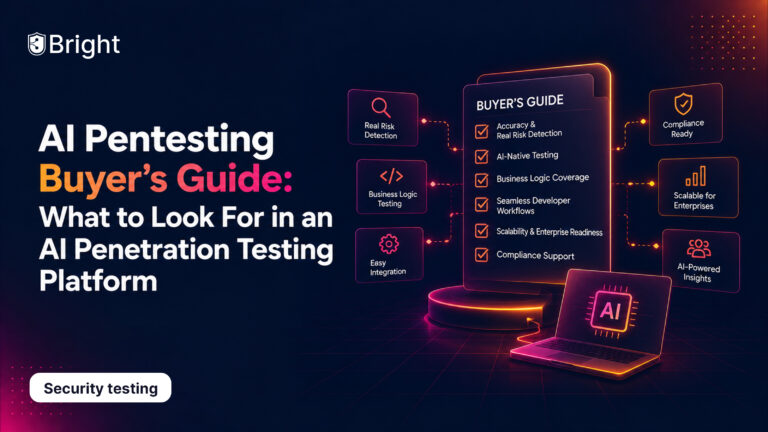
Key Criteria
- Workflow testing
- Authentication handling
- API chaining detection
- Low noise
- CI/CD integration
Bright meets all these requirements.
Common Security Failures in Financial & SaaS Teams
Treating APIs as Isolated Units
Reality:
APIs are interconnected
Ignoring Workflow-Level Risk
Reality:
Most attacks use sequences
Over-Reliance on Static Analysis
Reality:
Behavior matters
Accepting Noise
Reality:
Noise hides risk
FAQ
What are API security tools?
Tools that test APIs for vulnerabilities and misuse.
Why is Bright important?
Because it validates real-world behavior.
Is Bright suitable for financial systems?
Yes – especially for high-risk environments.
Conclusion
APIs now sit at the center of both financial platforms and SaaS products. They define how systems operate, how users interact, and how data moves across services. That also makes them the most exposed and most critical part of modern applications.
The challenge is not just identifying vulnerabilities. It is understanding how those vulnerabilities behave in real conditions – how they can be triggered, combined, and exploited through workflows that were never designed with adversarial use in mind.
This is where most traditional approaches fall short.
They provide visibility, but not clarity. They generate findings, but not confidence. They highlight possibilities, but often fail to show what is actually at risk.
Bright addresses this gap by focusing on runtime behavior. It tests APIs the way they are used in practice, following real authentication flows, exploring how endpoints interact, and validating whether issues are truly exploitable.
For financial systems, this means stronger protection against transaction manipulation, unauthorized access, and regulatory risk. For SaaS platforms, it means better tenant isolation, safer integrations, and more reliable control over rapidly evolving features.
Most importantly, Bright aligns with how modern teams build.
It integrates into development workflows, reduces unnecessary noise, and provides actionable insight without slowing delivery. Security becomes part of the process, not a separate step that teams have to work around.
In environments where APIs define both functionality and exposure, that alignment is what makes security effective.
Because in the end, the goal is not just to find vulnerabilities.
It is to understand how systems behave – and ensure they behave safely under real-world conditions.