
Table Of Contents
- Introduction
- The Growing Authentication Problem In AppSec
- Why OAuth 2.0 And PKCE Create A “Black Box” For Security Teams
- Where Traditional DAST Authentication Breaks Down
- The Hidden Security Risks Behind Failed Authentication Testing
- Automated Script Blocking And Modern AppSec Auth Flows
- Practical Strategies For OAuth 2.0 Security Testing
- How Bright Security Helps Teams Test Beyond Authentication
- What The Future Of Authentication Testing Looks Like
- FAQ
- Final Thoughts
Introduction
A few years ago, getting a DAST scanner authenticated into an application was relatively straightforward. Security teams would provide a username and password, configure a login form, and let the scanner do its job.
Today, that way does not work much.
Modern applications use things like OAuth 2.0 PKCE, Single Sign-On, multi-factor authentication, identity providers, and API-driven authentication workflows.
These technologies make applications more secure for users. They also create big challenges for security testing tools.
Many application security teams think their scans are covering the application, but later they find out that the scanner did not get to the parts that need authentication. That creates a dangerous blind spot.
The reality is that attackers rarely focus on public pages. They target authenticated APIs, account management workflows, administrative portals, and business-critical functionality hidden behind authentication layers.
As organizations increasingly use the best AI for coding, best AI coding assistants, and AI-powered development tools to build software faster, the complexity of authentication systems continues to grow. Security teams need ways to test these protected areas effectively.
Understanding DAST authentication challenges, OAuth 2.0 security testing, PKCE interception issues, and AppSec auth flows has become a critical part of modern application security.
The Growing Authentication Problem In AppSec
Authentication is a problem when it comes to testing security these days.Many organizations have put a lot of money into identity controls over the last few years.
We see platforms like Okta, Auth0, Microsoft Entra ID, and Google Identity being used by every company. These solutions make things more secure. They also make things more complicated for security scanners to deal with before they can even start testing.
The way authentication works now is pretty complicated. It might involve going forth between several domains, exchanging tokens, checking PKCE verification, doing MFA challenges using browser-based scripting, and checking session validation.
For a person using a website, this process feels really smooth. For a security scanner, each of these steps is a place where something could go wrong.
Authentication is still an issue, and it is something that security scanners have to deal with. The result is that many organizations are unknowingly testing only a fraction of their real attack surface.
Why OAuth 2.0 And PKCE Create A “Black Box” For Security Teams
Imagine you’re testing a banking application.
A customer logs in using Microsoft Entra ID. Behind the scenes, the application redirects the user to an identity provider, generates an authorization code, validates a PKCE challenge, exchanges tokens, and finally grants access to account information.
The entire process happens in seconds. Most users never notice it. Security scanners, however, must successfully execute every step. If a redirect is missed, authentication fails.
If a token expires during testing, coverage drops.
If PKCE validation isn’t handled correctly, protected functionality becomes completely invisible.
This creates what many AppSec teams refer to as the authentication “black box.”
The application appears secure because scans complete successfully, but large portions of authenticated functionality are never tested.
Unfortunately, those hidden areas often contain the most valuable business assets and the most attractive targets for attackers.
Where Traditional DAST Authentication Breaks Down
Many legacy DAST platforms were built during a time when authentication was much simpler.
Most applications used basic login forms and session cookies. Once authenticated, scanners could easily navigate the application and identify vulnerabilities.
Modern applications operate differently.
Authentication often relies on dynamic JavaScript execution, API-based authorization, token management, and external identity providers.
A common scenario involves a scanner successfully logging into an application but losing session state after a redirect. Another example is a scan that fails to refresh expired tokens during long-running assessments.
In both situations, testing coverage decreases dramatically.
The challenge is not necessarily that the scanner lacks vulnerability detection capabilities.
The challenge is reaching the functionality that needs to be tested.
This is why DAST authentication has become one of the most important considerations in enterprise AppSec programs.
The Hidden Security Risks Behind Failed Authentication Testing
When security teams can’t properly test areas that need a login, they can’t see some of the important parts of an application.
- Administrative dashboards
- Customer portals
- Payment systems
- APIs
- User management functions
- Business logic workflows
These are exactly the areas attackers go after. A vulnerability hidden within an API that needs a login may never show up during a scan that doesn’t do OAuth authentication correctly.
An authorization flaw could stay hidden for months just because the scanner never got to the part of the application. Many big security problems come from weaknesses inside areas that need a login, not from pages.
This is why good AppSec teams are focusing more on checking authenticated areas, rather than just looking at how many scans they complete. Mature AppSec teams focus on validating authenticated attack surfaces rather than simply measuring scan completion rates.
They understand that authenticated areas are parts of an application. Security teams must test these areas properly to find vulnerabilities. They need to make sure their scans complete OAuth authentication correctly.
Then can they be sure they’ve found all the vulnerabilities?
Coverage matters more than scan duration.
Automated Script Blocking And Modern AppSec Auth Flows
Modern web applications are becoming increasingly dependent on JavaScript frameworks and dynamic user experiences.
Applications built with React, Angular, Vue, and similar technologies frequently rely on browser-based authentication workflows that execute dynamically.
These environments create additional challenges for automated testing.
For example, many authentication flows depend on scripts that generate authorization tokens in real time. Some organizations deploy anti-bot technologies that intentionally block automated interactions. Others implement Content Security Policies and browser protections that interfere with traditional scanning approaches.
A scanner may appear to authenticate successfully while failing to execute critical client-side logic required to access protected functionality.
As applications become more dynamic, security testing must evolve beyond simple crawling and form submissions.
Modern AppSec requires authentication-aware testing approaches capable of understanding how real users interact with applications.
Practical Strategies For OAuth 2.0 Security Testing
When it comes to OAuth, there is no one-size-fits-all setup that works for every OAuth implementation. To do OAuth 2.0 security testing right, you need to understand how the application being tested handles authentication.
This means security teams have to take a look at how the application authorizes users, what happens to tokens over time, how redirects work, and how the application’s APIs talk to the identity providers.
The testing should not just focus on the authentication process itself. Also, what the application does after the user has been authenticated.
Some important tests involve checking things like OAuth authentication workflows, the boundaries of what users are allowed to do, how user sessions are managed, what permissions different roles have, who can access the APIs, and the rules that govern how the business works.
Organizations should also make sure to test authentication every time they make changes to the application, not just when they are releasing an update.
This can be done by adding authentication testing to the integration and continuous deployment workflows so security checks happen all the time, rather than just now and then.
How Bright Security Helps Teams Test Beyond Authentication
Most security teams don’t invest in DAST because they enjoy configuring login flows.
They invest in security testing because they want answers.
Can attackers access sensitive functionality?
Are authenticated APIs secure?
Can users access data they shouldn’t see?
Unfortunately, many AppSec teams spend more time troubleshooting authentication than identifying vulnerabilities.
Bright Security was designed with this reality in mind.
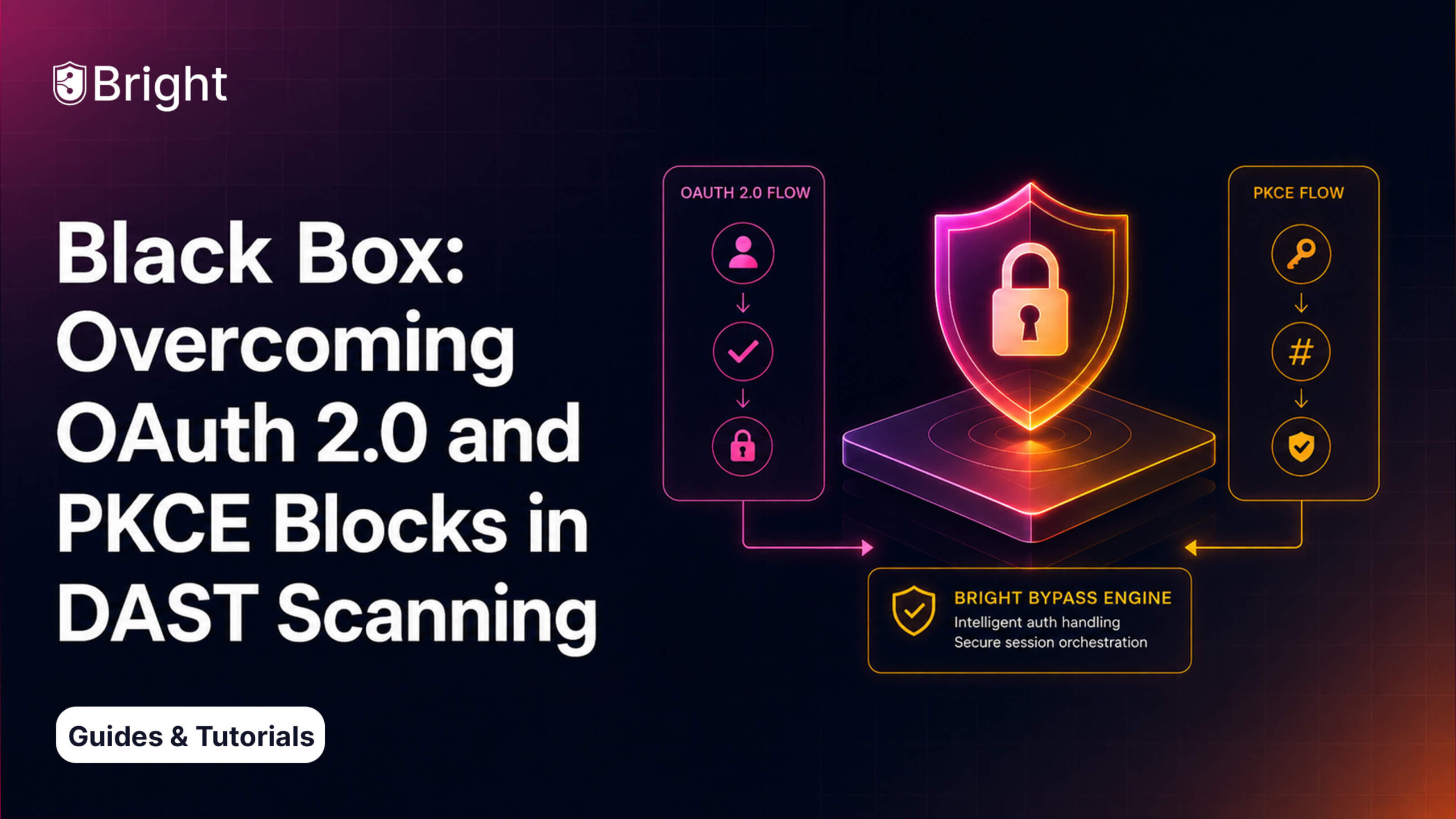
Rather than treating authentication as an afterthought, Bright helps organizations navigate modern authentication architectures, including OAuth 2.0, PKCE, SSO providers, and complex enterprise login workflows.
For example, if an application uses Okta or Microsoft Entra ID, security teams need confidence that protected functionality remains visible during testing. Bright helps organizations reach authenticated areas consistently, so testing can focus on identifying real security risks rather than fighting authentication barriers.
This becomes increasingly important as development teams adopt the best AI coding tools, best ai coding assistants, and AI-generated development workflows that accelerate application complexity.
The goal isn’t simply completing a scan.
The goal is to ensure the parts of the application that attackers actually care about are being tested effectively.
That’s where modern authentication-aware security testing creates real value.
What The Future Of Authentication Testing Looks Like
Authentication systems are not becoming simpler.
Organizations are moving toward passwordless authentication, adaptive access controls, Zero Trust architectures, behavioral identity verification, and AI-driven access management.
Each advancement improves security for users.
Each advancement also introduces new challenges for security testing.
Future AppSec programs will require testing solutions capable of understanding authentication context, maintaining session awareness, navigating complex authorization flows, and validating protected functionality continuously.
The organizations that succeed will be the ones that stop viewing authentication as a setup step and start viewing it as a core part of application security testing.
Because the future of AppSec isn’t simply about finding vulnerabilities.
It’s about finding vulnerabilities everywhere they can exist.
Including behind authentication.
FAQ
Why Is OAuth 2.0 Difficult For DAST Scanners?
OAuth 2.0 relies on redirects, token exchanges, authorization servers, and dynamic authentication workflows that are significantly more complex than traditional login forms.
What Is PKCE?
PKCE (Proof Key for Code Exchange) is a security mechanism designed to prevent authorization code interception attacks during OAuth authentication flows.
Why Are AppSec Authentication Flows Important?
Most business-critical functionality exists behind authentication. If those areas cannot be tested, organizations may miss critical vulnerabilities.
How Does Bright Security Improve OAuth 2.0 Security Testing?
Bright Security helps organizations navigate modern authentication workflows, maintain visibility into protected application functionality, and improve security coverage across authenticated attack surfaces.
Final Thoughts
The biggest challenge in modern application security isn’t always finding vulnerabilities.
Sometimes it’s simply reaching them.
As OAuth 2.0, PKCE, SSO, and advanced identity systems become standard across enterprise environments, traditional approaches to DAST authentication are struggling to keep pace.
At the same time, the rise of the best ai for coding, best ai coding assistants, and AI-powered development workflows is accelerating software delivery and increasing application complexity.
Security teams can no longer afford blind spots behind authentication barriers.
Organizations that invest in modern OAuth 2.0 security testing, authentication-aware DAST strategies, and comprehensive AppSec auth flow validation will gain significantly better visibility into their real attack surface.
Because in today’s enterprise environments, the most important vulnerabilities are often hidden behind the login screen.