

Why runtime validation is becoming essential for reducing AppSec noise in AI-native development
Table Of Contents
- Introduction
- The Growing Problem With SAST Noise
- Why False Positives Hurt Modern Engineering Teams
- AI-Generated Code Is Making The Problem Worse
- Why Static Findings Alone Are No Longer Enough
- The Runtime Validation Gap
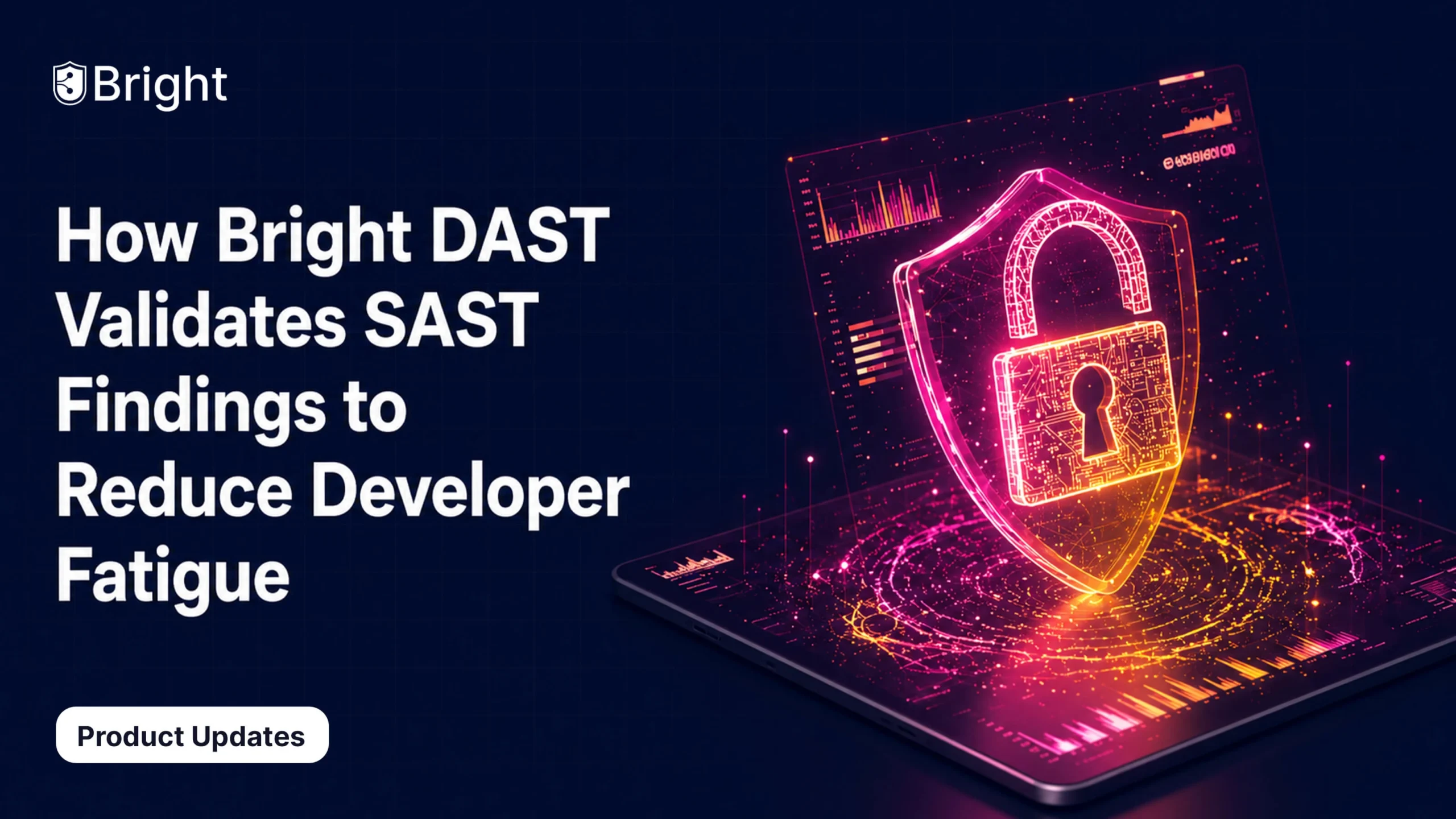
- How Bright DAST Validates SAST Findings
- Understanding DAST-Grounded Validation
- Why Runtime Exploitability Matters
- Reducing Developer Fatigue With Verified Findings
- How Bright Achieves <0.3% False Positives
- Runtime Validation For AI-Native Applications
- Bright DAST + SAST Workflow Architecture
- The Future Of AI-Aware AppSec
- Final Thoughts
Introduction
Modern AppSec teams are overwhelmed by security findings.
As organizations increasingly adopt:
- AI coding assistants
- Autonomous development workflows
- AI-generated APIs
- Continuous deployment pipelines
The number of static security findings continues to grow rapidly.
Tools focused on SAST can identify thousands of potential vulnerabilities across modern applications. But many of those findings are:
- Non-exploitable
- Contextually unreachable
- Runtime irrelevant
- False positives
This creates one of the biggest operational problems in modern application security:
Developer fatigue.
Developers are now expected to review enormous volumes of security alerts while simultaneously shipping software faster than ever before. The rise of the best AI coding assistants, best AI coding tools, and best AI models for coding has dramatically accelerated development velocity – but it has also accelerated security noise.
Modern AI-generated applications introduce:
- More APIs
- More integrations
- More runtime complexity
- Faster code generation cycles
And traditional static analysis alone cannot reliably determine which findings actually matter at runtime.
This is why modern AppSec programs are increasingly shifting toward:
DAST-grounded validation
A security model where runtime DAST continuously validates static findings to determine:
- Actual exploitability
- Runtime reachability
- Production relevance
- Remediation priority
Bright Security is helping organizations bridge this gap by combining runtime DAST with SAST correlation and exploit verification. Instead of overwhelming developers with theoretical findings, Bright continuously validates vulnerabilities dynamically – helping organizations reduce false positives to:
Less than ~3%.
This dramatically improves remediation efficiency while reducing developer burnout across modern engineering teams.
The Growing Problem With SAST Noise
SAST tools are extremely valuable for modern AppSec programs.
They help organizations:
- Detect insecure code patterns
- Identify vulnerable logic
- Enforce secure development practices
- Shift security earlier into the SDLC
But modern SAST environments often generate:
- Thousands of findings
- Duplicate alerts
- Contextless vulnerabilities
- Non-exploitable issues
This becomes especially difficult in organizations using:
- AI-generated code
- Large microservice environments
- Rapid CI/CD pipelines
- Autonomous engineering workflows
Security teams increasingly spend more time:
Reviewing findings
Than:
Validating actual risk
This creates major operational inefficiencies across engineering organizations.
Why False Positives Hurt Modern Engineering Teams
False positives are not just a tooling problem.
They directly impact:
- Developer productivity
- Remediation speed
- Engineering trust
- Security adoption
When developers repeatedly investigate findings that are not exploitable, security tools gradually lose credibility.
This creates:
- Alert fatigue
- Slower remediation
- Reduced developer engagement
- Security process avoidance
Over time, engineering teams begin treating AppSec alerts as:
Background noise
Instead of actionable security intelligence.
This problem becomes dramatically worse in AI-native environments where code generation velocity increases continuously.
AI-Generated Code Is Making The Problem Worse
Modern engineering teams increasingly rely on:
- GitHub Copilot
- Claude
- ChatGPT
- Cursor
- Gemini
- Other AI coding assistants
To generate production-ready applications rapidly.
The rise of the best AI coding assistants and best AI coding tools has fundamentally changed development speed.
But AI-generated applications often:
- Introduce repetitive insecure patterns
- Expand API attack surfaces
- Increase runtime complexity
- Create larger validation workloads
Static analysis tools can detect many of these patterns.
But they still struggle to determine:
Which vulnerabilities are actually exploitable at runtime
This creates enormous security noise at AI scale.
Why Static Findings Alone Are No Longer Enough
Static analysis evaluates code:
- Theoretically
- Predictively
- Contextually
But modern vulnerabilities increasingly depend on:
- Runtime state
- API execution paths
- Authentication context
- Dynamic workflows
- Tool execution behavior
This means many static findings:
- Cannot actually be exploited
- Exist in unreachable code
- Fail during runtime execution
- Depend on incorrect assumptions
Without runtime validation, organizations waste enormous amounts of engineering time investigating non-actionable findings.
The Runtime Validation Gap
One of the biggest weaknesses in traditional AppSec programs is the lack of runtime exploit validation.
Most security tools answer:
“Could this be vulnerable?”
But modern security teams increasingly need to know:
“Can this actually be exploited?”
That distinction matters enormously.
Because runtime validation dramatically improves:
- Prioritization
- Remediation efficiency
- Developer trust
- AppSec accuracy
This is where modern runtime DAST becomes critical.
How Bright DAST Validates SAST Findings
Bright Security approaches AppSec differently from traditional scanning platforms.
Instead of relying only on:
- Static signatures
- Pattern matching
- Theoretical findings
Bright continuously validates:
- Runtime exploitability
- API behavior
- Authentication flows
- Reachable attack paths
- Dynamic execution chains
This allows Bright to:
- Correlate SAST findings dynamically
- Validate exploitability automatically
- Eliminate non-actionable noise
- Prioritize verified vulnerabilities
Instead of flooding developers with thousands of theoretical alerts.
Understanding DAST-Grounded Validation
DAST-grounded validation means:
Using runtime testing to verify whether static findings are actually exploitable.
This dramatically improves AppSec signal quality.
Instead of:
Assuming vulnerabilities exist
Bright continuously:
- Executes applications
- Simulates attacks
- Tests APIs dynamically
- Validates exploitability
- Re-tests remediation automatically
This creates:
Actionable runtime security intelligence instead of theoretical noise.
Why Runtime Exploitability Matters
Modern applications behave dynamically.
Especially AI-native applications using:
- Autonomous workflows
- MCP integrations
- AI-generated APIs
- Runtime orchestration systems
Static analysis alone cannot fully understand:
- Runtime execution behavior
- Prompt-driven workflows
- Tool chaining
- Dynamic API access paths
This is why runtime validation is becoming foundational for modern AppSec programs.
Verified exploitability allows security teams to focus on:
Real risk
Instead of theoretical assumptions.
Reducing Developer Fatigue With Verified Findings
One of the biggest benefits of runtime validation is improved developer experience.
When findings are:
- Validated
- Reachable
- Reproducible
- Exploitable
Developers trust AppSec workflows significantly more.
This creates:
- Faster remediation
- Better security collaboration
- Reduced alert fatigue
- Higher developer engagement
Instead of reviewing thousands of noisy findings, developers focus on:
Real vulnerabilities that actually matter.
How Bright Achieves <0.3% False Positives
Bright combines:
- Runtime DAST
- Exploit validation
- API testing
- Reachability analysis
- Continuous validation
To dramatically reduce false positives.
Rather than depending only on static assumptions, Bright continuously validates:
- Runtime behavior
- Exploitability
- Reachable attack paths
- Dynamic execution conditions
This allows organizations to achieve:
Less than ~3% false-positive rates
While significantly improving remediation efficiency.
This becomes increasingly important as organizations scale AI-generated development workflows.
Runtime Validation For AI-Native Applications
Modern AI-native applications introduce:
- Dynamic workflows
- Runtime API chaining
- Prompt injection exposure
- MCP tool execution
- Autonomous behavior
Traditional AppSec tools were never designed for these environments.
Bright helps organizations continuously validate:
- AI-generated APIs
- Runtime AI workflows
- Autonomous execution chains
- Prompt injection exposure
- Dynamic runtime vulnerabilities
This allows organizations to secure modern AI-native systems continuously instead of relying only on periodic reviews.
Bright DAST + SAST Workflow Architecture
Traditional Workflow:
SAST Scan
|
Thousands Of Findings
|
Manual Review
|
Developer Fatigue
Bright Runtime Validation Workflow:
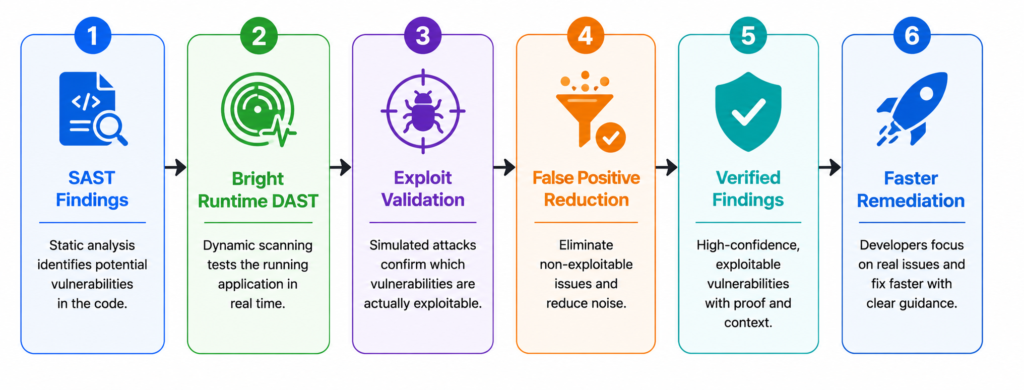
This creates:
A much cleaner and more scalable AppSec workflow.
The Future Of AI-Aware AppSec
Modern AppSec is rapidly evolving.
The future will increasingly depend on:
- Runtime validation
- AI-aware DAST
- Continuous exploit testing
- API runtime analysis
- Autonomous security workflows
As organizations continue using:
- The best AI coding assistants
- AI-generated APIs
- Autonomous development workflows
Static analysis alone will no longer provide sufficient visibility into runtime risk.
The future of AppSec depends on:
Continuous runtime exploit validation.
Final Thoughts
Modern engineering teams are shipping software faster than ever before.
The rise of the best AI coding tools, best AI coding assistants, and best generative AI for coding is accelerating application development across every industry.
But faster development also creates:
- More APIs
- More runtime complexity
- More security findings
- More AppSec noise
Static analysis remains extremely important.
But static findings alone cannot reliably determine:
- Runtime exploitability
- Reachable attack paths
- Production relevance
This is why modern AppSec programs increasingly rely on:
DAST-grounded validation
Bright Security helps organizations bridge the gap between SAST and runtime security validation by continuously verifying:
- Exploitability
- Reachability
- Runtime behavior
- Dynamic attack paths
This dramatically reduces false positives, improves remediation efficiency, and helps engineering teams focus on:
Real vulnerabilities instead of theoretical noise.
Because in modern AI-native environments, security teams do not need more alerts.
They need:
More validated security intelligence.automatically equals proven security.