
Table of Content
- The Rise—and the Fall —of AI Pair‑Programming
- Six Common Risks Introduced by AI‑Generated Code
- Why Traditional AppSec Approaches Struggle
- A Modern DAST Approach
- Key Capabilities to Look For
- Moving Forward
The Rise—and the Fall —of AI Pair‑Programming
Generative coding assistants have moved from novelty to near‑standard tooling in just a few years. They accelerate delivery, but that speed can hide blind spots—especially when models replicate insecure patterns that live in public repositories and forum snippets.
Six Common Risks Introduced by AI‑Generated Code
- Injection Flaws – Unsanitised input can creep in, opening SQL Injection, XSS or XXE paths.
- Insecure Defaults – Boilerplate may disable CSRF protection or store passwords in plain text.
- Hard‑Coded Secrets – Auto‑completed tokens and API keys might slip into commits.
- Missing Authorization Checks – Endpoints sometimes omit permission validation, creating logic‑access gaps.
- Outdated Dependencies – Suggested libraries can ship with known CVEs.
- Reviewer Blind Spots – When large portions of a pull-request diff are AI-generated, it is easy to skim security‑critical lines.
Why Traditional AppSec Approaches Struggle
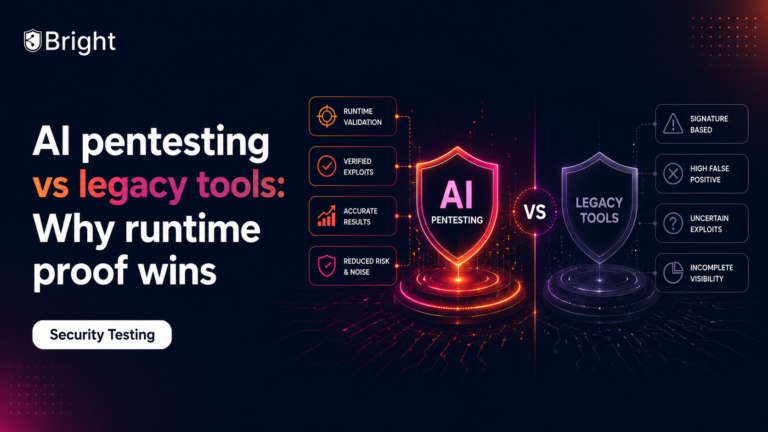
Static analysis generates high false‑positive rates, while legacy DAST often finds issues late in the pipeline—too late for today’s release cadence. Teams need feedback that is accurate, fast, and integrates with CI/CD.
A Modern DAST Approach
Bright’s developer‑centric DAST engine can be invoked on‑demand from the web UI, triggered by an API call, or integrated directly into CI/CD pipelines. By exercising the running application instead of parsing source code, it highlights issues that are actually exploitable and filters out the noise. Coverage spans everything from classic injection and XSS vulnerabilities to more subtle business‑logic and authorisation flaws.
Note: Bright is just one option—evaluate any DAST that offers low‑noise results, CI/CD integrations, and clear remediation guidance.
Key Capabilities to Look For
- Pipeline‑Friendly Scans – Triggered automatically on pull requests across GitHub Actions, Jenkins, Azure Pipelines and other well known CI CD platforms.
- Focused Findings – Results prioritise what is actually exploitable, cutting alert fatigue.
- Auto‑Verification – After a fix has been applied, Bright re‑runs the relevant tests to confirm the vulnerability is closed.
- Broad Test Coverage – A robust payload library should tackle classic injections, CSRF, XSS, and business‑logic abuse.
Moving Forward
AI assistants can transform productivity, but they also widen the potential attack surface. Combining them with an automated DAST such as Bright helps ensure that speed does not outpace security.
Curious how this fits into your workflow?