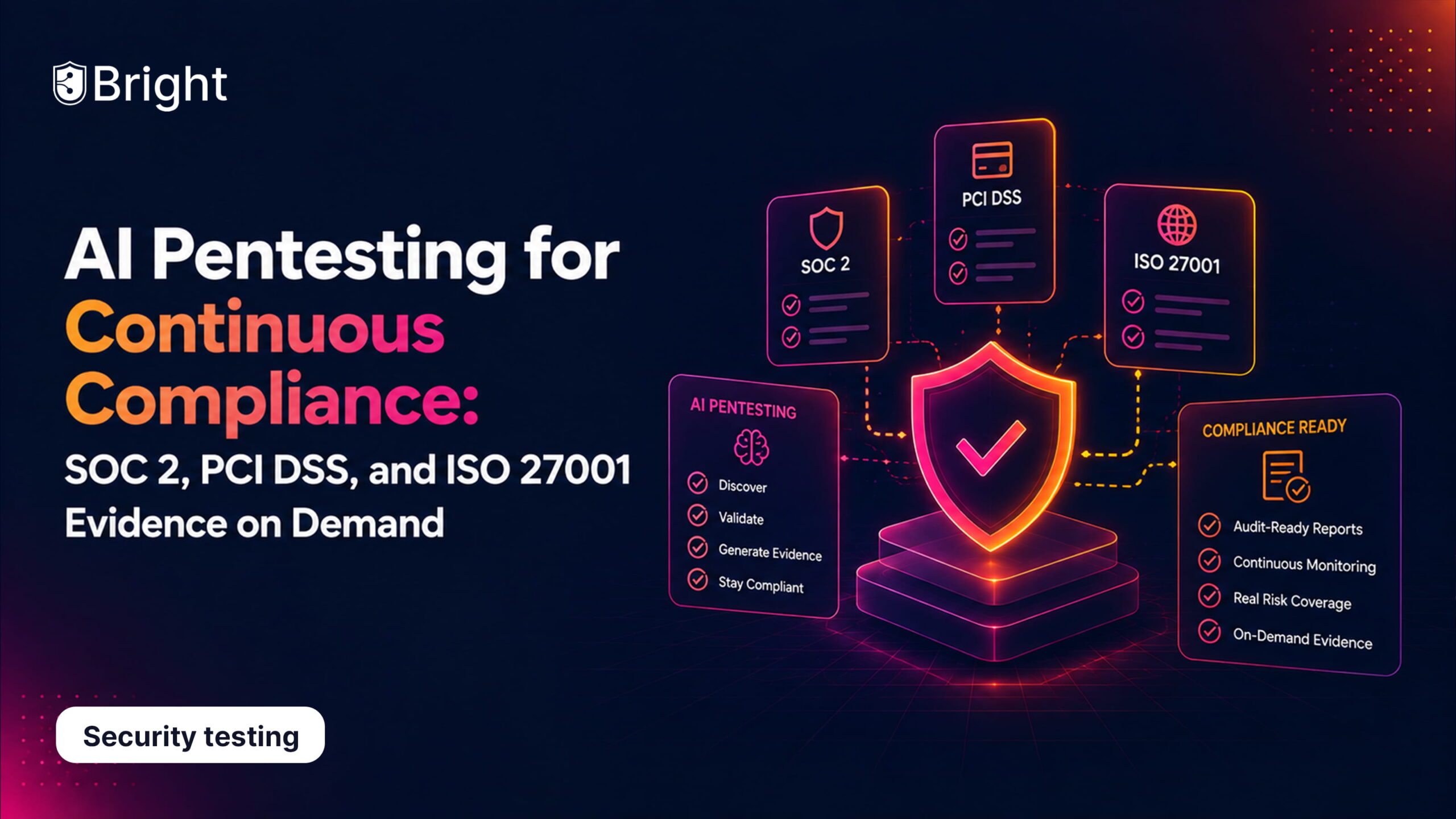

Your annual pentest report starts aging after the next release. A new endpoint, authentication change, payment flow, or third-party integration can alter the application that was originally assessed.
AI pentesting helps close that gap by testing applications as they change and preserving evidence of what happened. But frequency alone does not create credible compliance evidence. The record must show the approved scope, application version, test conditions, validated impact, remediation, and successful retest.
That turns a point-in-time security exercise into a traceable control history. It also gives auditors something more useful than a dashboard full of unresolved alerts.
Annual pentests leave an evidence gap between releases
An annual pentest still has value. It assesses a defined scope at a specific time, identifies complex attack paths, challenges assumptions, and can satisfy periodic testing requirements.
The limitation is time. The report proves what the tester observed during that engagement. It does not prove that the next deployment preserved the same security posture.
That gap matters because attackers do not follow audit calendars. In a 2024 Google Threat Intelligence analysis, vulnerabilities for which public exploits appeared after known exploitation had a median of 15 days from disclosure to observed exploitation. The result covers a particular vulnerability set, but it shows why a twelve-month testing cycle cannot provide continuous assurance on its own.
PCI DSS recognizes the same problem. Requirement 11.4 of PCI DSS v4.0.1 requires penetration testing at least annually and after significant infrastructure or application changes. The PCI Security Standards Council explains that post-change testing checks whether controls still work after an upgrade or modification.
The practical question is not whether you should abandon the annual engagement. It is how you will prove what happened between engagements.
What audit-ready AI pentesting evidence must show
Evidence on demand does not mean producing another scan report whenever an auditor asks. Useful AI pentesting evidence connects the test to the relevant system, release, risk, and remediation decision.
Evidence that the test occurred
The record should identify:
- The target application, APIs, and approved scope.
- The test date, trigger, environment, and application version.
- The testing mode, authenticated roles, and relevant configuration.
- The endpoints and workflows exercised.
- Any exclusions, blocked tests, or coverage limitations.
This context prevents a common audit problem: presenting a clean report without proving that it covered the current application or its highest-risk functions.
Evidence that the risk was resolved
A finding should preserve the reproducible attack path, runtime response or state change, affected role, business impact, remediation owner, and completion date. The original test should then run again against the fix.
Closing the ticket is not enough. The retest must show that the exploit no longer works while the authorized workflow still does. Sensitive values and exploit details should be sanitized before evidence leaves the security team.
Bright’s AI Pentesting Module separates AI-driven work from deterministic proof. AI supports attack-surface discovery, threat modeling, and exploit creation. Deterministic stages confirm exploitability against the running target and verify the fix. That separation keeps a plausible AI-generated hypothesis from becoming audit evidence without runtime confirmation.
How AI pentesting supports SOC 2, PCI DSS, and ISO 27001
The three frameworks do not treat penetration testing in the same way. Your evidence package should reflect those differences instead of attaching one report to three control lists.
| Framework | What it expects | Evidence continuous testing can support | What the tool does not replace |
| SOC 2 | Evidence that relevant controls are designed and, for Type II, operated effectively during the review period | Test history, coverage, validated findings, remediation timelines, and fix verification | The CPA examination, management assertions, policies, and nontechnical controls |
| PCI DSS v4.0.1 | A defined methodology, annual and post-change internal and external testing, remediation, and retesting | Scope, change-triggered tests, exploit evidence, remediation, and successful retests | Qualified independent testing, the PCI assessment, and other requirements |
| ISO/IEC 27001:2022 | Risk-based management and continual improvement of the information security management system | Technical vulnerability records, security-test results, risk-treatment inputs, corrective actions, and recurring verification | ISMS governance, the Statement of Applicability, internal audits, and certification decisions |
For SOC 2, recurring testing can support the AICPA Trust Services Criteria, particularly CC7.1 and CC7.2. It can document how you identify vulnerabilities, investigate findings, and respond. SOC 2 does not impose one universal annual pentest requirement. Your controls, risks, and auditor determine the relevant evidence.
PCI DSS is more explicit. Requirements 11.4.1 through 11.4.4 cover methodology, annual and post-change internal and external testing, remediation, and retesting. Automated penetration testing can add coverage between formal engagements. It does not remove requirements for scope, qualified and independent testers, or the wider assessment. Use the current PCI DSS v4.0.1 documents and confirm the approach with your assessor.
ISO/IEC 27001 is risk-based. Test records can support Annex A control 8.8 on technical vulnerabilities and 8.29 on security testing during development and acceptance. They also inform corrective action. But ISO/IEC 27001 covers the full ISMS, including people, processes, risk decisions, and governance. A testing platform cannot certify that system.
Build AI pentesting into the release process
Continuous testing should follow meaningful changes rather than produce maximum traffic on every commit.
Trigger focused tests when risk changes
Run targeted regression tests when a release changes authentication, authorization, payment processing, business logic, sensitive data flows, public endpoints, or third-party integrations. Infrastructure changes and major dependency updates may also justify a focused test.
Link each run to the build, ticket, or release that triggered it. This creates a clear sequence from change to test, finding, remediation, and retest. It also helps a reviewer understand why the organization selected that scope.
Keep broader testing and human judgment
Focused automation does not cover every risk. Schedule broader authenticated assessments for high-risk applications and major releases. Use human testers for ambiguous business logic, architectural weaknesses, and actions that could create serious operational consequences.
Set hard limits for approved targets, identities, environments, request rates, and prohibited actions. Use synthetic data where possible. Require human approval before destructive tests, bulk exports, financial activity, or production-impacting actions.
This is controlled automation, not uncontrolled autonomy. AI penetration testing should expand coverage without expanding the authorized blast radius.
Snap B2B shows how continuous evidence speeds external review
Snap B2B needed to satisfy the security requirements of a large financial institution. It had a mature product and engineering team, but no dedicated AppSec function, internal CISO, or continuous testing in its delivery pipelines. Building that capability internally could have delayed the partnership by months.
According to the Bright Snap B2B case study, Bright connected dynamic testing to CI/CD, validated findings, and packaged the results for the enterprise review. Scope and integration were completed in week one. Testing and remediation guidance followed in week two. Final documentation was submitted in week three.
Snap B2B passed the enterprise security review on its first submission, reduced readiness from months to weeks, and added no internal headcount. Alicia Roisman, Head of Fintech Strategy, said, “Bright allowed us to meet demanding enterprise security requirements quickly and confidently.”
This is a continuous DAST and AppSec case study, not a controlled benchmark of an AI model. Its value here is the operating pattern: integrate testing, validate results, retain the evidence, and support independent assurance where required.
That is the compliance advantage of AI pentesting. It helps your evidence follow the application instead of waiting for the next audit. Runtime validation makes that evidence more defensible, while verified retesting closes the record with proof that the issue no longer works.
To see how Bright discovers attack paths, validates exploitability, and verifies fixes against running applications, book a demo.
Frequently asked questions
Can AI pentesting replace an annual PCI DSS penetration test?
Not by itself. Continuous testing can strengthen coverage and support testing after significant changes. You must still satisfy PCI DSS requirements for methodology, scope, internal and external testing, tester qualifications, organizational independence, remediation, and retesting.
Does SOC 2 require annual penetration testing?
SOC 2 does not prescribe one universal pentest schedule for every service organization. Your risks, control design, system description, commitments, and auditor determine the necessary evidence. Recurring security testing can help demonstrate that relevant controls operated consistently throughout the review period.
Which ISO 27001 controls can penetration testing support?
Testing can support evidence for technical vulnerability management under Annex A 8.8 and security testing during development and acceptance under Annex A 8.29. Applicability depends on the organization’s risks, selected controls, and Statement of Applicability.
What makes pentest evidence audit-ready?
It should identify the scope, system version, test date, methodology, authenticated context, coverage, reproducible runtime result, remediation, and verified retest. It should also disclose exclusions and limitations. The auditor or assessor decides whether that evidence is sufficient for the relevant engagement.
Image brief
Recommended filename: ai-pentesting-continuous-compliance-evidence.png
Placement: Below the introduction.
Concept: A clean enterprise workflow showing a software release entering a scoped AI pentest, followed by runtime validation, remediation, verified retesting, and a time-stamped evidence record. Include three restrained labels for SOC 2, PCI DSS, and ISO 27001 beside the evidence record. Avoid humanoid robots, glowing locks, code rain, and science-fiction imagery.
Alt text: Continuous AI pentesting workflow creating validated evidence for SOC 2, PCI DSS, and ISO 27001 audits.