
An AI application can pass an audit and present a different risk profile days later. The provider updates the model. A team changes the system prompt. New documents enter the retrieval index. An agent receives another tool or broader permissions.
None of these changes makes the original audit invalid. They make its evidence time-bound.
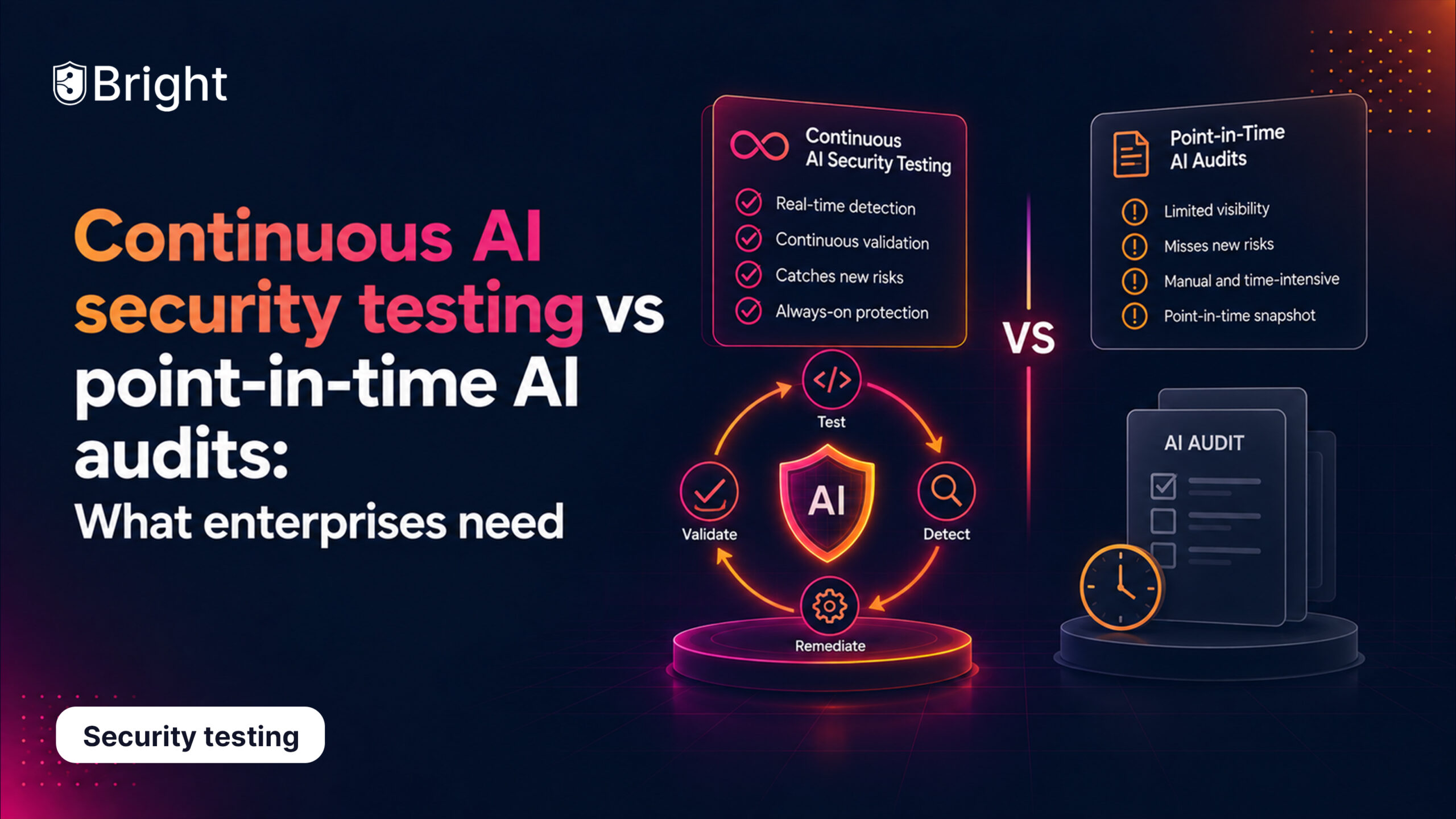
Effective AI security therefore needs two forms of assurance. Point-in-time audits establish whether governance, documentation, and controls meet defined requirements. Continuous testing checks whether those controls still prevent harmful outcomes as the system changes. Enterprises need both, connected through evidence that security and governance teams can use.
Point-in-time AI audits answer a different question
An AI audit evaluates a system against defined criteria. It may examine policies, inventories, risk classifications, data governance, privacy, human oversight, vendors, and control records. Independent audits provide a structured basis for trust.
Continuous AI testing has a narrower but more frequent job. It exercises a running or production-like system to determine whether an attacker can manipulate the model, cross an authorization boundary, expose protected data, misuse a tool, or trigger unsafe application behavior.
The approaches complement each other because they produce different evidence.
| Evaluation area | Point-in-time AI audit | Continuous AI security testing |
| Main question | Are required controls defined and operating during the review period? | Do those controls still stop harmful behavior now? |
| Scope | Governance, accountability, documentation, risk, privacy, and compliance | Models, prompts, retrieval, APIs, tools, identities, memory, and workflows |
| Evidence | Policies, interviews, samples, records, and control testing | Executed attacks, request traces, tool calls, responses, and state changes |
| Timing | Scheduled or event-based | Change-triggered and recurring |
| Strength | Independent baseline and formal accountability | Fast detection of regressions and newly reachable attack paths |
| Limitation | Evidence can become stale after material changes | Does not replace legal, governance, or independent review |
| Best use | Establishing control requirements and assurance | Verifying technical controls between audits |
The mistake is treating either column as sufficient. An audit can confirm that an organization has an approval policy for consequential agent actions. Runtime testing determines whether the application requests that approval when adversarial content changes the agent’s plan.
Why AI security changes between audits
AI applications add sources of change that the application owner may not control directly.
A model update can interpret the same instruction differently. A revised prompt can change tool selection. Retrieval data can introduce indirect prompt injection. A connector can gain another operation, while a service account can accumulate permissions without changing the agent’s interface.
Material changes include:
- Models, providers, routing, and generation settings
- System prompts, developer instructions, and guardrails
- Retrieval sources, indexes, and ranking rules
- Tools, connectors, MCP servers, and downstream APIs
- Identities, roles, tenants, and approval rights
- Memory, output handling, application code, and dependencies
- New attack techniques relevant to the architecture
The repository may stay unchanged while the system’s effective authority changes. That is why testing only at annual or quarterly intervals leaves an evidence gap.
The NIST AI Risk Management Framework says risk management should be “continuous, timely, and performed throughout the AI system lifecycle.” It also calls for ongoing monitoring and periodic review, with the frequency determined by the organization. The NIST guidance on deployed AI systems adds that validity and reliability are often assessed through ongoing testing or monitoring.
Continuous AI security testing needs runtime proof
More scanning is not automatically better assurance. An LLM can describe a convincing vulnerability without proving the path is reachable. A platform can also produce prompt failures that cannot reach protected data or consequential actions.
A useful test follows the execution chain:
- Define the authorized task and the outcome that must not occur.
- Introduce sanitized adversarial content through a realistic channel.
- Capture the model decision, tool request, identity, policy response, and resulting state.
- Confirm whether protected data, a restricted operation, or another boundary was reached.
- Replay the test after remediation and verify that the harmful outcome is blocked while normal behavior still works.
This model supports prompt injection, LLM data leakage, unsafe output handling, cross-tenant access, connector abuse, excessive agency, resource consumption, and authorization testing. The OWASP Top 10 for Agentic Applications reinforces why coverage must extend beyond prompts to tools, identities, memory, and multi-step actions.
One clean run proves little
Bright tested this problem by creating an approximately 300-line application with Claude Code Opus 4.6, inserting two critical vulnerabilities, and running five independent AI reviews. Only 32% of vulnerabilities were identified consistently across all five reviews. Sixty percent of the findings were false positives, and 60% of the reviews missed planted critical vulnerabilities. Every review also classified dead code as critical.
Runtime testing exposed two planted XSS vulnerabilities that the reviews missed. This controlled Bright experiment is not a benchmark for every model or product. Its lesson is important: probabilistic analysis needs repeated trials and deterministic validation before a result becomes a finding.
Build testing around change and consequence
Continuous does not mean attacking every system around the clock. It means testing when risk changes and repeating broader scenarios often enough to detect drift.
Use three testing layers:
- Release gates: Run a small set of high-impact regression tests before deployment.
- Change-triggered testing: Test after changes to models, prompts, retrieval data, tools, identities, permissions, output handling, or application code.
- Scheduled adaptive testing: Explore new attack variants and broader workflows weekly, monthly, or quarterly according to risk.
Prioritize consequences, not prompt volume. A public-document summarizer does not need the same depth as an agent that can export records, approve payments, change infrastructure, or execute code. For each high-impact workflow, define the prohibited outcome, enforcement point, and passing evidence.
Keep automated testing inside hard limits
AI security tools should operate within approved targets, identities, request ceilings, and action limits. Use synthetic data and restricted egress. Require human approval before tests that could execute code, transfer funds, delete records, or affect shared infrastructure.
Preserve an audit trail that connects every test to its input, model and prompt version, tool call, executing identity, policy decision, and outcome. Continuous testing without reproducibility creates activity, not assurance.
Connect audits and continuous tests into one assurance system
Start with the audit and risk process. It defines which systems are in scope, which harms matter, which controls must exist, who owns them, and how much residual risk the enterprise accepts. Convert the most important control objectives into executable tests.
Continuous testing supplies current evidence. Failed authorization scenarios go to the control owner. Validated vulnerabilities enter remediation. New tools or permissions trigger focused regression tests. The next audit receives a history of tests, outcomes, exceptions, fixes, and retests instead of a last-minute snapshot.
Track metrics that show assurance quality:
- Coverage of high-impact AI workflows and trust boundaries
- Percentage of material changes followed by regression testing
- Attack success rate across repeated trials
- Validated findings by business impact
- Time from change to finding validation
- Time from finding to verified remediation
- Tests with complete execution evidence
- Untested systems, data sources, and tools
The OWASP GenAI Red Teaming Guide states that “no AI model is ever truly ‘done’ or ‘secure.’” Audits remain essential for governance and accountability. But a changing system needs evidence between assessment dates. The strongest AI security program connects audit requirements to controlled runtime tests, validates impact, and verifies every material fix.
To see how Bright validates exploitable application paths and verifies remediation against running systems, book a demo.
Frequently asked questions
Does continuous AI security testing replace an AI audit?
No. Continuous testing verifies technical behavior between assessments. It does not replace governance, legal review, risk classification, privacy analysis, or independent assurance. Audits define and assess the control environment. Recurring tests confirm that important controls continue to work.
What should enterprises test continuously?
Test components that can change behavior or authority, including models, prompts, retrieval, APIs, tools, identities, memory, output handling, and high-impact workflows. Focus on outcomes such as data exposure, unauthorized tool execution, cross-tenant access, or restricted state changes.
How often should LLM security testing run?
Run focused regression tests after every material change. Include critical scenarios in release gates where safe, and run broader adaptive assessments on a risk-based schedule. Public, agentic, or high-authority systems usually need more frequent coverage than stable internal assistants with no sensitive data or tool access.
Can traditional application security tools test AI applications?
They can test reachable web and API weaknesses around an AI application, including authentication, authorization, injection, and output-handling paths. Effective LLM security also requires tests for model behavior, indirect prompt injection, retrieval, memory, tool selection, and agent workflows. The combined program should validate the final runtime outcome rather than treating either layer as complete.