
Table of Contents
- The Real Question AppSec Teams Are Asking
- What Snyk Actually Does Well.
- Why “Snyk Alternatives” Searches Are Increasing in 2026
- The Coverage Gap Static Tools Can’t Close
- Replace vs Complement: A Practical AppSec Breakdown
- Why DAST Becomes the Missing Layer
- What to Look for in a Modern Snyk Alternative Stack
- Where Bright Fits Without Replacing Everything
- Real-World AppSec Tooling Models Teams Are Adopting
- Frequently Asked Questions
- Conclusion: Fix the Runtime Gap, Not Just the Tool Stack
The Real Question AppSec Teams Are Asking
Most teams searching for “Snyk alternatives” are asking the wrong question.
They’re not really unhappy with Snyk’s ability to scan code or dependencies. What they’re struggling with is everything that happens after those scans run. Long backlogs. Developers are pushing back on the severity. Security teams are stuck explaining why something might be dangerous instead of proving that it actually is.
Snyk is often the first AppSec tool teams adopt because it fits neatly into developer workflows. It shows up early, runs fast, and speaks the language engineers understand. The frustration usually starts months later, when leadership asks a simple question: Which of these findings can actually be exploited?
That’s where the conversation shifts from “Which tool replaces Snyk?” to something more honest: What coverage are we missing entirely?
What Snyk Actually Does Well
Before talking about alternatives, it’s worth being clear about why Snyk exists in so many pipelines.
Strong Developer-First Static Analysis
Snyk is good at what it’s designed to do:
- Catch insecure code patterns early
- Flag vulnerable open-source dependencies
- Surface issues directly in pull requests
For teams trying to move security left, this matters. Engineers see issues before code ships, and security teams don’t have to chase fixes weeks later.
Natural Fit for Early SDLC Stages
Snyk shines when code is still being written. It’s fast, lightweight, and integrates cleanly into GitHub, GitLab, and CI systems. For catching obvious mistakes early, it works.
The problem isn’t that Snyk fails. The problem is that many of the most expensive vulnerabilities don’t exist at this stage at all.
Why “Snyk Alternatives” Searches Are Increasing in 2026
Teams don’t abandon Snyk overnight. They start questioning it quietly.
Alert Fatigue Creeps In
Over time, static findings pile up. Many of them are technically valid but practically irrelevant. Developers start asking:
- “Can anyone actually reach this?”
- “Has this ever been exploited?”
- “Why is this marked critical?”
When those questions don’t have clear answers, trust erodes.
Pricing Scales Faster Than Confidence
Seat-based pricing makes sense early. At scale, it becomes painful. Organizations end up paying more each year while still struggling to answer which risks truly matter.
AI-Generated Code Changed the Equation
AI coding tools introduced a new problem:
Code now looks clean and idiomatic by default. Static scanners see familiar patterns and move on. The risks show up later – in authorization logic, workflow abuse, and edge-case behavior, no rule was written to detect.
This isn’t a Snyk problem. It’s a static analysis limitation.
The Coverage Gap Static Tools Can’t Close
Static tools answer one question: Does this code look risky?
They cannot answer: Does this behavior break the system when it runs?
Exploitability Is a Runtime Question
An access control issue doesn’t live in a single file. It lives across:
- Auth logic
- API routing
- Business rules
- Session state
Static tools don’t execute flows. They infer.
Business Logic Lives Outside Signatures
Most serious incidents don’t involve obvious injections. They involve:
- Users are doing things out of order
- APIs are being called in combinations no one expected
- Permissions are working individually but failing collectively
These are runtime failures.
AI-Generated Code Amplifies This Gap
AI produces plausible code, not adversarially hardened systems. Static scanners see nothing unusual. Attackers see opportunity.
Replace vs Complement: A Practical AppSec Breakdown
This is where many teams get stuck. They assume switching tools will fix the problem.
What Teams Replace Snyk With (Static Side)
Some teams move to:
- Semgrep
- Checkmarx
- SonarQube
- Fortify
- GitHub Advanced Security
These tools can reduce noise or improve customization. But they don’t change the fundamental limitation: they still analyze code, not behavior.
What Teams Add Instead of Replacing
More mature teams keep static tools and add:
- Dynamic Application Security Testing (DAST)
- API security testing
- Runtime validation in CI/CD
This isn’t redundancy. It’s coverage.
Why DAST Becomes the Missing Layer
DAST doesn’t try to understand code. It doesn’t care how elegant your architecture is.
It asks a simpler question: What happens if someone actually tries to break this?
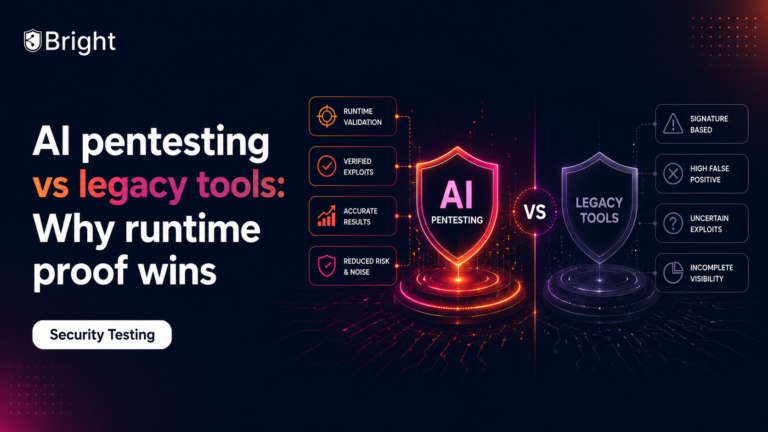
Static Finds Patterns, DAST Proves Impact
Static tools say: “This might be unsafe.”
DAST says: “Here’s the request that bypasses it.”
That difference matters when prioritizing work.
Runtime Testing Finds Real Production Risk
DAST uncovers:
- Broken access control
- Authentication edge cases
- API misuse
- Workflow abuse
- Hidden endpoints
These are exactly the issues static scanners miss.
AI Development Makes Runtime Validation Non-Optional
When code changes daily, and logic is generated automatically, trusting static rules alone becomes dangerous. Runtime behavior is the only ground truth.
What to Look for in a Modern Snyk Alternative Stack
If you’re evaluating alternatives, look beyond feature checklists.
Low-Noise Findings Developers Believe
If engineers don’t trust the output, the tool is already failing.
Authentication and Authorization Support
Most real issues live behind login screens. Tools that can’t handle auth aren’t testing your application.
API-First Coverage
Modern apps are API-driven. Scanners that treat APIs as an afterthought won’t keep up.
Fix Verification
Closing a ticket isn’t the same as fixing a vulnerability. Retesting matters.
CI/CD-Native Operation
Security that doesn’t fit delivery pipelines gets ignored.
Where Bright Fits Without Replacing Everything
Bright doesn’t compete with Snyk on static scanning. It solves a different problem.
Validating What’s Actually Exploitable
Bright runs dynamic tests against running applications. It confirms whether issues can be exploited in real workflows, not just inferred from code.
Filtering Noise Automatically
Static findings can feed into runtime testing. If an issue isn’t exploitable, it doesn’t reach developers. That alone changes team dynamics.
Continuous Retesting in CI/CD
When fixes land, Bright retests automatically. Security teams stop guessing whether something was actually resolved.
This isn’t about replacing tools. It’s about closing the loop that static tools leave open.
Burp becomes the specialist tool.
Real-World AppSec Tooling Models Teams Are Adopting
The Baseline Stack
- SAST for early detection
- DAST for runtime validation
- API testing for coverage depth
The AI-Ready Model
- Static scanning for hygiene
- Runtime testing for behavior
- Continuous validation for drift
The Developer-Trust Model
Faster remediation
Fewer findings
Higher confidence
Frequently Asked Questions
What are the best Snyk alternatives for AppSec teams?
There isn’t a single replacement. Most teams pair static tools with DAST to cover runtime risk.
Does replacing Snyk mean losing SCA?
Only if you remove it entirely, many teams keep SCA and improve runtime coverage instead.
Why isn’t SAST enough anymore?
Because most serious vulnerabilities don’t live in isolated code patterns. They emerge at runtime.
What does DAST catch that Snyk misses?
Access control issues, workflow abuse, API misuse, and exploitable logic flaws.
Can Bright replace Snyk?
No. Bright complements static tools by validating exploitability at runtime.
How should teams combine static and dynamic testing?
Static finds early risk. Dynamic proves real impact. Together, they reduce noise and risk.
Conclusion: Fix the Runtime Gap, Not Just the Tool Stack
The rise in “Snyk alternatives” searches isn’t about dissatisfaction with static scanning. It’s about a growing realization that static analysis alone no longer reflects real risk.
Applications today are dynamic, API-driven, and increasingly shaped by AI-generated logic. The vulnerabilities that matter most rarely announce themselves in source code. They surface when systems run, interact, and fail under real conditions.
Replacing one static tool with another won’t solve that. What changes outcomes is adding a layer that validates behavior – one that shows which issues are exploitable, which fixes worked, and which risks are real.
That’s where runtime testing belongs. And that’s why mature AppSec teams aren’t asking “What replaces Snyk?” anymore.
They’re asking: What finally tells us the truth about our application in production?