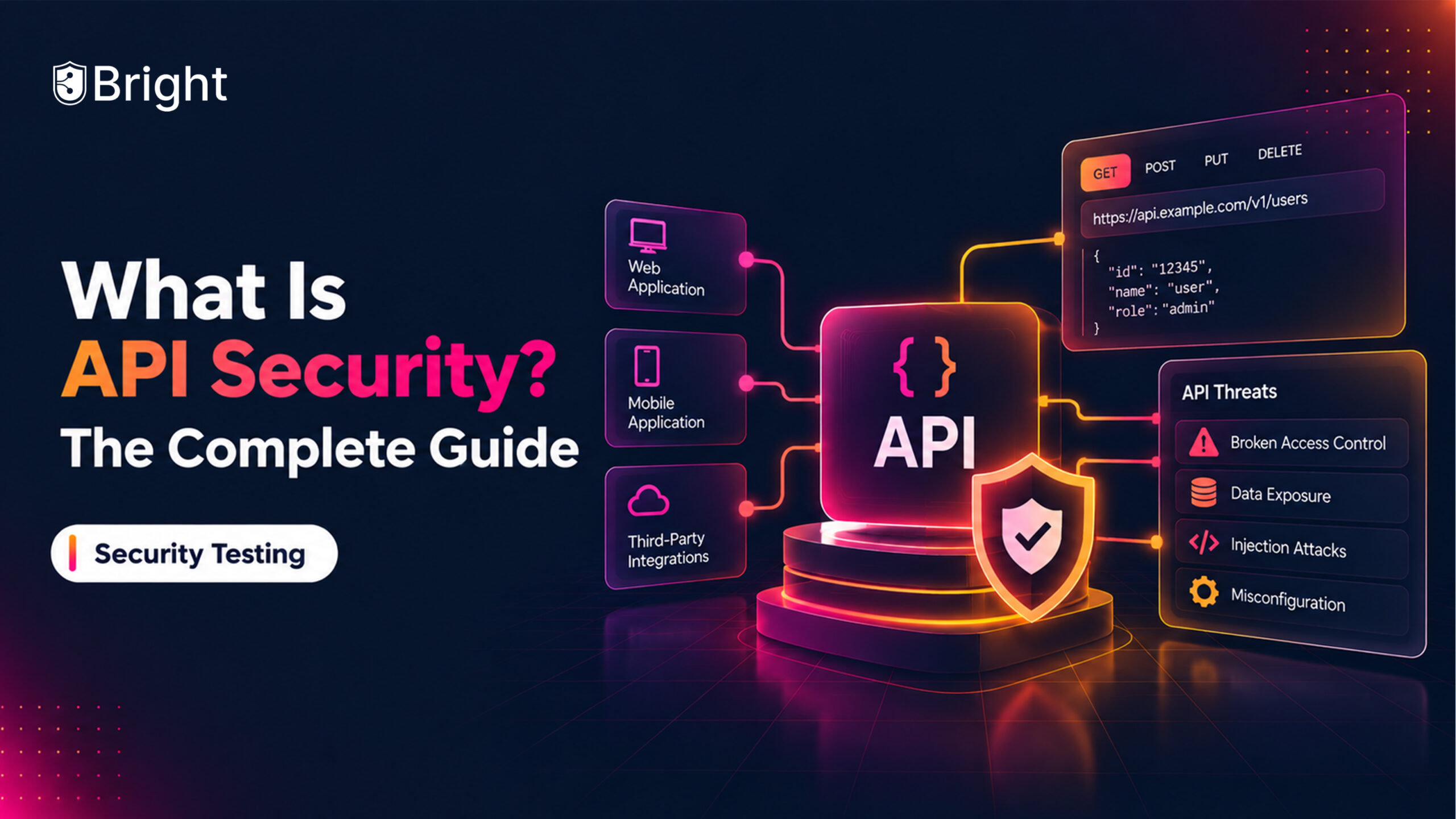

An Application Programming Interface, or API, allows software applications and services to communicate, exchange data, and trigger actions. APIs sit behind mobile applications, SaaS products, microservices, payment systems, third party integrations, and a growing number of AI powered applications.
API security is the practice of protecting these interfaces from unauthorized access, data exposure, abuse, and attack. It covers authentication, authorization, data protection, configuration, monitoring, vulnerability testing, and remediation throughout the API lifecycle.
The need for stronger API security has grown with the attack surface. Akamai documented more than 150 billion API attacks between January 2023 and December 2024. It also recorded 311 billion web application attacks in 2024, a 33% year over year increase. Akamai’s State of Apps and API Security 2025 research connects this growth in part to the rapid adoption of AI powered applications and the additional API exposure they create.
Securing APIs now requires more than putting authentication or a gateway in front of an endpoint. You need to know which APIs exist, determine what each user or service should be allowed to access, test how APIs behave under attack, and verify whether identified vulnerabilities can actually be exploited.
Why Is API Security Important?
Businesses use APIs to connect applications, customers, partners, services, and data. Depending on the application, an API might allow a caller to retrieve customer records, process payments, update an account, upload files, initiate transactions, or invoke internal services.
That makes APIs useful to legitimate applications and attractive to attackers.
A vulnerable API can allow attackers to:
- Access another user’s or organization’s data
- Abuse stolen credentials or session tokens
- Modify transactions or application state
- Invoke privileged functions
- Scrape sensitive or proprietary information
- Exhaust application resources
- Manipulate business workflows
- Reach vulnerable backend systems
- Exploit trusted third party connections
The challenge grows as API estates become larger and more distributed.
API inventories are often less complete than organizations assume. Cloudflare found that organizations had a median of 33% more public facing API endpoints than they knew about, based on the difference between machine learning based discovery and customer supplied identifiers. Its Application Security Report research shows why shadow APIs can remain outside normal testing, monitoring, and governance.
How Is API Security Different From General Application Security?
API security is part of application security, but APIs create a different type of attack surface.
Traditional web security often worked around a relatively clear front door. Users interacted through a browser, requests followed predictable patterns, and a Web Application Firewall, or WAF, could inspect traffic for common malicious payloads.
Modern applications have many more entry points, including public REST APIs, mobile APIs, partner APIs, internal microservice APIs, GraphQL endpoints, administrative APIs, third party integrations, older API versions, and APIs used by AI applications or agents.
These interfaces also change frequently as developers add endpoints and release functionality through CI/CD. More importantly, many API attacks do not look malicious at the request level.
Consider:
GET /api/accounts/5821
The user may have a valid token. The request may follow the documented schema. Nothing in the payload looks suspicious. But if changing 5821 to another account identifier exposes another customer’s information, the application has an authorization vulnerability.
A WAF looking for known attack signatures may not see anything unusual because the weakness exists in the application’s logic. This is why modern API security requires authenticated testing, authorization checks, application context, and visibility into runtime behavior.
Authentication and Authorization Are Different Controls
Authentication and authorization are often grouped together, but they answer different questions.
Authentication asks: Who are you?
It verifies the identity of a user, service, or application. APIs commonly use OAuth 2.0, OpenID Connect, JWTs, API keys, mutual TLS, or session based authentication.
Authorization asks: What are you allowed to access or do?
A user can be properly authenticated and still have permission to access only certain objects, functions, fields, or accounts. For example, authenticating a customer does not mean that customer should be able to access every invoice in the system. The distinction matters because authorization weaknesses appear repeatedly in the current OWASP API Security Top 10.
OWASP API Security Top 10 Risks
As of 2026, the OWASP API Security Top 10 2023 remains the current edition. The framework reflects how API threats have evolved, with significant emphasis on authorization failures, resource consumption, sensitive business flows, API inventory, and dependencies on third party APIs. View the OWASP API Security Top 10 2023
| OWASP API Security Risk | What It Means |
| API1:2023 Broken Object Level Authorization | A user can access an object or record they should not have permission to reach. |
| API2:2023 Broken Authentication | Authentication weaknesses let attackers impersonate legitimate users or services. |
| API3:2023 Broken Object Property Level Authorization | Users can read or change individual object properties outside their permission level. |
| API4:2023 Unrestricted Resource Consumption | Attackers consume excessive compute, bandwidth, storage, memory, or third party resources. |
| API5:2023 Broken Function Level Authorization | Users can invoke functions intended for a more privileged role. |
| API6:2023 Unrestricted Access to Sensitive Business Flows | Attackers automate legitimate functionality in ways that damage the business. |
| API7:2023 Server Side Request Forgery | An API can be manipulated into requesting unintended internal or external resources. |
| API8:2023 Security Misconfiguration | Unsafe configurations expose the API or supporting infrastructure. |
| API9:2023 Improper Inventory Management | Forgotten, undocumented, or deprecated APIs remain exposed. |
| API10:2023 Unsafe Consumption of APIs | Applications place too much trust in data received from other APIs. |
Broken Object Level Authorization
Broken Object Level Authorization, commonly known as BOLA, remains the number one risk in the OWASP API Security Top 10.
BOLA happens when an API uses an object identifier without verifying that the caller is authorized to access that particular object.
For example:
GET /api/orders/28741
If an authenticated user changes the ID to another valid order number and receives someone else’s order, authentication has succeeded while authorization has failed.
These vulnerabilities are particularly important because the request itself can look completely legitimate. Server side authorization should therefore be checked whenever an endpoint accepts an object identifier and accesses sensitive data or functionality.
Broken Object Property and Function Level Authorization
Authorization can also fail at the property or function level.
An API might correctly let a customer access their profile but return internal properties that should only be visible to administrators. A standard user may also be blocked from an administrative function in the UI while the underlying API endpoint remains callable.
Authorization needs to apply consistently to objects, individual properties, functions, roles, token scopes, tenant boundaries, HTTP methods, and application workflows. The client interface should never be responsible for enforcing sensitive authorization decisions.
Sensitive Business Flow Abuse
Not every API attack depends on malformed requests, injection payloads, or broken authentication.
Attackers can automate legitimate business functionality to reserve limited inventory, create large numbers of accounts, abuse referral schemes, scrape proprietary information, reuse promotions, or manipulate multi step financial processes.
Each individual request may be valid. The vulnerability becomes clear only when you examine the sequence, frequency, or business outcome.
This is why API security testing increasingly needs to cover business logic rather than treating every endpoint as an isolated technical interface.
Unrestricted Resource Consumption
API operations can consume very different amounts of infrastructure. Large uploads, complex GraphQL queries, bulk exports, report generation, database searches, image processing, third party calls, and AI model requests can all be expensive.
Rate limiting helps, but organizations may also need to control request size, concurrency, query complexity, quotas, per user usage, token usage, and third party costs. The right limit depends on what the operation actually does.
Improper Inventory Management
Security teams cannot test an API they do not know exists. Two common inventory problems are:
Shadow APIs: endpoints that operate outside the organization’s known or governed API inventory.
Zombie APIs: deprecated or outdated versions that remain accessible after development teams believe they have been retired.
Both can fall outside normal vulnerability testing and monitoring.
A useful inventory records the API owner, environment, version, authentication method, data sensitivity, exposure, dependencies, and lifecycle status.
Inventory also needs to stay current as teams deploy new routes and services. Bright explores how discovery differs from active security testing in its guide to DAST, API discovery, and runtime API security.
API Security Across REST, SOAP, and GraphQL
Different API architectures introduce different technical considerations, but the same fundamental principles remain: authenticate callers, enforce authorization, validate input, protect sensitive data, constrain resources, and test how the API behaves at runtime.
REST API Security
REST is widely used for web, mobile, SaaS, and microservice APIs. REST does not provide a complete built in security model. Security depends on how the API is implemented and deployed.
Common controls include TLS, OAuth 2.0 or another appropriate authentication mechanism, server side authorization, request and response validation, secure token handling, rate limiting, logging, API gateways, and appropriate HTTP method restrictions. API gateways can centralize authentication, routing, traffic policies, TLS, logging, and rate limits.
But they do not replace security controls inside the application. A gateway can determine whether a token is valid. The application still needs to decide whether that identity can access a specific account, modify an invoice, or call an administrative function. The same limitation applies to WAFs. They can block many common malicious payloads, but they cannot reliably detect every authorization or business logic weakness.
SOAP API Security
SOAP is a structured messaging protocol that can use security standards such as WS Security, XML encryption, XML signatures, and SAML based identity.
These mechanisms can provide strong enterprise security capabilities, while REST typically relies on security controls implemented through HTTP, identity standards, gateways, and the application itself.
Neither architecture is inherently secure. The strength of API security depends on how authentication, authorization, encryption, configuration, input validation, and testing are implemented.
SOAP services still require correct authorization, safe XML parsing, secure authentication, appropriate encryption, configuration controls, and vulnerability testing.
GraphQL Security
GraphQL lets clients define the data and relationships they want returned. That flexibility is useful, but it changes the way security controls need to work.
Important considerations include:
Query depth: Deeply nested queries can require significant server processing.
Query complexity: Two queries with similar depth can have very different computational costs.
Authorization: Permission checks should apply to individual objects, fields, and operations.
Introspection: Organizations should deliberately decide whether schema introspection needs to remain publicly available in production.
Batching and aliases: A single request may contain multiple operations, which can defeat simplistic request based rate limiting.
Resource consumption: Controls should account for actual query cost rather than only HTTP request volume. Apply query depth and complexity limits, use throttling for expensive operations, enforce reasonable execution timeouts, and apply rate limits by user or IP where appropriate. OWASP specifically recommends these controls for reducing GraphQL denial of service risk. OWASP GraphQL Security Cheat Sheet
GraphQL should also be tested for injection, broken authorization, authentication weaknesses, data exposure, insecure configuration, and business logic problems.
API Security Testing Methods
Effective API security testing needs to cover more than malicious input. It should test the complete attack surface, including API discovery, authenticated functionality, authorization boundaries, input handling, business logic, resource consumption, and multi step workflows.
Testing should also continue as APIs change rather than being limited to a point in time assessment.
Discover the API Attack Surface
Start by understanding what you actually need to test.
Sources can include OpenAPI or Swagger specifications, Postman collections, HAR files, gateway configurations, developer documentation, application traffic, service inventories, and runtime API discovery.
Compare the documented attack surface with the services and traffic that actually exist. This can uncover older versions, undocumented routes, shadow APIs, test endpoints, and interfaces that never entered the formal security process.
Discovery and security testing solve different problems.
Discovery answers: What APIs exist?
Security testing answers: How can those APIs be attacked or abused?
Organizations usually need both.
Test Authentication and Authorization
Anonymous scanning covers only part of most API attack surfaces.
Important application functionality often appears after login, which means testing needs representative identities and roles.
Useful tests include:
- Can User A access User B’s data?
- Can one tenant access another tenant’s resources?
- Can a lower privilege role invoke administrator functions?
- Can read only credentials perform write operations?
- Can sensitive properties be modified?
- Do expired or revoked tokens still work?
- Does changing an HTTP method affect authorization?
- Are token scopes enforced consistently?
Authentication itself should also be tested across login, password reset, token refresh, logout, account recovery, and service to service flows.
Tools that cannot maintain authenticated context will miss a large part of many real APIs. Authentication support is therefore an important evaluation criterion when comparing API security testing tools for CI/CD pipelines.
Test Parameters, Input Validation, and Injection
API requests contain many values clients can manipulate directly, including path parameters, query parameters, JSON or XML properties, headers, cookies, object identifiers, prices, quantities, and pagination controls.
Test how the API behaves when these values fall outside expected conditions. Input validation should verify types, ranges, lengths, formats, schemas, required fields, and unexpected properties.
APIs can also expose server side vulnerabilities such as SQL injection, NoSQL injection, command injection, LDAP injection, and template injection.
Testing should determine whether untrusted input reaches an interpreter in an unsafe way, using controlled payloads and systems where testing is explicitly authorized. Automated dynamic testing can help validate these weaknesses without relying on unnecessarily disruptive commands.
Fuzzing and boundary tests can supplement this process by sending unexpected types, very large values, null values, malformed data, invalid encodings, oversized payloads, or duplicate parameters.
Look for server errors, inconsistent validation, data exposure, crashes, or abnormal resource consumption.
Test HTTP Methods and Business Logic
APIs may expose different behavior through GET, POST, PUT, PATCH, DELETE, and other methods.
Verify that methods that should be unavailable are blocked and that authorization remains consistent between methods. A user may not see a delete option in the interface while the underlying DELETE endpoint remains accessible.
Security testing should also examine complete business workflows.
Consider an order process:
- Create an order
- Apply a discount
- Authorize payment
- Confirm the order
- Trigger fulfillment
Every endpoint may work correctly in isolation.
A vulnerability can still exist if a caller can reuse the discount, alter the price after payment authorization, skip a required step, replay fulfillment, or change identity between stages.
These are application behavior problems rather than simple input validation problems.
Integrate API Testing Into CI/CD
Point in time testing becomes outdated quickly when APIs change continuously.
New endpoints appear. Authentication flows change. Authorization rules evolve. Third party dependencies are added.
API security tests can run during development, on pull requests, in CI/CD, in staging, before release, on a schedule, after sensitive changes, and after remediation.
This moves feedback closer to the code change that introduced the issue. Bright’s guide to continuous API security testing in production explains how continuous testing can complement production monitoring.
API Testing Tools
API development and functional testing tools can support secure development, but they serve a different purpose from dedicated API security testing.
Functional tools help teams verify whether APIs behave as expected. Security testing deliberately challenges authentication, authorization, input handling, application logic, and runtime behavior to uncover exploitable weaknesses.
Postman helps teams create and organize requests, environments, collections, and automated functional tests.
OpenAPI and Swagger describe endpoints, schemas, parameters, authentication requirements, and responses. Accurate specifications also provide useful inputs for security testing.
Apache JMeter focuses primarily on performance and load testing and can help evaluate traffic behavior and resource consumption.
SoapUI supports automated functional testing for REST and SOAP services.
Karate supports API test automation, assertions, mocks, and reusable workflows.
Fiddler lets developers and security practitioners inspect and debug HTTP traffic.
Organizations selecting dedicated API security technology should additionally evaluate authenticated scanning, authorization testing, API coverage, runtime validation, CI/CD integration, business logic testing, and the reproducibility of findings.
API Security Best Practices for 2026
There is no single control that secures every API. Strong API security best practices combine preventive controls, attack surface visibility, continuous testing, and monitoring.
Maintain a Current API Inventory
Treat every API as a managed software asset.
Track the owner, version, environment, exposure, authentication method, data sensitivity, dependencies, and lifecycle status.
Deprecated APIs should have a real retirement process rather than disappearing from documentation while remaining reachable.
Discovery should supplement documentation because deployed endpoints can appear outside the formal inventory, especially in environments where teams frequently release new services or API versions.
Enforce Authorization Server Side
Authorization should be enforced for sensitive objects, fields, functions, and workflows.
Do not rely on the frontend to determine what a user can access.
The server should verify object ownership, roles, tenant membership, token scopes, requested functions, and relevant business rules before returning data or performing an action.
Use Strong Authentication and Protect Credentials
Choose established authentication mechanisms appropriate to the API and client.
OAuth 2.0 and OpenID Connect are widely used, but correct configuration remains essential. Validate token signatures, expiration, audience, issuer, and scopes. Rotate credentials and support revocation where appropriate.
API keys, secrets, and service credentials should not be embedded in public repositories or client applications where they can be extracted easily.
Apply least privilege so a compromised service credential does not automatically expose unrelated data or functionality.
Encrypt and Validate API Data
Use modern TLS for sensitive API traffic. Sensitive information at rest should also receive protection appropriate to its classification, regulatory obligations, and threat model.
Validate incoming requests against the expected schema. Check data types, lengths, formats, ranges, required fields, content types, and unexpected properties.
Response security matters too. Return only the information the client actually needs rather than exposing complete backend objects and relying on the client to hide sensitive fields.
Apply Appropriate Rate and Resource Controls
Rate limits should reflect the cost and sensitivity of the operation. Authentication requests, data exports, expensive searches, payments, file processing, GraphQL queries, and AI model calls may need stricter controls than basic read requests. Controls can consider frequency, payload size, query complexity, identity, concurrency, API key, token, and operation cost.
Use API Gateways and WAFs as Security Layers
API gateways and WAFs remain valuable. They can provide authentication, TLS, rate limiting, routing, logging, request policies, and protection against many recognizable attacks.
But they do not automatically understand whether an authenticated user should access a particular customer record or whether a valid sequence of API requests is abusing a business workflow. Application level authorization and security testing are still required.
Apply Zero Trust Principles to API Access
Internal network location should not automatically make an API request trustworthy.
Apply authentication and authorization according to the user or service identity, requested resource, application context, and action being performed.
NIST’s zero trust guidance removes implicit trust based solely on network location and focuses protection on users, services, assets, and resources. NIST SP 800-207: Zero Trust Architecture
For APIs, that means internal services need explicit identities and appropriate permissions just as external callers do.
Use Service Mesh Controls for Service to Service APIs
Microservice environments often contain large volumes of internal API traffic that never pass through a public API gateway.
A service mesh can help enforce consistent identity, mutual TLS, authorization policies, and traffic controls between services.
NIST’s cloud native zero trust guidance specifically describes API gateways, sidecar proxies, and application identity infrastructure as components that can enforce granular policies across services in hybrid and multi cloud environments. NIST SP 800-207A
A service mesh does not replace application level authorization or vulnerability testing, but it can reduce reliance on implicit trust between workloads.
Monitor API Activity
Security testing identifies weaknesses. Runtime monitoring helps detect attacks and abuse in deployed environments.
Useful telemetry can include authentication failures, authorization denials, unexpected endpoint activity, repeated object enumeration, token anomalies, unusual request volumes, administrative operations, and rate limit violations.
Testing and monitoring are complementary rather than interchangeable.
Account for AI Agents as API Consumers
AI agents add another class of machine identity to API ecosystems.
Postman’s 2025 State of the API Report surveyed more than 5,700 developers, architects, and executives. 51% of developers cited unauthorized or excessive API calls from AI agents as a top security concern.
Agents may hold credentials, call APIs at machine speed, chain operations across services, and access sensitive information without a human reviewing every request.
The fundamental controls remain familiar:
- Give agents distinct identities
- Apply least privilege
- Narrow token scopes
- Protect credentials
- Set resource and cost limits
- Monitor machine activity
- Require additional approval for high impact operations where appropriate
Interfaces such as MCP tools should also be treated as part of the broader API attack surface when they expose business functions to AI systems.
Continuously Test and Revalidate
Finding a vulnerability is not the same as proving it is exploitable, and closing a ticket is not proof that the weakness is gone.
Dynamic security testing can exercise the running API and determine how it behaves under attack.
After developers apply a fix, retesting the affected behavior provides evidence that remediation worked.
What Continuous API Security Looks Like at Enterprise Scale
Bright’s work with a North American top 10 global bank shows how this model can work when dynamic testing is embedded into development rather than treated as an occasional assessment.
The bank operates more than 500 critical customer facing applications and more than 10,000 applications and APIs. After integrating Bright into multiple CI/CD pipelines, the organization increased testing from roughly 700 scans per month in 2023 to more than 30,000 scans per month by the end of 2024. Bright reports that the bank reduced vulnerability detection and remediation time by more than 70%.
The important point is not simply the scan volume. Dynamic testing became part of the ongoing development process rather than something teams waited months to perform through external testing.
Read the North American bank case study
Test APIs With Bright Dynamic AppSec
Bright Dynamic AppSec tests running web applications, APIs, and business logic and integrates security testing with development workflows.
Bright supports API coverage using inputs such as OpenAPI specifications, Postman collections, and application traffic. Authenticated dynamic testing helps exercise functionality that would remain invisible to a scanner operating only against public endpoints.
The focus is not simply generating more vulnerability alerts.
Runtime validation helps establish whether a suspected vulnerability can actually be triggered in the running application, giving security and engineering teams stronger evidence for prioritization and remediation.
Bright STAR extends this approach around finding, fixing, and validating vulnerabilities across the development lifecycle.
As API estates continue to grow, security testing needs to keep pace with how APIs are actually developed and changed.
Book a demo with Bright Security to see how continuous dynamic testing can fit into your API security program.
API Security FAQ
What is API security?
API security is the practice of protecting application programming interfaces, the data they process, and the functions they expose from unauthorized access, misuse, and attack. It includes authentication, authorization, encryption, request validation, API inventory, resource controls, security testing, monitoring, and remediation.
What are the most common API security risks?
The current OWASP API Security Top 10 includes Broken Object Level Authorization, broken authentication, Broken Object Property Level Authorization, unrestricted resource consumption, Broken Function Level Authorization, unrestricted access to sensitive business flows, Server Side Request Forgery, security misconfiguration, improper inventory management, and unsafe consumption of APIs.
What is API security testing?
API security testing examines how an API responds when identities, permissions, parameters, inputs, HTTP methods, and workflows are deliberately manipulated. It can uncover authorization failures, authentication weaknesses, injection vulnerabilities, resource abuse, security misconfiguration, and business logic flaws.
What is the difference between API security and API management?
API management focuses on operating APIs, including publishing, routing, analytics, versioning, developer access, and traffic management.
API security focuses specifically on protecting API data and functionality against vulnerabilities and abuse. API gateways and API management platforms provide useful security controls, but they do not replace application level authorization and security testing.
How often should APIs be security tested?
APIs should be tested throughout the software development lifecycle. Automated testing can run in CI/CD, staging, before releases, after sensitive changes, and after remediation. Periodic penetration testing and production monitoring can complement this continuous model.
Are API gateways enough to secure APIs?
No. API gateways can enforce authentication, rate limits, TLS, routing, logging, and other traffic policies. They cannot automatically identify every authorization or business logic vulnerability inside the underlying application. API security still requires application level controls and security testing.