
Table Of Contents
- Introduction
- The Customers You Should Worry About Aren’t Usually the Loud Ones
- Why AppSec KPIs Matter More Than Activity Metrics
- Turning Security Data Into Actionable Conversations
- How Bright Helps Teams Stay Ahead of Customer Risk
- Why Automated B2B Customer Engagement Is Becoming Essential
- Building Better Security Outcomes Through Visibility
- Final Thoughts
Introduction
A customer success leader recently told me something that stuck with me. He wasn’t worried about customers who complained. He was worried about customers who went quiet.
Customers who stop joining review calls, slowly reduce platform usage, or become less engaged rarely raise immediate concern. On the surface, everything appears normal. Support tickets aren’t increasing. Escalations aren’t happening. Nobody is raising alarms.
Then renewal season arrives, and suddenly everyone is trying to understand what went wrong. In application security, this happens more often than most people realize.
The warning signs are usually there long before the customer becomes unhappy. Scan activity starts dropping. Adoption slows across development teams. Applications are no longer tested as frequently as they should be. Vulnerabilities remain unresolved for longer periods of time.
The challenge isn’t collecting this information. Most AppSec platforms already generate enormous amounts of data. The challenge is recognizing what that data is telling you while there’s still time to act on it.
At Bright, we’ve found that some of the strongest customer relationships are built when teams identify these signals early and engage before small problems become bigger ones. That’s why proactive customer success is becoming such an important part of modern AppSec programs.
The Customers You Should Worry About Aren’t Usually the Loud Ones
It’s natural to assume that unhappy customers will tell you they’re unhappy. Sometimes they do. More often, they don’t. What usually happens is much more gradual.
A customer who was actively running scans every week starts running them every month. Development teams that were highly engaged become focused on other priorities. Security findings begin accumulating because remediation workflows aren’t moving as quickly as they once did.
None of these changes looks dramatic by themselves. That’s what makes them easy to miss.
One thing we’ve observed at Bright is that successful AppSec programs leave clues. The same is true for struggling programs. The challenge is understanding which signals matter and which ones don’t.
A drop in login activity may not mean much. A drop in application coverage combined with declining scan frequency and slower remediation timelines tells a very different story.
When viewed together, those metrics often reveal challenges long before customers raise concerns directly.
This is where proactive customer success creates real value. Instead of reacting to problems after they appear, teams can start meaningful conversations while there is still time to influence outcomes.
Why AppSec KPIs Matter More Than Activity Metrics
One of the common traps when dealing with customer success is basing success metrics on activities instead of progress. The customer could be performing regular scans. The customer might log into your platform regularly.
The customer might even generate thousands of findings. None of these metrics would guarantee any success. It is all about the progress of the security program.
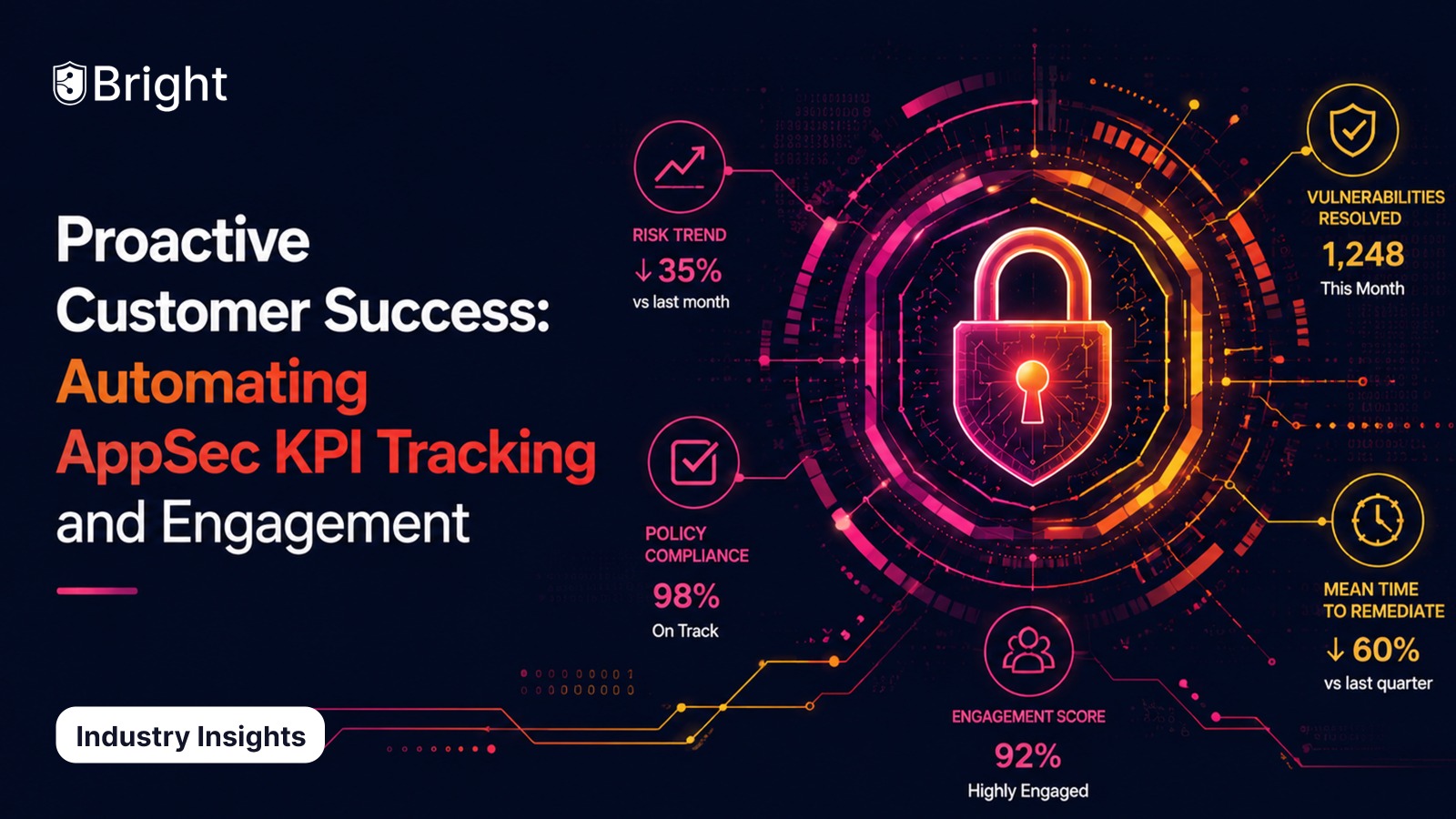
For instance, at Bright, we often emphasize the importance of using AppSec KPIs instead of metrics based on activity. Application coverage, remediation velocity, vulnerability aging, consistency of testing, and adoption by developers will likely show much better results.
Let us consider two companies. Both run an equal number of scans per month. Based on that data alone, you might conclude that both parties are equally active in using your platform.
However, one party manages to reduce the vulnerability backlog, widen the coverage range, and improve the pace of remediation. Meanwhile, the other company witnesses increasing vulnerabilities, as well as a decrease in the number of scanned apps. Same activity. Completely different outcomes. That is why AppSec KPIs play an essential role in customer success.
Turning Security Data Into Actionable Conversations
The best customer success teams don’t simply report numbers. They explain what those numbers mean. This sounds obvious, but it’s surprisingly difficult in practice.
Modern security environments generate massive amounts of information. Customers already have dashboards, reports, alerts, and analytics. What they often need is context.
A customer success manager looking at declining scan activity should be asking questions.
Did priorities change?
Did onboarding stall within a specific team?
Is there a workflow problem preventing adoption?
Has ownership shifted internally?
At Bright, we’ve learned that the most productive customer conversations rarely start with metrics. They start with observations.
Instead of saying, “Your scan activity decreased by 15%,” the conversation becomes, “We’ve noticed fewer applications are being tested than they were three months ago. Has anything changed in the development process?”
That’s a very different discussion. The goal isn’t to present data. The goal is to help customers understand what the data might be telling them. When customer success teams approach engagement this way, they become strategic partners rather than platform administrators.
How Bright Helps Teams Stay Ahead of Customer Risk
As AppSec programs grow, maintaining visibility becomes increasingly difficult.
A company testing ten applications can often understand its environment without much effort. A company testing hundreds of applications across multiple business units faces a completely different challenge.
That’s one reason Bright places such a strong emphasis on visibility and continuous insight.
It should not be left to customer success teams to wait until quarterly reviews to ascertain the healthiness of a security program. The teams need to be able to notice and react to any changes that occur.
By using the Bright approach, there would be an opportunity for proactive engagement. Customer success managers will be working with actual data and identifying where things can go wrong even before issues arise.
The result isn’t simply better reporting. The result is better timing. And in customer success, timing often matters more than information.
Why Automated B2B Customer Engagement Is Becoming Essential
The phrase “automated customer engagement” sometimes creates the wrong impression. People imagine generic emails and impersonal workflows. In reality, the best automation does the opposite.
It helps customer success teams spend more time having useful conversations and less time searching for signals.
Think about the amount of information generated inside a modern AppSec platform. Tracking every scan, application, vulnerability trend, onboarding milestone, and adoption metric manually isn’t realistic.
Automation helps surface the customers who may need attention.
At Bright, automation supports customer success rather than replacing it. The technology identifies patterns, highlights changes, and surfaces risks. People provide the expertise, guidance, and relationships that help customers succeed.
That combination scales much more effectively than relying entirely on manual processes. And as security programs continue growing, it’s becoming increasingly necessary.
Building Better Security Outcomes Through Visibility
One thing we’ve consistently noticed is that customers make better decisions when they can clearly see progress.
Visibility creates accountability. It creates alignment between security teams and leadership. It creates opportunities to identify problems before they become expensive.
Most importantly, it helps organizations understand whether their security investments are producing meaningful results.
Bright supports this by helping teams monitor the AppSec KPIs that matter most. Instead of waiting for annual reviews or renewal discussions, customers gain ongoing insight into how their programs are performing.
That visibility changes the conversation. Customer success becomes less about platform usage and more about outcomes. And that’s ultimately what customers care about.
Final Thoughts
The most successful customer success programs rarely operate in reactive mode.
They identify patterns early, understand what those patterns mean, and engage before customers experience problems.
In application security, it requires more than periodic check-ins and adoption reports. It requires meaningful AppSec KPIs, continuous visibility, and the ability to turn data into action.
At Bright, we’ve found that proactive customer success isn’t really about automation or reporting. Those are just tools.
The real goal is helping customers achieve stronger security outcomes before challenges start affecting progress. Because the customers who need help the most are often the ones who haven’t asked for it yet.