

How Modern Security Teams Scale Without Losing Depth
Table of Contents
- Introduction
- Why Manual Pen Testing Became the Standard.
- The Structural Limits of Manual Testing in Modern Environments
- What Automated DAST Actually Does
- How Modern DAST Tools Have Evolved
- Bright Security: From Scanning to Validation
- Automated DAST vs Manual Pen Testing (Practical Comparison)
- Where Manual Pen Testing Still Adds Value
- How Leading Teams Combine Automated DAST and Manual Testing
- Vendor Traps When Evaluating DAST Tools
- How Security Leaders Approach This Shift (Procurement View)
- FAQ
- Conclusion
Introduction
For a long time, manual penetration testing sat at the center of application security programs.
It wasn’t just a tool – it was a mindset.
Organizations relied on skilled testers to think like attackers, explore applications creatively, and uncover weaknesses that automated systems often missed. The process was thorough, contextual, and grounded in real-world attack scenarios.
And for a while, that was enough.
But the nature of applications has changed.
Modern systems are not static. They are distributed, API-driven, and constantly evolving. Code moves from development to production in days – sometimes hours. Features are added continuously. Integrations expand over time.
This creates a mismatch.
Manual pen testing still provides depth. But it cannot keep pace with how frequently applications change.
That’s where Bright Automated DAST is starting to take a more central role.
Not because it replaces human expertise – but because it provides something manual testing cannot:
Continuous validation.
And in modern environments, that is what security teams are actually missing.
Why Manual Pen Testing Became the Standard
Manual testing became the foundation of AppSec for a reason.
It offered something early dynamic application security testing tools could not: context.
A skilled tester could:
- Understand business logic
- Chain multiple vulnerabilities together
- Identify non-obvious attack paths
- Adapt testing based on application behavior
This made manual testing highly effective for:
- Complex applications
- Business logic vulnerabilities
- Edge-case scenarios
For many years, this approach worked well.
Applications were:
- Simpler
- Less distributed
- Released less frequently
Testing once or twice a year was often sufficient to maintain a reasonable security posture.
But those conditions no longer exist.
The Structural Limits of Manual Testing in Modern Environments
The limitations of manual testing are not about quality.
They are about scale, speed, and coverage.
1. Periodic Testing vs Continuous Change
Manual testing happens at fixed intervals.
Applications change continuously.
That creates gaps – sometimes large ones – between when an application is tested and when it is actually running in production.
2. Limited Coverage
Even the most skilled testers operate within time constraints.
They cannot:
- Test every endpoint
- Explore every workflow
- Validate every API interaction
Modern applications often include hundreds of APIs and complex service interactions. Covering all of this manually is not realistic.
3. High Cost
Manual engagements require:
- Specialized expertise
- Time for planning and execution
- Coordination across teams
This makes frequent testing expensive and difficult to scale.
4. Delayed Feedback Loops
Findings from manual testing often arrive:
- Weeks after testing begins
- After code has already been deployed
Developers then have to revisit older code, which slows remediation and reduces efficiency.
5. Difficulty Keeping Up With APIs
Modern applications are API-first.
While manual testers can explore APIs, doing so at scale – across environments and releases – is challenging.
These limitations do not make manual testing obsolete.
But they do make it insufficient as the primary security mechanism.
What Automated DAST Actually Does
Automated DAST takes a different approach.
Instead of analyzing code, it tests applications from the outside – the way an attacker would.
It interacts with running systems and observes how they behave.
Core Capabilities
Modern DAST tools can:
- Scan web applications and APIs
- Test authentication and authorization flows
- Identify common vulnerabilities
- Integrate into CI/CD pipelines
- Run continuously across environments
Key Advantage: Frequency
The biggest difference is not capability.
It is frequency.
Automated DAST can run:
- On every build
- On every deployment
- On demand
This transforms testing from a periodic activity into a continuous process.
What This Changes
Instead of asking:
“Was this secure at the time of testing?”
Teams can ask:
“Is this secure right now?”
How Modern DAST Tools Have Evolved
Early DAST tools had real limitations:
- High false positive rates
- Poor handling of authentication
- Limited support for APIs
- Surface-level scanning
These issues made them less reliable than manual testing.
But the category has evolved.
Modern Improvements
Today’s dynamic application security testing platforms:
- Handle complex authentication flows
- Support API-first architectures
- Explore workflows more effectively
- Provide better accuracy
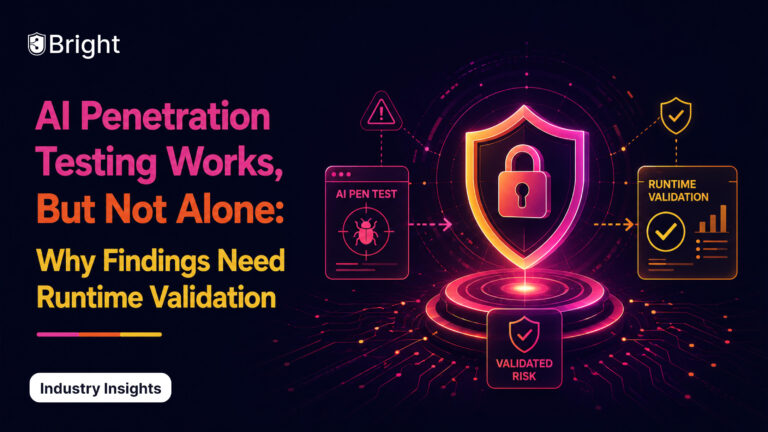
More importantly, they focus on validation – not just detection.
Bright Security: From Scanning to Validation
Bright represents a shift in how automated DAST is applied.
Traditional tools focus on identifying potential issues.
Bright focuses on confirming whether those issues actually matter.
What Bright Does Differently
Bright:
- Interacts with applications in real conditions
- Tests APIs, workflows, and user flows
- Simulates attacker behavior
- Validates exploitability
Why This Matters
Security teams are not short on findings.
They are short on clarity.
Bright helps answer:
“Can this actually be exploited?”
Practical Impact
- Reduced false positives
- Clear prioritization
- Faster remediation
- Better alignment with developer workflows
This is why Bright is often used to replace manual penetration testing for repeatable testing tasks – while keeping manual testing focused on deeper, more complex scenarios.
Automated DAST vs Manual Pen Testing (Practical Comparison)
| Capability | Manual Pen Testing | Automated DAST (Bright) |
| Frequency | Periodic | Continuous |
| Coverage | Limited | Scalable |
| Speed | Slow | Fast |
| Cost | High per test | Lower over time |
| Creativity | High | Structured |
| Validation | High | High (modern DAST) |
Key Insight
Manual testing provides depth.
Automated DAST provides consistency and scale.
Modern security requires both.
Where Manual Pen Testing Still Adds Value
Even with advanced automated DAST, manual testing remains important.
Complex Business Logic
Some vulnerabilities require human reasoning and creativity.
Attack Chaining
Experienced testers can combine multiple weaknesses into realistic attack paths.
Red Team Exercises
Simulating real attackers requires human expertise.
Compliance Requirements
Certain industries require periodic manual testing.
Manual testing is not going away.
Its role is becoming more focused.
How Leading Teams Combine Automated DAST and Manual Testing
The most effective approach is layered.
Continuous Layer
Automated DAST:
- Runs frequently
- Covers broad attack surfaces
- Provides ongoing validation
Deep Testing Layer
Manual testing:
- Focuses on complex scenarios
- Explores edge cases
- Validates high-risk areas
Outcome
This combination provides:
- Coverage
- Depth
- Efficiency
Vendor Traps When Evaluating DAST Tools
Not all Dast tools deliver the same value.
“Fully automated = no need for manual testing”
False.
Automation complements human expertise.
Legacy tools with high noise
Some tools still generate excessive false positives.
Demo-driven decisions
Controlled environments do not reflect real-world complexity.
Poor integration
If tools don’t fit into CI/CD workflows, adoption suffers.
How Security Leaders Approach This Shift (Procurement View)
Security leaders evaluate tools based on outcomes, not features.
What They Look For
- Accuracy of findings
- Reduction in false positives
- Integration with development workflows
- Scalability across applications
- Evidence of real-world validation
Key Questions
- Can this scale with our applications?
- Does this reduce manual effort?
- Does this improve prioritization?
FAQ
Can automated DAST replace manual penetration testing?
It can replace a large portion of repetitive testing, but not all.
What is dynamic application security testing?
It tests running applications by simulating real-world interactions.
Why are modern dast tools important?
Because they provide continuous visibility into application behavior.
When should manual testing be used?
For complex scenarios and deep analysis.
Conclusion
Manual penetration testing is not disappearing.
But it is no longer the foundation of modern application security.
Applications move too fast. Architectures are too complex. Attack surfaces change too frequently.
Periodic testing cannot keep up with continuous change.
This is why Bright Automated DAST is becoming central.
It allows security teams to test applications as they evolve – not months later.
It reduces blind spots.
It improves feedback loops.
And it helps teams focus on what actually matters.
This is where platforms like Bright play a critical role.
Not by replacing manual testing entirely.
But by automating what should be continuous, repeatable, and scalable.
Because in modern AppSec, the challenge is not just finding vulnerabilities.
It’s keeping up with them – in real time, at scale, and with confidence.