
Table Of Contents
- Introduction
- The Problem With Traditional Shift-Left Security
- Why Requirements Matter More Than Most Teams Realize
- How AI-Generated E2E Tests Are Changing Security
- How Bright Helps Teams Prevent Problems Earlier
- Why Copilot Rules Matter
- The Future of Shift-Left AI
- Final Thoughts
Introduction
Not long ago, almost all security discussions happened long after development had started. Requirements were finalized, engineers built features, security teams got to look at what was produced, and fixed issues, if any were found. Otherwise, things proceeded to release.
This way of operating software was fairly efficient for slow-moving software.
Times have changed. Development teams operate faster and release more often than ever before, not to mention how they integrate AI into their processes. Once a security issue is discovered, say, in a pull request or security test, engineers find themselves having spent several days or even weeks working on the problematic feature.
Here at Bright, we’ve observed a trend among engineering teams that adopt modern software development practices. It turns out that many of those security findings that end up in a ticket didn’t actually originate in the code at all – they originated in the planning process.
And that’s why today, the focus of the shift-left security discussion is changing. From early identification to prevention, in other words.
The Problem With Traditional Shift-Left Security
Most organizations have some degree of Shift-Left security measures in effect. Static code analysis is performed as part of the CI/CD pipeline, dependency scanning is done for open-source packages, and automatic feedback is provided on pull requests before merging code.
These practices are useful, but there is one thing they all share – they happen post-development.
At this point, architectural design is completed. The user experience is planned. The product specifications have already formed expectations about how the application is going to function.
Consider a fairly common situation. A new feature for customers is built, and then a team realizes there is an authorization problem. Naturally, the first thing they do is review the code. But when they conduct a root-cause analysis, it becomes clear that the initial specification failed to properly define who was supposed to have access to which resources.
The code only implemented the requirement. It is for reasons like this that more and more security teams begin questioning the traditional approach to code reviews and vulnerability scans. They wonder if security could be involved at an earlier stage of decision-making.
Why Requirements Matter More Than Most Teams Realize
Requirements rarely feel like a security concern.
They’re often discussed in planning meetings, written into tickets, or documented as user stories. Product managers focus on functionality. Engineers think about implementation. Security usually joins the conversation later.
The problem is that vulnerabilities often grow from small assumptions that nobody notices at the time.
A workflow assumes users should see certain data. An API is expected to be used only by internal systems. A business process relies on trust instead of validation. Individually, these decisions seem harmless. Months later, they can become security issues that require significant effort to fix.
We’ve seen teams spend days investigating vulnerabilities that ultimately traced back to a single sentence in a requirement document. Not because anyone made a mistake, but because security wasn’t part of the discussion when the requirement was created.
That is where AI is starting to make a difference.
How AI-Generated E2E Tests Are Changing Security
Most engineering teams don’t have unlimited time to write and maintain end-to-end tests. As applications grow, keeping test coverage aligned with real-world behavior becomes increasingly difficult.
AI-generated E2E tests help address that challenge.
Instead of relying entirely on manually written scenarios, teams can generate test workflows directly from requirements, user stories, and application behavior. More importantly, AI often explores paths that humans don’t immediately think about.
A developer might test how a workflow is supposed to function. AI-generated E2E tests can also evaluate unusual sequences, unexpected inputs, and edge cases that reveal hidden weaknesses.
At Bright, we’ve seen organizations use AI-generated E2E tests to uncover authorization issues, workflow flaws, and business logic problems long before those issues reached production. The value isn’t just automation. It’s the ability to examine applications from perspectives that traditional testing often misses.
When security teams talk about automated bug prevention, this is usually what they mean: identifying risky behavior before customers – or attackers – discover it.
How Bright Helps Teams Prevent Problems Earlier
One important takeaway from collaborating with security teams and engineers is that no one wants another dashboard full of alerts. The fact is, most companies already have more findings than they can act on.
What they really need is assurance – assurance that the requirements will be sound. Assurance that any code generated by AI adheres to best practices. And assurance that testing accurately simulates what happens in production.
Bright provides that assurance through continuous validation throughout the development life cycle. Security isn’t treated as an afterthought; rather, it is possible to validate test results and requirements early on, when there is still plenty of time to fix things.
This works perfectly well in today’s fast-paced DevSecOps environment where development processes operate in rapid sprints, and AI becomes increasingly integrated. There is no need to wait until vulnerabilities emerge; issues can be detected much earlier.
Why Copilot Rules Matter
AI coding assistants have changed how many developers work. They generate code, suggest implementations, and help teams move faster than ever before.
The challenge is that AI models optimize for completing tasks, not necessarily for following an organization’s security standards.
That’s why Copilot rules are becoming increasingly important.
Clear rules help guide AI toward approved development patterns, secure authentication flows, and safer API implementations. Instead of relying on individual developers to remember every security guideline, organizations can build expectations directly into AI-assisted workflows.
Combined with AI-generated E2E tests and continuous validation from Bright, these guardrails create a much stronger foundation for secure software development.
The Future of Shift-Left AI
Phase two of Shift-Left security will not be marked by more scanners. It will be marked by even earlier decision-making.
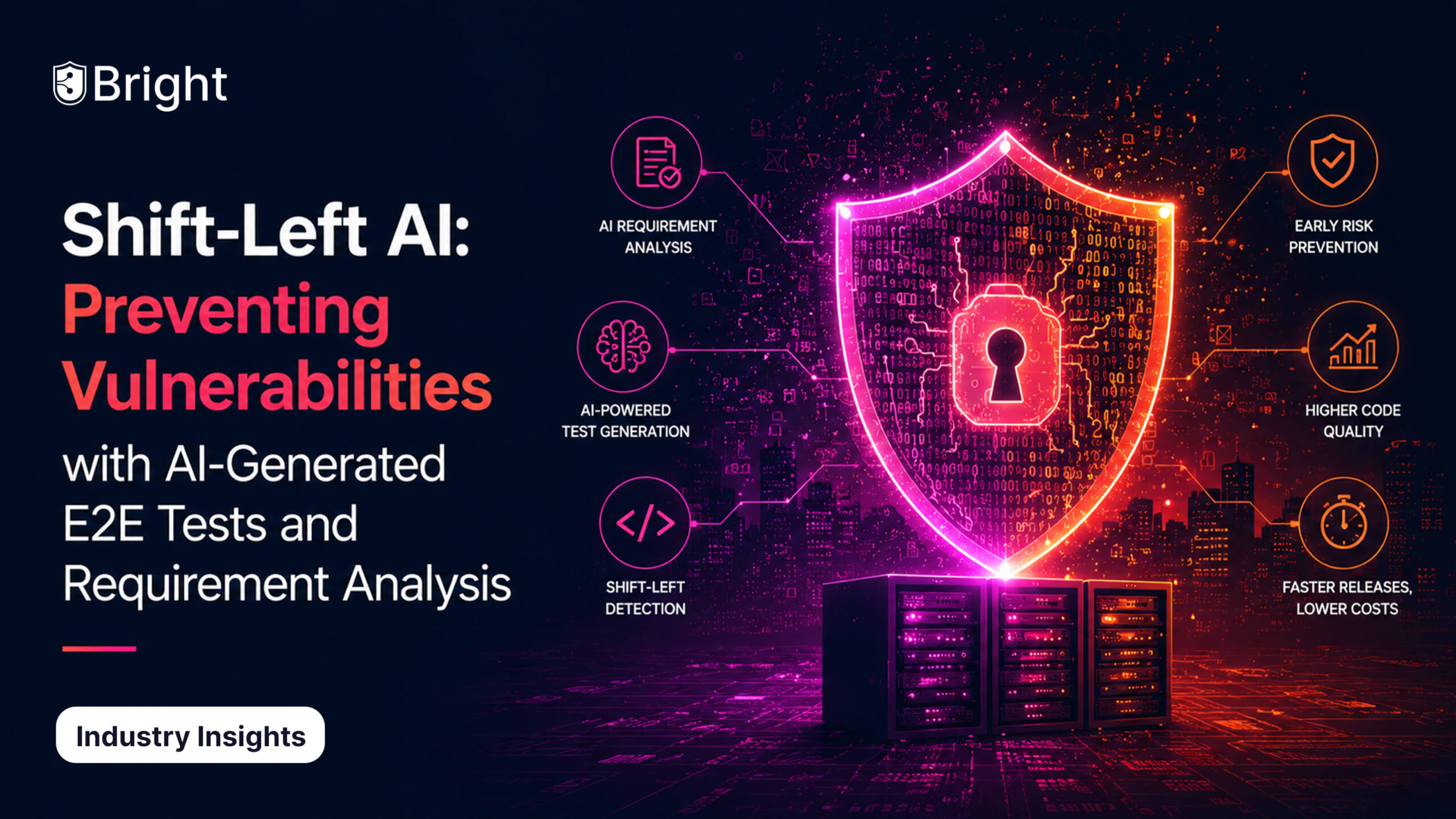
AI technology is enabling organizations to analyze requirements, create realistic testing scenarios, discover potential risk factors, and verify correct behavior well before code enters production. Security is slowly but surely becoming a proactive process rather than a reactive one.
This trend is being observed by Bright. Those who are benefiting the most from AI technology do not just write more code; they write better code, without errors and security risks that might otherwise end up in production code. That’s what automated bug prevention is all about.
Final Thoughts
For years, application security has focused on discovering vulnerabilities as quickly as possible. That work remains important, but the conversation is evolving.
Organizations are beginning to realize that the biggest win isn’t finding a vulnerability earlier. It’s preventing that vulnerability from being introduced at all.
AI-generated E2E tests, requirement analysis, Copilot rules, and continuous validation are helping teams move closer to that goal. Combined with Bright’s approach to continuous application security, they allow engineering teams to build security into the earliest stages of development rather than adding it later.
The result isn’t just fewer vulnerabilities. It’s less rework, faster releases, and greater confidence in the software being shipped.