
And What Modern Security Testing Looks Like Instead
Table of Contents
- Introduction
- Why CI/CD Pipelines Need Fast and Continuous Security.
- What Teams Get Wrong About DAST in CI/CD
- The Problem With Traditional DAST Tools
- Where Traditional DAST Breaks in CI/CD Pipelines
- The Hidden Cost of Using Legacy DAST in DevOps
- What Modern CI/CD Security Actually Requires
- Why Validation Matters More Than Scanning
- How Bright Works Seamlessly in CI/CD
- Before vs After Bright Modern DAST
- What to Look for in CI/CD-Friendly DAST Tools
- Common Mistakes
- FAQ
- Conclusion
Introduction
Modern software delivery is built around speed.
Teams deploy multiple times a day.
Changes move from code to production in minutes.
And CI/CD pipelines make this possible.
But security hasn’t always kept up.
Traditional DAST tools were designed for a different era.
An era where applications were tested periodically.
Where releases were slower.
And where scanning could happen without impacting delivery timelines.
That world no longer exists.
Today, when teams try to integrate traditional DAST into CI/CD pipelines, things start to break.
Pipelines slow down.
Scans take too long.
Developers skip security checks just to keep releases moving.
The result is predictable.
Security becomes a bottleneck instead of an enabler.
The core issue is not that DAST is ineffective.
It’s that traditional DAST models are not designed for continuous environments.
This is where modern approaches, like Bright, change the equation.
Instead of scan-heavy, periodic testing, Bright introduces continuous, validation-driven security that fits naturally into CI/CD pipelines.
Why CI/CD Pipelines Need Fast and Continuous Security
CI/CD pipelines are built for speed and consistency.
Every code change triggers automated processes:
- Build
- Test
- Deploy
Security must operate within this same model.
It cannot be slow.
It cannot be manual.
And it cannot interrupt the flow.
Modern pipelines require security that is:
- Automated
- Lightweight
- Continuous
The problem is that traditional DAST tools don’t meet these requirements.
They rely on full scans that take hours. They generate results after the pipeline has already moved forward. And they often require manual review before action can be taken.
This creates a mismatch. Pipelines move fast. Security moves slowly.
Bright solves this by aligning with the pipeline itself.
It runs continuously, provides immediate feedback, and avoids blocking development workflows.ces noise. And it gives teams meaningful results.
What Teams Get Wrong About DAST in CI/CD
Many teams believe integrating DAST into CI/CD is simple.
They assume:
“Just add a scan step to the pipeline.”
But this approach introduces problems almost immediately.
Full DAST scans are resource-heavy.
Running them on every build slows pipelines significantly.
To compensate, teams reduce scan frequency.
They move scans to nightly runs or pre-release stages.
This creates gaps.
Vulnerabilities are discovered too late. Fixes are delayed.
And security becomes reactive instead of proactive.
Another common mistake is assuming more scanning equals better security. In reality, more scans often produce more noise. Without validation, teams are overwhelmed with findings that are difficult to prioritize.
Bright avoids these issues entirely.
It doesn’t rely on heavy scans.
It continuously tests applications in real environments, providing meaningful results without slowing pipelines.
The Problem With Traditional DAST Tools
Traditional DAST tools are built around a scan-based model.
They crawl applications, generate requests, and analyze responses.
This approach works in static environments.
But it breaks in CI/CD.
Scan-Based Execution
Scans take time.
In fast pipelines, even a delay of a few minutes can impact delivery.
Most scans take much longer.
Long Run Times
Large applications require deep scanning.
This increases execution time and resource usage.
Pipelines become inefficient.
High False Positives
Traditional tools detect potential issues.
They do not validate exploitability.
This creates noise.
Limited Workflow Awareness
Modern applications rely on workflows.
Traditional tools test endpoints in isolation.
They miss real vulnerabilities.
Poor API Handling
APIs are central to modern apps.
Many tools treat them as secondary.
This leads to incomplete coverage.
Bright addresses all of these issues.It removes dependency on scans.
It validates findings.
And it understands application behavior.
Where Traditional DAST Breaks in CI/CD Pipelines
The failure of traditional DAST becomes clear when mapped to pipeline stages.
Build Stage
Pipelines must remain fast.
DAST scans slow this stage.
Teams disable them.
Test Stage
Limited time leads to shallow testing.
Coverage is incomplete.
Pre-Release Stage
Scans are moved here to avoid delays.
But this creates last-minute issues.
Releases get blocked.
Post-Deployment
Some teams scan after deployment.
This is too late.
Vulnerabilities reach production.
This pattern repeats across organizations.
Security is either:
- Skipped
- Delayed
- Or ineffective
Bright changes this model.
It operates across all stages without blocking them.
The Hidden Cost of Using Legacy DAST in DevOps
The highest cost of traditional DAST is not licensing.
It is an operational impact.
Pipeline Slowdowns
Delayed builds reduce deployment frequency.
Developer Frustration
Slow tools interrupt workflows.
Developers avoid using them.
Delayed Remediation
Issues are found late.
Fixes take longer.
Increased Triage Effort
False positives require manual validation.
Time is wasted.
Infrastructure Costs
Heavy scans consume resources.
Costs increase over time.
The biggest loss is developer velocity.
When pipelines slow down, innovation slows down.
Bright eliminates these hidden costs.
It enables security without friction.
What Modern CI/CD Security Actually Requires
Modern security must match modern development.
It must be:
- Continuous
- Automated
- Accurate
- Scalable
Security should run in the background.
It should not block pipelines. It should not require manual intervention. It should provide clear, actionable results.
API and workflow coverage are essential. Without them, testing is incomplete. False positives must be minimized. Noise reduces effectiveness.
Application security needs to follow the philosophy of DevSecOps today. It needs to be continuous, automated, and incorporated into each step of the software development life cycle.
The continuous test process identifies threats immediately once they are created. The shorter gap between detection and resolution helps to keep the risks low.
Automation is crucial to scale. Security operations need to operate without human intervention so that teams can sustain their speed without putting safety at risk.
CI/CD pipeline integration makes sure that the security process is included in the developer’s workflow instead of being separate from it.
The tools need to integrate seamlessly with other solutions such as version control and deployment solutions.
Bright meets all of these requirements.
It integrates seamlessly into CI/CD. It provides validated results. And it scales with applications.
Bright checks all of these boxes with continuous, validated test processes.
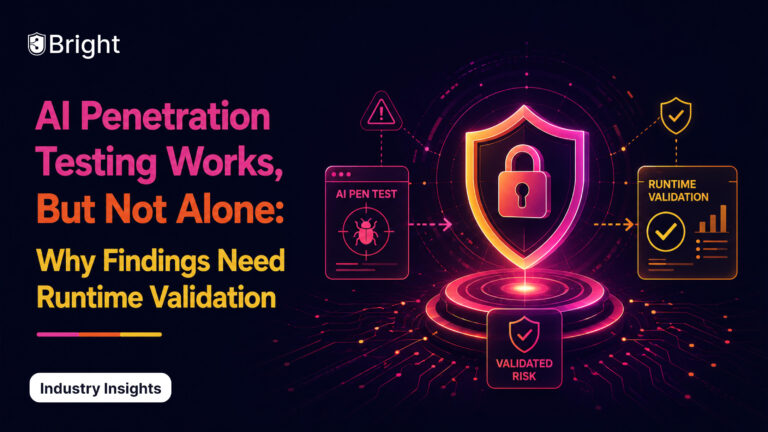
Why Validation Matters More Than Scanning
Scanning identifies potential vulnerabilities.
Validation confirms whether they are real.
This difference is critical.
Without validation:
- Every finding needs investigation
- Teams waste time
- Decisions slow down
With validation:
- Findings are actionable
- Prioritization is clear
- Remediation is faster
In CI/CD environments, speed matters.
Teams cannot afford to analyze hundreds of alerts. They need clarity.
Bright focuses on validation.
It ensures that findings reflect real risk. This reduces noise and improves efficiency.
How Bright Works Seamlessly in CI/CD
Bright is designed for modern pipelines.
Continuous Testing
Security runs continuously.
No reliance on scheduled scans.
No Pipeline Blocking
Testing does not delay builds.
Workflows remain fast.
API + Workflow Coverage
Applications are tested as they behave.
Not just endpoints.
Validated Findings
Only real vulnerabilities are reported.
Noise is eliminated.
CI/CD Integration
Bright integrates directly into pipelines.
No complex setup.
The result is a system where security becomes part of development. Not an obstacle.
Bright is designed specifically for modern development environments. Its continuous testing model eliminates the need for periodic scans, allowing security to operate in real time.
Workflow-based testing enables Bright to analyze how applications behave across multiple interactions. This is particularly important for APIs, where vulnerabilities often exist within sequences of requests.
By validating vulnerabilities before reporting them, Bright ensures that findings are accurate and actionable. This reduces noise and improves developer trust.
Integration with CI/CD pipelines is easy and needs little to no setup. Bright works behind the scenes and helps ensure that you get your security without impacting your development process.s this shift with a focus on clarity and validation.
Before vs After Bright Modern DAST
Before
- Slow pipelines
- Delayed scans
- High false positives
- Manual triage
- Developer friction
After
- Fast pipelines
- Continuous testing
- Validated findings
- Faster remediation
- Smooth workflows
This shift is significant.
It changes how teams approach security.
Traditional DAST tools generate too many vulnerabilities, which have to be validated manually, leading to inefficiencies during the entire remediation process.
The benefits will be realized once an organization shifts to the new age approach of validation first. This will reduce clutter, improve accuracy, and make the entire process fast and efficient.
This shift is indeed revolutionary in its nature because there is no denying the fact that there will be a fundamental shift in the manner in which organizations operate. This is what Bright is able to provide.e, organizations seeking to eliminate false positive rates from their applications should consider Bright.
What to Look for in CI/CD-Friendly DAST Tools
Organizations should evaluate tools based on:
- Continuous testing capability
- Validation of vulnerabilities
- API and workflow support
- Fast execution
- Low false positive rate
- Seamless CI/CD integration
Tools that rely on scans will struggle. Tools that validate and integrate will succeed.
When choosing a DAST tool for CI/CD, one needs to focus on such parameters as relevance. The continuous testing functionality will make it possible to stay on top of things with vulnerabilities.
Another thing that can make the difference between good and excellent tools is the validation of findings. Such an option is definitely preferable to the mere detection of possible problems.
Efficient performance and scalability matter when dealing with modern software, and thus, such functionality of tools needs to be considered. The ability to integrate with CI/CD systems is crucial, too.
All of the requirements mentioned above can be met by Bright.
Bright meets all these criteria. It is built for modern environments.
Common Mistakes
❌ Forcing scan-based tools into CI/CD
✔ Use continuous testing
❌ Running full scans on every build
✔ Test continuously
❌ Ignoring APIs
✔ Test workflows
❌ Blocking pipelines
✔ Enable flow
It is very common for companies to try to adapt the old tools for new environments rather than using the new solutions built for them. It results in ineffective operations.
One more error in security assessment that companies tend to make is placing the emphasis on how often the scan should be done rather than making sure its results are accurate.
Another thing to keep in mind when conducting security assessments is taking into account APIs and workflows, which play an important role in applications.
By utilizing Bright, companies can avoid making these mistakes.
FAQ
Why do traditional DAST tools fail in CI/CD?
Because they rely on slow, scan-based models.
Can DAST work in CI/CD pipelines?
Yes, with continuous and lightweight approaches.
What is the biggest challenge?
Balancing speed and security.
How does Bright help?
By providing continuous, validated testing without slowing pipelines.
Conclusion
CI/CD pipelines demand speed.
Traditional DAST tools were not built for this.
They slow the pipelines.
They create noise.
They delay remediation.
Modern application security requires a different approach.
One that is continuous.
One that is accurate.
One that fits seamlessly into development workflows.
The CI/CD pipeline has revolutionized the way software delivery is handled. And if the way software delivery is done changes, security should adapt accordingly.
Dynamic application security testing tools have been helpful so far, but with changing technology, they are no longer sufficient.
Their scan-based testing nature, susceptibility to false positives, and lack of compatibility with workflow have rendered them unsuitable for use with CI/CD pipelines.
There is a need for new solutions that offer speed, accuracy, and compatibility with workflow.
Bright represents this shift.
It aligns security with CI/CD. It removes bottlenecks. And it enables teams to move fast without compromising security. In modern environments, security should not block delivery. It should accelerate it.driven continuous testing solution that not only helps in eliminating false positives but also aids in the speed of remediation. In today’s DevSecOps world, not only is it an improvement but also a necessity. constant change, successful security means more than mere detection; it means comprehension.