+ Securing the AI SDLC

Finding the Bugs Scanners Can't

You code. We break it. Then we help you fix it.

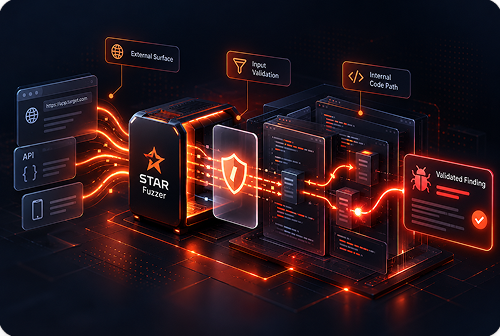
DAST shows what attackers can reach from the outside. But real breaches often hide deeper, in the code that runs after a request is accepted. STAR Fuzzer closes that gap by fuzzing your security-critical functions and delivering evidence-backed findings you can fix fast.
Self-contained application fuzzing

No app startup. No cloud scanner. No authentication required.

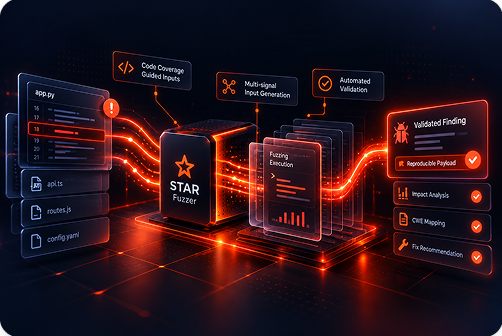
STAR Fuzzer is a self-contained mode of Bright STAR. It builds a small program around each security-critical function and mutates inputs across generations, guided by code coverage and a multi-signal fitness function.

Run the fuzzing workflow against supported code and harness environments without maintaining a live application or request-level scan loop.

Evidence developers can act on

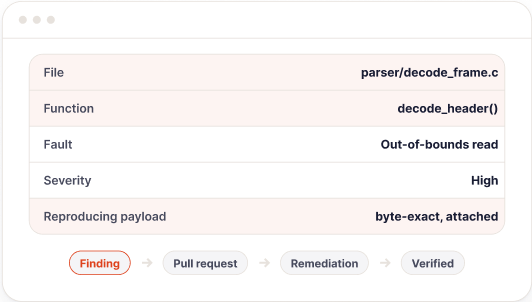
Every issue comes with the file, function, and payload to reproduce it.

Every reported issue includes the exact file and function that holds the bug, together with a byte-exact reproducing payload. Findings are delivered through the same pull-request and summary workflow as other STAR findings, so developers can investigate, fix, replay, and verify the result.

Slide 1 of 3 — Reach the bugs scanners miss

Trusted by security teams at companies like

The problem

DAST cannot reach every security-critical path

Dynamic application security testing is designed to test what an attacker can reach through an application's exposed surface: HTTP endpoints, parameters, authentication flows, and live request behavior.

That coverage is essential. But some of the most disruptive defects are deeper inside the code, past input validation and behind the request layer. These defects can lead to outages, denial of service, unstable services, or exploitable security conditions.

STAR Fuzzer hardens the inside-out attack surface. It complements dynamic scanning by testing security-critical functions directly, even when the target doesn't have a running web application, cloud scanner, or HTTP surface.

Type confusion

Unhandled exceptions

Out-of-memory conditions

Unbounded allocation

Algorithmic complexity blow-ups

Memory-safety bugs

Crashes and hangs caused by unexpected input combinations

What is STAR Fuzzer

A self-contained fuzzing mode inside Bright STAR

STAR Fuzzer identifies security-critical functions, generates a tailored fuzzing harness for each one, drives an evolutionary fuzzer against the harness, and security-triages every fault. The goal isn't to produce a pile of benign panics: it's to identify reachable, security-relevant defects and provide the evidence developers need to reproduce and fix them.

Where STAR Harness runs a live application and scans it with Bright's deterministic DAST engine, STAR Fuzzer points at the internal functions that process untrusted input, building a small program around each risky function and mutating its inputs across generations.

1

No running application required

STAR Fuzzer doesn't require an application to be started, a cloud scanner, authentication credentials, or an HTTP repeater. It runs against the code and generated harness in a self-contained workflow.

2

Evidence attached to every reported issue

Every reported issue includes the exact file and function that contains the bug, together with a byte-exact reproducing payload, delivered in the same pull request workflow as other STAR findings.

3

Structure-aware and language-agnostic

STAR Fuzzer is designed to work across C/C++, Rust, Go, Java/Kotlin, .NET, Node, and Python, mutating inputs with awareness of the target's structure rather than relying only on blind byte mutation.

Why it matters

Find the defects request-level scanners aren't shaped to trigger

0

App startup, DAST, or authentication required

Fuzzing runs fully self-contained against generated function harnesses.

~0×

Faster harness throughput in persistent mode

Persistent-mode harness execution is approximately 51× faster than process-per-input execution.

0

Fitness signals guide the search

A multi-signal fitness function guides the fuzzer beyond raw code coverage and past validation gates.

1

Reachable-only findings

Every fault is triaged for a real path from untrusted input to the crash or security-relevant condition. Benign robustness noise is filtered out.

2

Evidence built in

Each issue carries the offending file and function together with a byte-exact reproducing payload, so developers can reproduce, fix, and verify the result.

3

Self-contained execution

No application startup, cloud scanner, authentication flow, or request-level scan loop is required for the fuzzing workflow.

4

Internal attack-surface coverage

STAR Fuzzer reaches security-critical functions that sit behind input validation and beyond the HTTP surface tested by conventional DAST.

One STAR agent, two attack surfaces

Dynamic / Harness Mode versus Fuzzer Mode

Dynamic mode secures the application from the outside in. Fuzzer mode hardens the code from the inside out. They use the same STAR agent and produce the same pull-request and summary output — they're complementary, not alternatives.

DimensionDynamic / Harness ModeFuzzer Mode
Run modeRUN_MODE=full, dynamic, or functionRUN_MODE=fuzzing
What it testsLive applications over HTTP, real endpoints, parameters, and authentication flowsSecurity-critical functions reached past input validation, in isolation
EngineBright's deterministic DAST scanner through a RepeaterAn evolutionary fuzzer driving a per-function harness
What it findsInjection, SSRF, XSS, authorization flaws, SQLi, BOLA, and classic web vulnerabilitiesCrashes, hangs, out-of-memory conditions, memory-safety bugs, and algorithmic-complexity blow-ups
What it needsApplication startup, Repeater, authentication, endpoint registrationNo application startup, cloud scanner, Repeater, authentication, or scan loop
Proof of issueA reproduced exploit against the running application; rescan confirms the fixA byte-exact payload that crashes or triggers the function; replay confirms the fix
FallbackFunction-Harness mode can wrap critical functions when full startup failsFuzzer mode is standalone by design and provides a deeper path into those functions
Compare Bright DAST and STAR Fuzzer

The STAR Fuzzer cycle

From security-critical function to confirmed bug

STAR Fuzzer combines AI-assisted harness generation with coverage-guided, multi-signal fuzzing and security triage. The process is designed to move from a function that looks risky to a reproducible issue a developer can investigate and fix.

1

Identify

Find security-critical functions on an untrusted-input path.

2

Harness

An LLM writes a faithful, sanitizer-backed harness for each function.

3

Probe

Verify the harness truly reaches the target function before trusting its results.

4

Fuzz

Evolve inputs across generations to surface crashes, hangs, out-of-memory conditions, and other security-relevant behavior.

5

Triage & PR

Judge reachability and impact, then ship the evidence in a pull request and summary.

The advantage

Reach the code paths DAST cannot

1

Not just web-facing

Dynamic / Harness Mode needs an HTTP surface to scan. STAR Fuzzer doesn't, and can also cover non-web software such as IoT and embedded firmware, desktop applications, non-web services, raw binary protocols, and parsers.

2

Reaches what DAST cannot

STAR Fuzzer looks for bugs behind input validation, including type confusion, division-by-zero, invalid allocations, algorithmic-complexity blow-ups, and other outage-class defects a request-level scan may not prove.

3

Structure-aware, not blind bytes

The fuzzer mutates inputs with awareness of parser framing, checksums, lengths, and structure, so the search spends its budget on meaningful paths instead of being rejected at the validation gate.

4

Signal, not noise

Faults are security-triaged for reachability and impact, with a calibrated severity and rationale. The objective is genuine, exploitable risk, not a wall of benign panics.

5

Runs anywhere, including on-premises

The fuzzing workflow runs inside your environment. No application needs to stay running, no cloud scanner is required, and no credentials are needed for the self-contained fuzzing mode.

Built for developer action

Every finding arrives with the proof needed to fix it

A fuzzing result is only useful if a developer can reproduce and understand it. STAR Fuzzer findings include:

  • The affected file
  • The affected function
  • The reproducing payload
  • The observed fault or failure mode
  • Reachability and security-triage context
  • Severity and rationale
  • Pull-request and summary delivery through the STAR workflow

STAR Fuzzer turns an internal code-level failure into a developer-ready security finding instead of an opaque fuzzing log.

Find the function → Reproduce the fault → Fix the code → Replay the payload → Verify the result

See a Fuzzer Finding

STAR Fuzzer and the AI SDLC

Security for code that changes faster than review processes

AI-assisted development increases the speed and volume of software changes. It also increases the need for security testing that can move beyond surface-level pattern detection.

For security teams

Expand coverage beyond externally reachable endpoints and prioritize findings with reachability, impact, and reproduction evidence.

For developers

Receive the exact file, function, and payload needed to reproduce and fix the issue.

For engineering leaders

Run a self-contained workflow that can fit into the development lifecycle without requiring every target to operate as a continuously running web application.

Product integration

One STAR agent across the application and code attack surfaces

STAR Fuzzer is a self-contained mode of Bright STAR. It uses the same broader STAR workflow and produces the same pull-request and summary output as other STAR findings.

Dynamic / Harness Mode

Test the live application from the outside in.

Fuzzer Mode

Test security-critical functions from the inside out.

Bright STAR

Connect findings, remediation, and verification.

STAR Agent

Bring security actions into supported development workflows.

Proof and technical detail

Designed for reproducibility, triage, and verification

Harness generation

STAR Fuzzer generates a tailored harness around each security-critical function. The harness is designed to exercise the function faithfully and is checked before its results are trusted.

Evolutionary search

The fuzzer evolves inputs across generations, using code coverage and multiple fitness signals to guide exploration beyond simple validation gates.

Security triage

The system evaluates faults for reachability and impact, filtering benign robustness noise before it reaches the development backlog.

Reproducing payloads

Each reported issue includes a byte-exact payload that can be replayed to reproduce the fault and validate the fix.

Language support

STAR Fuzzer is language-agnostic across C/C++, Rust, Go, Java/Kotlin, .NET, Node, and Python.

Frequently Asked Questions

What is STAR Fuzzer?

STAR Fuzzer is a self-contained mode of Bright STAR that identifies security-critical functions, generates tailored fuzzing harnesses, drives an evolutionary fuzzer against them, and security-triages the results into evidence-backed findings.

How is STAR Fuzzer different from DAST?

DAST tests what an attacker can reach through HTTP and live request behavior. STAR Fuzzer tests security-critical functions past input validation, in isolation, and does not require a running application, cloud scanner, or authentication flow.

Does STAR Fuzzer require a running application?

No. STAR Fuzzer runs against the code and generated harness in a self-contained workflow. It does not need application startup, a Repeater, or request-level scanning.

What kinds of bugs can STAR Fuzzer find?

Crashes, hangs, out-of-memory conditions, memory-safety bugs, type confusion, unbounded allocation, and algorithmic-complexity blow-ups that request-level scans may not trigger.

Does STAR Fuzzer only work for web applications?

No. STAR Fuzzer can cover non-web software such as IoT and embedded firmware, desktop applications, non-web services, raw binary protocols, and parsers, where the relevant code, build, and harness conditions are supported.

Find the bugs scanners can't

See how STAR Fuzzer proves the fault and delivers evidence to your workflow.

Get a 30-minute walkthrough of the STAR Fuzzer workflow, including function discovery, harness generation, evolutionary fuzzing, triage, and pull-request evidence.

Consent

Related resources

More ways to secure the AI SDLC

Bright STAR

Secure AI-generated and human-written code with validated findings, remediation, and verified fixes.

Explore Bright STAR →

Bright AI Pentesting

Discover, exploit, and prove real vulnerabilities continuously across live applications and APIs.

Explore AI Pentesting →

Fuzzing and Runtime Validation Guide

Learn how function-level application fuzzing complements runtime vulnerability validation.

Read the Guide →

Certifications and recognition