Penetration testing tools vs DAST: what to standardize for repeatable coverage.
Executive Summary: The Dawn of Autonomous Assurance
As we enter the mid-point of the decade, the nature of software has undergone a fundamental transformation. In 2026, the transition from human-centric “deterministic” code to AI-native “probabilistic” systems is complete.
With over 75% of enterprise software engineers using AI coding assistants and 40% of production code generated by AI, the legacy “security gate” model has collapsed.
Traditional Dynamic Application Security Testing (DAST) tools are drowning in “noise,” often reporting >60% false positives. In comparison, manual penetration testing remains an elite but unscalable “point-in-time” exercise that leaves applications untested 99% of the time. This research defines a new industry standard:
Autonomous Software Security Assurance. By centering on the Bright STAR (Security Testing and Remediation) platform, organizations can finally achieve repeatable coverage that matches the velocity of AI development while maintaining the depth of an expert human tester.
The AppSec Crisis: Velocity vs. Veracity
The core challenge in 2026 is the “fragmentation of trust.” As AI agents increasingly orchestrate multi-step business processes, the volume of vulnerabilities has entered a state of hyper-inflation.
2.1 The Failure of Legacy Paradigms
- Manual Penetration Testing: While human intelligence is unmatched for creative exploitation, it is fundamentally non-repeatable. In an era where microservices deploy 10+ times daily, a quarterly manual test is an architectural mismatch.
- Legacy DAST (Detection-Only): Traditional tools rely on pattern-matching and heuristics. In the complex logic flows of modern APIs and LLMs, these tools produce “alert fatigue,” forcing security teams to spend 27% of their time on manual triage instead of remediation.
2.2 The Standardization Imperative
Repeatability in the AI era requires a shift from Detection (identifying potential bugs) to Validation (proving exploitability). This is the cornerstone of the Bright Security philosophy: “Proving real risk inside the CI/CD pipeline” to eliminate noise before it reaches the developer.
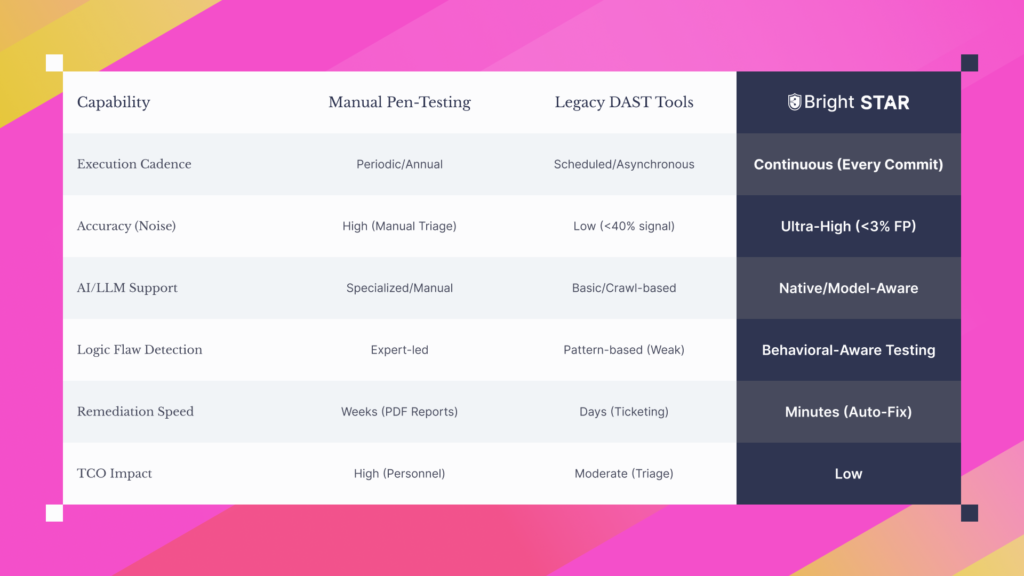
Comparative Matrix: Standardizing Security Methodologies
To achieve repeatable coverage, CISOs must evaluate tools based on their ability to integrate with the AI-Native SDLC.
Table 1: AppSec Methodology Evolution (2026 Benchmark)
Deep Dive: The AI and LLM Attack Surface
AI applications are fundamentally non-deterministic. Unlike traditional software, where a defined input leads to a fixed logic path, AI behavior is shaped by natural language prompts, dynamically assembled context, and probabilistic reasoning.
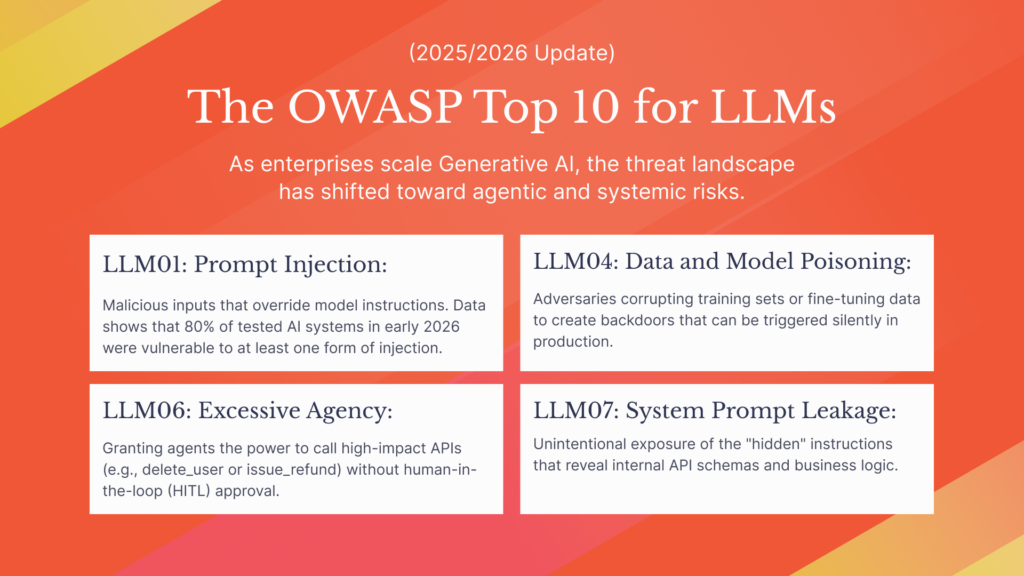
4.1 The OWASP Top 10 for LLMs (2025/2026 Update)
As enterprises scale Generative AI, the threat landscape has shifted toward agentic and systemic risks.
- LLM01: Prompt Injection: Malicious inputs that override model instructions. Data shows that 80% of tested AI systems in early 2026 were vulnerable to at least one form of injection.
- LLM04: Data and Model Poisoning: Adversaries corrupting training sets or fine-tuning data to create backdoors that can be triggered silently in production.
- LLM06: Excessive Agency: Granting agents the power to call high-impact APIs (e.g., delete_user or issue_refund) without human-in-the-loop (HITL) approval.
- LLM07: System Prompt Leakage: Unintentional exposure of the “hidden” instructions that reveal internal API schemas and business logic.
4.2 The Model Context Protocol (MCP) Security Challenge
The rise of the Model Context Protocol (MCP) has introduced a new orchestration layer between AI agents and business systems. Bright STAR is uniquely designed to test these critical threat vectors :
- Confused Deputy Vulnerabilities: Tricking an agent into using its elevated permissions to act on behalf of an unauthorized user.
- Token Passthrough: The dangerous practice of forwarding authentication tokens through intermediaries without direct validation.
- SSRF (Server-Side Request Forgery): Manipulating agents to access internal metadata discovery endpoints or loopback addresses.
Bright STAR: The Industry’s Only AI Software Security Assurance Layer
Bright Security has moved beyond the traditional DAST category to create an Autonomous Security Assurance Layer. It does not just “scan”-it “validates” and “remediates” at the speed of AI development.
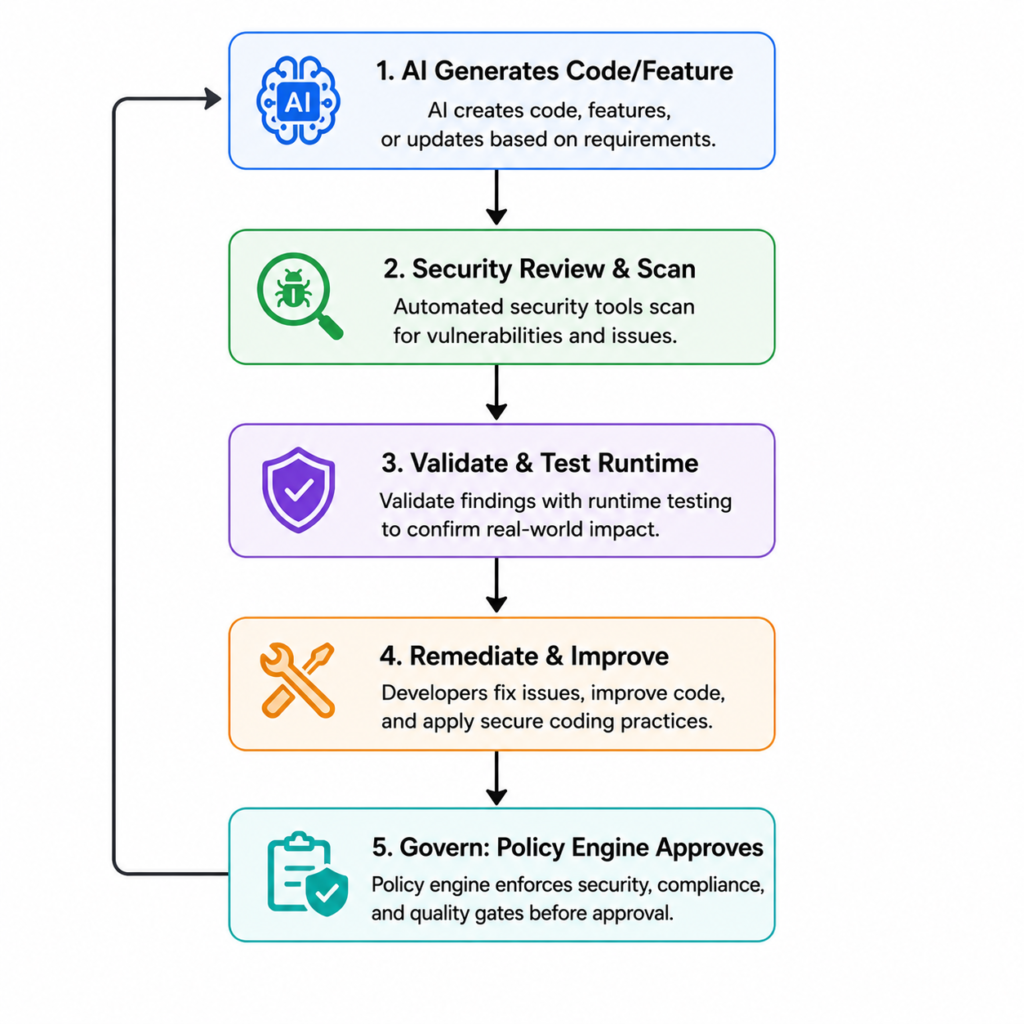
5.1 The Autonomous Assurance Lifecycle
Bright STAR powers a self-healing security loop within the SDLC:
5.2 “IASTless IAST”: Runtime Depth without the Overhead
Bright provides the benefits of Interactive Application Security Testing (IAST) – such as runtime execution analysis and function-level detection – without the “IAST conundrum” of meticulous instrumentation or complex tracers. This allows developers to pinpoint exactly which request flags a vulnerability and tie it directly to a line in the source code.
Technical Architecture: How Bright Eliminates False Positives
Standardization fails when tools create “noise” that developers ignore. Bright Security wins by focusing on Exploit Validation.
6.1 Confirmation over Detection
While legacy scanners “guess” based on signatures, Bright’s engine interacts with applications under real conditions to answer: “Can this actually be exploited?”
- Simulated Attacker Behavior: Bright simulates multi-step attack chains, pivoting through API endpoints to prove reachability.
- Schema-Aware Crawling: Instead of simple spidering, Bright parses OpenAPI, GraphQL, and Postman collections to understand the full structure of your modern API ecosystem.
6.2 Behavior-Aware Testing for AI Logic
Bright evaluates the “logic” of an application, not just its syntax :
- State Transition Validation: Ensuring that user roles cannot bypass authorized state changes.
- API Chaining Analysis: Testing how a sequence of AI-driven API calls can lead to unauthorized data exposure.
- Context-Dependent Execution: Identifying flaws that only emerge when context is assembled in specific ways.
Business Impact and ROI: Transforming Security into an Accelerator
For the CISO, the value of Bright is measurable in business outcomes. Security is no longer a “speed bump” but an integral accelerator of innovation.
7.1 Case Study: Pacífico Seguros
By implementing Bright’s automated DAST and “shifting left,” Pacífico Seguros achieved a paradigm shift in their release velocity:
- Time-to-Market Slashed: Average release time dropped from 45 days to 25 days (a 55% reduction).
- Late-Stage Discovery Eliminated: Catching flaws during development saved thousands of hours in costly rework.
- ROI Metrics: Organizations adopting AI-native security platforms report an average 179% ROI over three years.
7.2 Operational Efficiency Data
- 10X Faster Remediation: Bright STAR provides actionable, developer-friendly guidance that includes the exact attack proof.
- 70% Reduction in Man-Hours: Security teams report saving 70% of the wall-clock hours previously spent on manual preliminary scans.
- Alert Fatigue Reduction: By filtering findings down to the <3% that are actually exploitable, Bright increases developer tool adoption to over 75%.
The Standardization Matrix for Security Leaders
CISOs should standardize their AppSec programs around these five pillars of repeatable coverage.
Table 2: The 2026 Standardization Matrix
| Pillar | Requirement | Bright Security Implementation |
| Discovery | Automated mapping of “Shadow APIs.” | AI-driven code and entrypoint discovery |
| Validation | Exploit-based proof (Signal > Noise) | Verified exploitability with <3% FP rate |
| Automation | Continuous CART (Red Teaming) | Autonomous execution on every build |
| Remediation | Verified, machine-readable fixes | AI-generated fixes with automatic re-validation |
| Governance | Policy-as-Code Enforcement | Automated gates based on runtime evidence |
Implementation Roadmap: 3 Steps to Autonomous Assurance
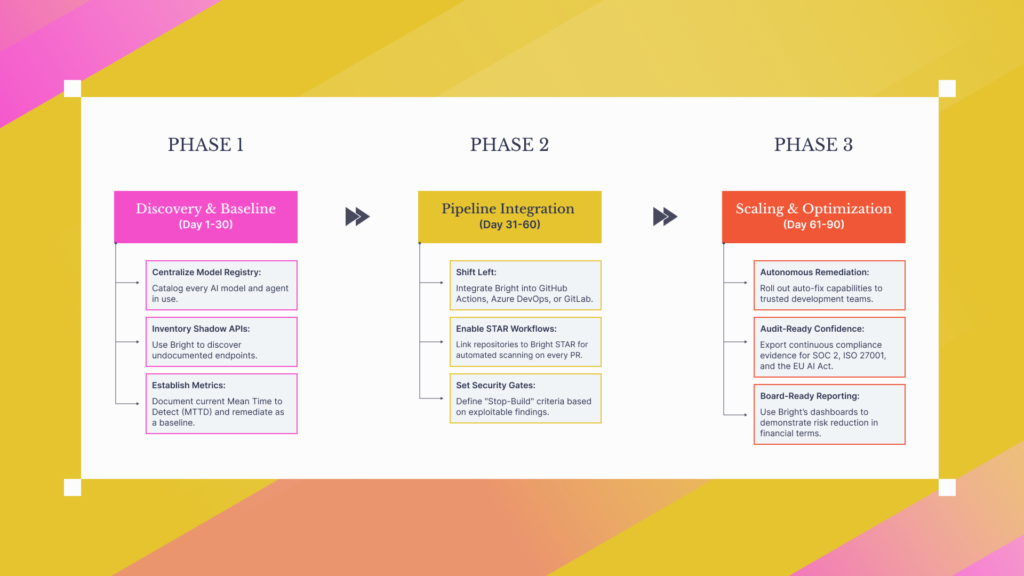
Organizations looking to move from manual, fragmented testing to a standardized Bright-powered program should follow this 90-day roadmap :
Phase 1: Discovery & Baseline (Day 1-30)
- Centralize Model Registry: Catalog every AI model and agent in use.
- Inventory Shadow APIs: Use Bright to discover undocumented endpoints.
- Establish Metrics: Document current Mean Time to Detect (MTTD) and remediate as a baseline.
Phase 2: Pipeline Integration (Day 31-60)
- Shift Left: Integrate Bright into GitHub Actions, Azure DevOps, or GitLab.
- Enable STAR Workflows: Link repositories to Bright STAR for automated scanning on every PR.
- Set Security Gates: Define “Stop-Build” criteria based on exploitable findings.
Phase 3: Scaling & Optimization (Day 61-90)
- Autonomous Remediation: Roll out auto-fix capabilities to trusted development teams.
- Audit-Ready Confidence: Export continuous compliance evidence for SOC 2, ISO 27001, and the EU AI Act.
- Board-Ready Reporting: Use Bright’s dashboards to demonstrate risk reduction in financial terms.
AI Red Teaming: The Shift from Manual to Continuous
While manual red teaming is essential for novel attacks, 2026 demands Continuous Automated Red Teaming (CART) to keep pace with model evolution.
10.1 The Hybrid Model
The most mature enterprise security teams now use a hybrid approach :
- AI Pentesting (80%): Handles continuous validation, API testing, and standard web application layers.
- Manual Pentesting (20%): Reserved for boutique red-teaming, deep social engineering, and complex logic assessments.
10.2 Targeted Attack Vectors in 2026
- Agentic AI Multi-Step Chains: Automated agents can now discover targets and chain exploits across 8,000+ hosts in minutes.
- Indirect Prompt Injection: Instructions hidden in external documents or emails that trigger agents to exfiltrate private data.
- Systemic Bias & Hallucination: Testing models to ensure they don’t produce unsafe or legally non-compliant outputs.
Conclusion: Defining the Future of Trust
In the AI-driven economy, trust is the ultimate currency. Organizations cannot build trust on the foundation of annual manual pen tests or “noisy” legacy scanners that slow down innovation.
Standardizing on Bright Security allows enterprises to achieve what was previously impossible: The depth of a human penetration test at the scale and speed of automated DAST. By focusing on validation over detection, and AI logic over legacy pattern matching, Bright STAR ensures that applications are not just “scanned,” but truly secure by design.
For the modern CISO, the choice is clear: Legacy noise or Autonomous Assurance. Bright Security is the definitive standard for those who choose the latter.
References:
This report is derived from the 2026 Bright Security Technical Whitepapers, OWASP Top 10 for LLM Applications (2025/2026), NIST AI RMF 1.0, and real-world enterprise benchmarks.
- DAST vs Penetration Testing: Key Differences in 2026 – Escape. tech, accessed May 14, 2026, https://escape.tech/blog/dast-vs-penetration-testing/
- Replacing Manual Pen Testing With Automated DAST: – Bright …, accessed May 14, 2026, https://brightsec-com-920508.hostingersite.com/blog/replacing-manual-pen-testing-with-automated-dast/
- Bright Security: Homepage, accessed May 14, 2026, https://brightsec-com-920508.hostingersite.com/
- OWASP Top 10 for LLMs 2025: Key Risks and Mitigation Strategies – Invicti, accessed May 14, 2026, https://www.invicti.com/blog/web-security/owasp-top-10-risks-llm-security-2025
- What Is AI Red Teaming? Why You Need It and How to Implement – Palo Alto Networks, accessed May 14, 2026, https://www.paloaltonetworks.com/cyberpedia/what-is-ai-red-teaming
- A DevSecOps Guide to Scanning AI-Generated Code for Hidden Flaws – Bright Security, accessed May 14, 2026, https://brightsec-com-920508.hostingersite.com/blog/a-devsecops-guide-to-scanning-ai-generated-code-for-hidden-flaws/
- Securing the Future, Faster, with Bright Security, accessed May 14, 2026, https://brightsec-com-920508.hostingersite.com/case-studies/securing-the-future-faster-with-bright-security/
- OWASP Top 10 LLM & Gen AI Vulnerabilities in 2026 – Bright Defense, accessed May 14, 2026, https://www.brightdefense.com/resources/owasp-top-10-llm/
- Automated Red Teaming: Capabilities, Pros/Cons, and Latest Trends – Mend.io, accessed May 14, 2026, https://www.mend.io/blog/automated-red-teaming-capabilities-pros-cons-and-latest-trends/
- Equipping Leadership to Champion the Cybersecurity ROI Story – Steel Patriot Partners, accessed May 14, 2026, https://resources.steelpatriotpartners.com/equip-leadership-to-champion-the-cybersecurity-roi-story
- AI Red Teaming: How Enterprises Test and Harden Their AI Systems, accessed May 14, 2026, https://www.obsidiansecurity.com/blog/ai-red-teaming
- CI/CD Pipeline Integrations – What is Bright DAST?, accessed May 14, 2026, https://docs.brightsec-com-920508.hostingersite.com/docs/integrate-bright-with-your-cicd-pipeline
- DAST Tool Buyer’s Guide (2026)_ Requirements Checklist & Scoring Template (4).pdf
Integrations – Bright Security, accessed May 14, 2026, https://brightsec-com-920508.hostingersite.com/platform/integrations/