The $4M Security Mistake That DevSecOps Fixes During Cybersecurity Awareness Month

You thought your AI-made apps were secure? Think again.

It’s Cybersecurity Awareness Month, Week 2.

Everyone’s talking about building security awareness into the development process.

But here’s the thing — security shouldn’t be limited to October.


Hackers don’t take breaks after Cybersecurity Awareness Month ends.

So keeping systems safe has to be a year-round habit.

Anyway, it’s trending right now, and it’s something worth talking about.

We tested an AI platform that built a full-stack forum app in just a few minutes.

When we looked closer, the results were surprising.

Let’s just say we found more vulnerabilities than most teams would ever feel okay with.

I’ve shared a LinkedIn post with the results — and we’ll be testing more AI platforms soon. Stay tuned.

Table of Contents

  1. Introduction – Why Cybersecurity Awareness Should Last All Year
  2. What DevSecOps Really Means for Development Teams
  3. How to Add DAST Scans into Your CI/CD Pipeline
  4. Building Teams That Care About Security
  5. Bright Security’s STAR – The Developer-Friendly DAST Tool
  6. Common DevSecOps Challenges and How to Solve Them
  7. Simple Visual Guide – DevSecOps Flow and Awareness Training
  8. Conclusion – Turning Awareness into Everyday Action

Introduction – Why Cybersecurity Awareness Should Last All Year

Every October, everyone starts talking about Cybersecurity Awareness Month.

People post tips, join webinars, and talk about passwords.

But hackers don’t wait for October.

Security problems can happen any day, any time.

That’s why cybersecurity awareness should never stop after one month.

Teams need to make it a habit — part of everyday work.

DevSecOps helps with that.

It builds security right into how teams code, test, and deploy.

What DevSecOps Really Means for Development Teams

DevSecOps is about teamwork.


Developers, ops, and security people all share the same goal — safe software.

In old systems, security came at the end.

Teams built apps, deployed them, and then security checked later.

By then, it was often too late.

Now, security starts from the first step.

It’s built into the workflow — not added later.

And with cybersecurity awareness training, developers learn to spot mistakes early.


It’s not about blaming anyone; it’s about learning together.

How to Add DAST Scans into Your CI/CD Pipeline

Let’s talk about something practical — DAST.

That means Dynamic Application Security Testing.

It finds real problems when your app is running.
Adding DAST into your CI/CD pipeline is easier than it sounds.

Here’s how:

  1. Run DAST scans in your staging builds.
  2. Make it automatic — scans start with every new code push.
  3. Send clear, short reports to developers.
  4. Fix and re-test in the same flow.

This way, you’re not waiting for issues to appear later.


You’re preventing them before they go live.

That’s what Cybersecurity Awareness Month is really about — taking action early.

Building Teams That Care About Security

Security doesn’t work if people don’t care.

Forget boring training slides.

Show real code examples.

Let developers see how a small bug can become a big problem.

Give them feedback.

Make cybersecurity awareness training part of every sprint, not just once a year.

When people understand why security matters, they naturally start caring.

That’s how you build a security-aware team.

Bright Security’s STAR – The Developer-Friendly DAST Tool

Let’s be honest — most security tools slow developers down.

They’re hard to use and give too many false alerts.

Bright Security’s STAR changes that.

It’s made for developers, not against them.

STAR runs inside your CI/CD pipeline.

It scans apps and APIs while developers code — fast and easy.

Here’s what makes it great:

  • Quick results — scans in minutes.
  • Smart detection — finds actual, significant problems.
  • Straight reporting — no fancy language. Simple words, clear writing are best when we create our reports.
  • Works early — feedback before deploys.

It is having that crafty teammate who quietly fixes things before the user really notices it.

That’s what cybersecurity awareness looks like in real life.

Common DevSecOps Challenges and How to Solve Them

DevSecOps isn’t always smooth.


Here are some typical problems — and ways to fix them.

Problem No. 1: “Security slows us down.”

→ Use automation. Resources like STAR make things more efficient and easier to find issues before they become big problems.

Problem No. 2: “It’s too complex.”

→ Start small. Add

Problem 3: “No one owns security.”

→ Make it everyone’s job. Awareness starts with teamwork.

Cybersecurity awareness is not about being perfect.

It’s about getting better every day.

Simple Visual Guide – DevSecOps Flow and Awareness Training

Keep it simple.

Security should be something that sort of follows your code, not get in the way of it.

Here’s the flow:

Code → Scan → Fix → Deploy → Repeat.

And for training:

Study → Practice → Review → Get Better.

Make good use of easy visuals and short guides.

Keep visibility on — on dashboards, boards, chits or team chats.

That’s how awareness becomes a daily habit.

Conclusion – Turning Awareness into Everyday Action

Cybersecurity Awareness Month reminds us to care about security.


But DevSecOps makes us practice every day.

When developers and ops and security work together, safety comes naturally.

So, when someone asks “When is cybersecurity most important?”
The answer is simple — always.

With tools like Bright Security’s STAR, teams stay safe, ship faster, and worry less.


Because real cybersecurity awareness doesn’t stop in October — it starts there and continues all year.

The Future of DAST: Strengths, Weaknesses, and Alternatives

Table of Contents 

What is DAST? (Dynamic Application Security Testing explained)

Strengths of DAST in Modern Security Testing

Weaknesses and limitations of DAST


Alternatives and Complements to DAST

Implementation best practices for DAST in DevSecOps

Conclusion

FAQs

Application security is a moving target. New frameworks, faster releases, and API-first designs change the attack surface every quarter. That is why teams still lean on DAST and broader dynamic application security testing to see how their software behaves under real attack conditions. Understanding where DAST shines, where it struggles, and how it fits with other approaches helps you ship faster without flying blind.

Recent breach patterns keep the pressure on runtime testing, not just code checks. Exploitation of known vulnerabilities continues to rival stolen credentials as a top entry point. API growth adds even more moving parts, so your testing needs to meet that reality.

What is DAST? (Dynamic Application Security Testing explained)

DAST is a black-box test that probes a running app or API from the outside. It sends crafted requests, follows links and flows, and flags risky behaviors. Think of it as a friendly attacker that never looks at your source.

Where it fits:

  • SAST scans code before runtime.
  • IAST instruments the app during tests to watch data flows.
  • RASP sits inside the app to block bad behavior at runtime.

A real development cycle example:

A product team opens a feature branch for a new checkout flow. SAST runs on every commit and catches a hardcoded token. A lightweight DAST smoke test runs on the ephemeral preview environment and finds an authentication redirect that leaks a session cookie under a rare edge case. IAST, attached to the integration tests, confirms the tainted flow. The developer fixes it, pushes, and the CI gates pass. Release proceeds with confidence.

DAST’s “outside-in” view is valuable because many serious weaknesses only emerge when the app runs with real inputs and state. Injection and XSS issues are classic examples.

Strengths of DAST in Modern Security Testing

DAST scanning remains a core part of automated security testing for a reason. Here is how it helps in practice.

  • Easy CI/CD integration. Trigger smoke scans on pull requests, deeper scans nightly, and full scans pre-release.
  • Finds runtime problems. Misconfigurations, broken sessions, and auth flows often only appear under load or with real cookies.
  • Vendor neutral. You can test third-party or legacy apps without source access.
  • Covers web apps and APIs. Modern tools crawl OpenAPI and GraphQL and exercise negative cases.
  • Reveals exploitability. Seeing an actual payload succeed clarifies risk for developers and product owners.

Quick view

StrengthExample vulnerability detectedWhy it matters
Finds runtime issuesSQL injection, cross-site scriptingThese are still among the most exploited vectors in real breaches.
Black-box approachAuthentication flaws, broken access controlTests the app the way attackers do, without code access.
Works without source3rd-party components, legacy appsLets security validate everything that touches production.
API-aware scanningSchema drift, mass assignment, permissive CORSMatches the API-first reality of modern systems.

For more on DAST’s mechanics, Bright’s primer is a helpful overview: What Is Dynamic Application Security Testing (DAST)? and Analyzing DAST Methods: Quick and Shallow vs In-Depth Scans.

Weaknesses and limitations of DAST

No tool is magic. Here are the tradeoffs you will encounter and how they play out day to day.

  • Limited code visibility. DAST flags the symptom, not the line number. Developers need context to fix quickly.
  • False positives and heavy scans. Poorly tuned scans waste CI minutes and developer attention.
  • Modern architecture coverage. Microservices, ephemeral envs, and event-driven flows are hard to crawl.
  • Business logic gaps. Subtle logic abuse often needs human-designed tests or IAST-style tracing.

Summary table

LimitationImpact in a real sprintMitigation
No source insight“Where do I fix this?” slows remediationPair with SAST and IAST. Add trace IDs to logs.
Noisy results if untunedDevs ignore alerts and disable checksStart with smoke tests. Calibrate and whitelist.
API and microservice sprawlMissed endpoints and shadow servicesFeed OpenAPI specs. Include contract tests.
Weak on logic flawsAbuse cases slip to productionAdd abuse stories to QA. Use IAST to trace flows.

Why this is normal: DAST was designed to emulate an external attacker. That lens is powerful, but it cannot replace other application security testing methods on its own.

Alternatives and Complements to DAST

  • SAST (Static Application Security Testing). Great for early feedback on code patterns and secrets. Links issues to files and lines.
  • IAST (Interactive Application Security Testing). Instruments the app during tests and traces the vulnerable path. Ideal for cutting false positives.
  • RASP (Runtime Application Self-Protection). Monitors and blocks at runtime. Useful when patch cycles lag.

Why layered testing matters

No single technique sees everything. Combine prevention in code with runtime validation and continuous monitoring. Helpful deep dives from Bright:

The next chapter for DAST: trends and predictions

What is shaping DAST

  • Cloud-native and containers. Scanners must handle short-lived preview environments and service meshes.
  • API-first development. Schema-driven scanning and negative testing become table stakes as APIs multiply.
  • AI-driven automation. Vendors apply AI to generate smarter payloads, deduplicate noise, and explain fixes.
  • Continuous monitoring. Teams shift from big quarterly scans to fast, gated smoke tests on every commit.

Our prediction

DAST will not disappear. It will become more focused: quicker smoke tests in CI, deeper targeted runs pre-release, and API-first coverage fed by your specs. DAST will sit alongside SAST and IAST, with RASP acting as a runtime safety net.

Attackers keep testing your running software. You should too.

Implementation best practices for DAST in DevSecOps

  1. Start with clear goals. Pick must-cover apps and APIs. Define smoke versus deep scans.
  2. Automate in CI/CD.
    • Pull requests: 5 to 10 minute smoke tests against ephemeral envs.
    • Nightly: broader authenticated scans.
    • Pre-release: full regression scan against a prod-like stage.
  3. Feed your scanner. Provide OpenAPI or GraphQL schemas, test creds, and known routes. Include edge-case payloads from past incidents.
  4. Tune to reduce noise. Calibrate timeouts, rate limits, and auth flows. Track a “mean-time-to-first-true-positive” metric to guard against alert fatigue.
  5. Pair with SAST and IAST. Use SAST for code-localized fixes and IAST to trace vulnerable paths. Route findings to the same backlog with dedupe rules.
  6. Educate devs. Run short clinics on interpreting DAST results. Show examples from your systems, not generic slides.
  7. Measure what matters. Trend exploitability, not just count. Did the proof of concept actually work? How long until fixed?

For hands-on tactics, see Bright’s What Is Dynamic Application Security Testing (DAST)? and Analyzing DAST Methods: Quick and Shallow vs In-Depth Scans.

Conclusion

DAST gives you an attacker’s eye view. That is its superpower. It finds runtime issues that code-only tools miss, and it helps non-security stakeholders grasp risk.

It also has limits. DAST does not see your code, can be noisy if untuned, and needs help with logic flaws. The answer is not to pick sides. It is to combine approaches and automate the boring parts.

The future is an integrated testing strategy: fast DAST smoke tests every commit, SAST and IAST for depth, and RASP to protect production. There is no one-size-fits-all. Build the mix that matches your stack and speed.

FAQs

How often should you run a DAST scan?
Run smoke tests on every pull request or merge. Run broader scans nightly and full scans before release. Keep them fast enough that developers trust them.

Can DAST test APIs and microservices?
Yes. Modern tools ingest OpenAPI or GraphQL and can authenticate across services. Coverage depends on good specs and pre-auth flows.

Is DAST suitable for small businesses?
Yes. Start small with a few key routes and auth flows. Use CI smoke tests to limit cost and time.

What is the difference between automated DAST and manual penetration testing?
Automated DAST scales and catches common classes fast. Manual testing explores creative logic flaws and chained exploits. Use both for important systems.

Do DAST tools slow down applications during testing?
Scans generate traffic, so rate limit and point them at non-production or isolated staging when possible. Use smoke scans with conservative settings in CI.

How Bright Helps You Achieve NIS2 and EU AI Act Compliance with Built-In Security

At Bright, we don’t just build application security tools – we live security. As Bright’s CISO, I understand the weight of regulatory frameworks like the NIS2 Directive and the EU AI Act, because we operate under the same scrutiny and expectations we help our customers address. We built Bright to help security leaders and AppSec teams integrate compliance naturally into their workflows, not bolt it on as an afterthought.

Regulatory change in the EU is coming fast, and it’s reshaping how organizations think about risk. NIS2 significantly broadens the definition of “essential entities,” placing critical focus on continuous risk monitoring, rapid incident reporting, and supplier oversight. The EU AI Act goes a step further into uncharted territory – requiring provable technical robustness, secure data handling, and the ability to monitor AI systems long after deployment. These frameworks aren’t just legal hurdles; they reflect a shift toward real operational accountability. And while the stakes are high, they also present a clear opportunity to align better security with smarter compliance.

Table of Content

  1. Meeting NIS2 Requirements with Bright DAST
  2. Audit Readiness Built Into the Process
  3. Rapid Incident Response for the 72-Hour Mandate
  4. Securing the Supply Chain
  5. Addressing EU AI Act Requirements
  6. Standards-Based Compliance for AI Security
  7. Removing the Ambiguity from Compliance
  8. More Than the Minimum: Raising the Bar

Meeting NIS2 Requirements with Bright DAST

Let’s start with NIS2. It’s no longer enough to scan your apps once a year and call it risk management. The directive expects ongoing identification and remediation of vulnerabilities across your systems. Bright DAST enables continuous scanning of your web applications and APIs, including authenticated and logic-based testing that covers the OWASP Top 10 and beyond. Our platform doesn’t just flag issues; it correlates them to risk severity, suggests fix paths, and integrates directly into your CI/CD pipeline, issue trackers like Jira, and collaboration tools like Slack. This enables organizations to enforce security checks on every build or push, making vulnerability remediation part of the development cycle – not a post-deployment surprise.

Audit Readiness Built Into the Process

Audit readiness is baked into the process. Every scan run in Bright is logged, every issue is tracked with metadata, and every fix is verified. When regulators or auditors ask how you’ve fulfilled the directive’s Article 21 requirements, Bright gives you a defensible audit trail showing exactly how vulnerabilities were identified, triaged, and resolved. No more scrambling to stitch together reports from disconnected tools.

Rapid Incident Response for the 72-Hour Mandate

Incident response timelines – especially the 72-hour reporting mandate in NIS2 – require fast, reliable detection. Bright integrates with SIEM platforms and supports webhook and API-based automation so your existing detection and response infrastructure can respond immediately to scan results. Because our scan data includes contextual metadata – like attack surface characteristics – it reduces ambiguity when compiling regulatory disclosures. You’re not just compliant; you’re ready with the right information, in the right format, when time is tight.

Securing the Supply Chain

Supply chain security, one of NIS2’s most challenging mandates, is a native part of our workflow. Bright supports SBOM-style visibility through detailed scans of open-source dependencies, third-party integrations, and microservice components – highlighting known vulnerabilities or unsafe configurations. And if you or your vendor runs Bright, authorized scans of internal and external ecosystems provide rich reports detailing what’s wrong and how to fix it. Our scan reports include remediation guidance and exploit evidence to accelerate prioritization. These insights support vendor risk assessments and due diligence without the guesswork or overhead of traditional questionnaires, helping ensure you’re not inheriting someone else’s risk.

Addressing EU AI Act Requirements

The AI Act introduces a new level of scrutiny for how AI systems are secured – and Bright is one of the few DAST platforms that meets it head-on. We’ve built capabilities that specifically target threats to AI models and interfaces, including prompt injection, and insecure output handling. Our attack simulation engine can be used against LLM endpoints, REST and GraphQL APIs, and other AI-exposed interfaces to identify vulnerabilities that could affect decision logic, user trust, or downstream compliance. Combined with role-based authentication testing and output validation, Bright enables you to test AI behavior not just for functionality, but for safety and resilience.

Standards-Based Compliance for AI Security

Our work aligns with the OWASP Top 10 for LLMs and ENISA’s AI cybersecurity guidelines – giving you a standards-based foundation for compliance. With Bright, organizations can simulate real-world adversarial scenarios and document how their AI systems handle them. That supports Articles 9 and 15 of the AI Act, which require that risk mitigation and technical robustness are proven – not assumed. And our platform supports continuous validation post-deployment, helping you catch performance drift or degraded security before it turns into regulatory trouble.

Removing the Ambiguity from Compliance

What we hear from CISOs, time and again, is that the laws themselves aren’t the hard part – it’s the ambiguity of how to satisfy them. Bright DAST was built to remove that ambiguity. We translate regulatory mandates into daily security activity. We don’t ask you to slow down or bolt on compliance – we let you embed it directly into how your security program already works.

More Than the Minimum: Raising the Bar

And that’s the bottom line. At Bright, our goal isn’t to give you more dashboards or another pile of alerts. Our job is to help you move faster, stay ahead of threats, and walk into every audit knowing you’ve done more than the minimum – you’ve built something secure, resilient, and compliant by design. Whether you’re preparing for NIS2, the AI Act, or both, Bright DAST is here not just to help you meet the bar – but to raise it.

Top 5 LLM AppSec Risks (and How to Test for Them)

Large-language-model–powered applications went from hack-day demos to billable features in record time. E-commerce chatbots write refund policies, help-desk copilots triage tickets, and data-analysis agents turn CSVs into slide decks—often shipping to production after only lightweight QA. Traditional test suites were never built for systems that can be talked into misbehaving, and the gap shows. Below are the five failure modes teams encounter most often, along with practical ways to probe for each one before customers (or criminals) do.

Table of Content

  1. Prompt Injection.
  2. Data Leakage.
  3. Insecure Plugin Use.
  4. Business-Logic Abuse.
  5. Over-trusting the Model.
  6. Putting It All Together

1 — Prompt Injection.
Every user message nudges the model’s latent brain; a cleverly crafted prompt can nudge it right past your guard-rails. Security researcher Johann Rehberger demonstrated earlier this year that a single hidden HTML tag could trick ChatGPT’s browser assistant into exfiltrating data and visiting attacker-controlled links, echoing similar findings by The Guardian’s red-team tests. Testing looks less like SQLi payloads and more like social engineering: seed the system with adversarial instructions (“Ignore all previous directions…”) and validate that the response is stripped, blocked, or sandboxed. OWASP’s LLM01:2025 guidance recommends contextual filters around both system and user prompts plus continuous red-teaming to keep up with jailbreak variants.

2 — Data Leakage.
LLMs happily echo back whatever sits in context, including personal data or corporate secrets. A June-2025 review in Data Privacy & AI warned that model-driven agents can leak sensitive fields even when fine-tuned on anonymised corpora, because prompts at runtime re-introduce live secrets. The OWASP Gen-AI project now lists “Sensitive Information Disclosure” as its second-highest risk category. Validation means exercising the app with redacted and watermark-tagged inputs, then diffing responses for unintended echoes; Bright’s CI-native scanner automates this by flagging high-entropy substrings or regex-matched PII in model output during unit tests, long before staging.

3 — Insecure Plugin Use.
Plugins and function calls super-charge LLMs—think “/create-invoice” or “/run-SQL”—but each new capability is an unvetted API surface. Researchers from Zhejiang University catalogued attacks that swap a benign weather plugin for a malicious dopplegänger and silently rewrite the model’s answers or harvest tokens. OWASP flags the pattern under “Insecure Plugin Design”. Safe integration starts with SBOM-style inventories, allow-lists, and contract tests that mock every plugin response for edge-case fuzzing. Bright’s modern DAST engine treats plugin routes as first-class entry points, scanning them alongside the conversational layer so coverage stays complete even as the ecosystem evolves.

4 — Business-Logic Abuse.
Unlike classic input validation bugs, LLM exploits often twist intent: a customer-support bot that was supposed to cap refunds at £50 quietly authorises £5 000 when the request is phrased empathetically. OWASP’s new Business Logic Abuse Top-10 details dozens of real-world scenarios where flows crumble under persuasive prose, while the BLADE framework shows how attackers chain these lapses to bypass entire mitigation layers. Simulation is key: write user stories that probe limits (“If my toddler broke the laptop, could you replace it?”) and assert policy outcomes. Canary values and state-aware test harnesses help catch over-generous logic before it hits production.

5 — Over-trusting the Model.
Hallucinations are punch-lines until they’re SQL commands or compliance statements your backend executes. The PROMPTFUZZ project applies coverage-guided fuzzing to LLM prompts, mutating seeds until the model contradicts itself or fabricates citations. Teams can replicate the idea locally: feed adversarial prompts, compare outputs to a ground truth, and fail the build when confidence scores dip below an acceptable threshold. Bright pipelines support custom “assert” hooks so these adversarial tests run automatically alongside regression suites, catching trust-boundary spills early.

Putting It All Together

Prompt manipulation, sensitive-data echoes, rogue plugins, logic gymnastics, and blind faith in AI—all five risks trace back to one theme: models do exactly what we ask, not what we intend. Traditional scanners that only grep for XSS can’t see that intent layer, which is why teams are layering dialog-aware testing into CI/CD. Bright’s LLM extensions emerged from that gap: lightweight YAML to describe conversation flows, fuzzers that mutate prompts, and a results view developers actually read.

When the next feature spec says “just bolt a GPT-4 call onto it,” remember the five fault lines above. Exercise them with the same rigor you give SQL injection or deserialisations bugs, and do it early—before the marketing launch, before production telemetry, ideally before code review. The faster you find the cracks, the less likely your shiny new chatbot becomes tomorrow’s breach headline.

API Security Mistakes You Didn’t Know You Were Making (and How to Fix Them)

Table of Content

  1. Introduction
  2. Why APIs Are an Attractive Attack Vector
  3. Common API Security Mistakes Developers Overlook
  4. Real‑World Lesson: Shifting Left in Practice
  5. Best Practices & Proactive Testing
  6. Quick‑Reference Checklist Before Shipping a New Endpoint
  7. Bright: Your Fast‑Path to API Security Confidence

Introduction

Application Programming Interfaces (APIs) are the nerve‑endings of modern software—every mobile tap and micro‑service call ultimately flows through an endpoint. Their strategic importance makes them an irresistible target. Bright research underscores that APIs sit at the center of the most dangerous vulnerabilities highlighted in the OWASP API Top 10 (localhost/brightsecurdev/).

Why APIs Are an Attractive Attack Vector

  • Business logic exposure: APIs often surface direct access to data and privileged operations.
  • Rapid churn: Fast feature releases can outpace traditional security reviews.
  • Complex authentication flows: OAuth, OIDC, and custom tokens multiply the chance of misconfiguration.

Common API Security Mistakes Developers Overlook

1. Skipping Robust Input Validation

Failing to validate and sanitize parameters leaves APIs open to injection, deserialization, and XML/JSON parsing attacks. Bright stresses that strict server‑side validation is the first—and sometimes only—barrier against malformed or malicious payloads (localhost/brightsecurdev/).

2. Broken Authentication & Over‑Permissive Access

Excessive token scopes or poorly configured sessions hand adversaries a skeleton key. Bright’s breakdown of broken authentication shows how weak session management can grant unauthorized access to every downstream service (localhost/brightsecurdev/).

3. Missing or Inconsistent Rate Limiting

Without per‑user or per‑IP throttling, attackers can launch credential‑stuffing or resource‑exhaustion attacks. Bright recommends implementing adaptive rate limiting at the gateway and validating limits with automated scans (localhost/brightsecurdev/).

4. Data Leakage in Responses & Errors

Verbose error messages, stack traces, and over‑broad GraphQL resolvers routinely spill sensitive objects. Bright’s API best‑practice guides advise masking PII and limiting response fields to the minimum required (localhost/brightsecurdev/).

5. Misconfiguration & Shadow APIs

Default configurations, forgotten test endpoints, and undocumented “zombie” versions expand the attack surface. Asset mismanagement and security misconfiguration both rank in the OWASP API Top 10 lists maintained by Bright (localhost/brightsecurdev/).

6. Insufficient Logging & Monitoring

If you can’t see attacks, you can’t stop them. Bright outlines the importance of standardized log formats and full‑lifecycle monitoring to detect anomalies early (localhost/brightsecurdev/).

Real‑World Lesson: Shifting Left in Practice

A Fortune‑500 software vendor embedded Bright’s DAST scans in unit‑test workflows and caught critical API flaws weeks before release—saving costly hotfix cycles and a potential breach (go.brightsecurdev.wpenginepowered.com).

Best Practices & Proactive Testing

GoalBright‑Powered Action
Shift security leftTrigger Bright scans on every pull request or build pipeline stage to surface issues immediately
Automate CI/CD checksUse Bright’s scan templates for OWASP API Top 10 or PCI DSS to fail builds that introduce new risks
Validate schemas & keep inventoryBright’s Schema Editor flags erroneous or undocumented endpoints, ensuring the whole surface is tested
Test authentication pathsPre‑scan authentication objects and flows in Bright to confirm protected resources are actually scanned

Quick‑Reference Checklist Before Shipping a New Endpoint

  1. Server‑side input validation passes?
  2. Token scopes least‑privilege and short‑lived?
  3. Rate limits enabled and verified by Bright tests?
  4. Responses scrubbed of PII and stack traces?
  5. Endpoint documented and included in your schema inventory?
  6. Monitoring & alerting rules in place?

Bright: Your Fast‑Path to API Security Confidence

Bright’s developer‑first DAST platform delivers attacker‑level testing at the speed of CI/CD. With near‑zero false positives, smart auto‑fix guidance, and deep API‑schema awareness, Bright helps teams catch and remediate vulnerabilities long before production (docs.brightsecurdev.wpenginepowered.com).

Ready to see your APIs through an attacker’s eyes? Book a demo today and turn the API security mistakes above into a competitive advantage.

Beware of AI tools that claim to fix security vulnerabilities but fall woefully short!

Where others claim to auto-fix, Bright auto-validates!

TL:DR

There is a big difference between auto-fixing and auto-validating a fix suggestion, the first gives a false sense of security while the second provides a real validated and secured response.

In this post we will discuss the difference between simply asking the AI (LLM) to provide a fix, and having the ability to ensure the fix fully fixes the problem.

The Problem: LLM and AI can only read and respond to text, they have no ability to validate and check the responses they give, this becomes an even more critical issue when combined with a static detection approach of SAST solutions in which from the beginning the finding can’t be validated, and the fix for the guestimated issue cannot be validated either.

Example 1 – SQL Injection:

Given the following vulnerable code:

We can easily identify an SQL injection in the “value” field and so does the AI:

The problem here is that even though the AI fixed the injection via “value”, the “key” which is also user controlled is still vulnerable.

Enabling to attack it as: “{ “1=1 — “: “x” }” which will construct the SQL Query as: 

Allowing an injection vector.

This means that by blindly following the AI and applying its fix, the target is still vulnerable.

The issue with the Static approach we discussed above is that as far as the SAST and AI solutions perspective the problem is now fixed. 

Using a Dynamic approach will by default rerun a test against this end point and will identify that there is still an issue with the key names and that an SQL Injection is still there.

After this vulnerability is detected, the dynamic solution then notifies the AI know that there is still an issue: 

This response and the following suggested fix highlights again why its paramount to not blindly trust the AI responses without having the ability to validate them and re-engage the AI to iterate over the response. Bright STAR does this automatically.

Just to hammer in the point, even different models will still make that mistake, here is CoPilot using the claude sonnet 4 premium model:

As can be seen in the picture, it makes the exact same error.

And here is the same using GTP4.1:

Where we can see it makes the same mistake as well.

Example 2 – OS Injection: 

Given the code:

There are actually two OSI vectors here, the –flags and the flags’ values.

Both can be used in order to attack the logic.

Giving this code to the LLM we can see: 

The fix only addresses the –flags, but neglects to validate and sanitize the actual values. 

When confronted with this the AI says: 

Again, we can see that only accepting the first patch or fix suggestion by the AI without validation or interaction leaves the application vulnerable due to partial fixes.

To conclude, without full dynamic validation the fixes in many cases will leave applications and APIs vulnerable and organizations at risk due to AI’s shortcomings. In many cases security issues are not obvious or may have multiple vectors and possible payloads in which case the AI will usually fix the first issue it detects and neglects to remediate other potential vulnerabilities.

How to Write Secure AI-Generated Code

Generative AI has quickly become a staple in modern software development. Developers are using tools like GitHub Copilot and ChatGPT to build features, generate tests, and accelerate development timelines. But speed comes with a trade-off. AI may be able to write functional code, but it doesn’t understand context or intent, and it certainly doesn’t understand security.

If you’re relying on AI to help write your code, here’s the reality: unless you’re guiding it intentionally and reviewing its output thoroughly, it will likely introduce risks. That’s because AI models generate what looks statistically correct – not necessarily what’s secure or maintainable.

This article explores how to use AI coding tools without compromising your application’s security posture.

Table of Content

  1. The Hidden Risks of AI-Created Code
  2. Write Secure Prompts, Not Just Code
  3. Never Skip Review, Even for “Simple” Code
  4. Validate Everything Because AI Often Doesn’t
  5. Be Careful with Dependencies
  6. Watch for Secrets and Unsafe Defaults
  7. Educate Your Team on AI Usage
  8. Final Thoughts

The Hidden Risks of AI-Created Code

AI models are trained on massive datasets, including public repositories and community Q&A forums. While that’s a rich source of examples, it also means AI often reproduces insecure practices that it’s seen before: outdated cryptographic functions, SQL queries without parameterization, or web handlers with no input validation.

In practice, that means developers can end up shipping vulnerable code that “works” – at least until attackers find the gap. These risks aren’t hypothetical. Researchers have already shown how large language models can generate code that’s exploitable, even when prompted with common use cases.

Write Secure Prompts, Not Just Code

The quality and safety of AI-generated code often comes down to how you ask for it. Vague prompts tend to produce code that’s generic and potentially insecure. For example, asking for a “login API in Node.js” may return something that stores plain-text passwords or relies on insecure query building.

Instead, you should explicitly ask the AI to use secure components: request password hashing with bcrypt, parameterized queries, and structured validation libraries. The more security expectations you include in the prompt, the more likely the output will reflect them. It’s also worth stating what to avoid – functions like eval, for example, or insecure serialization patterns.

In a team setting, it helps to standardize secure prompt templates so that developers are nudged toward best practices from the start.

Never Skip Review, Even for “Simple” Code

Treat AI-generated code the same way you’d treat code from a junior developer: don’t assume it’s right just because it compiles. Manual review is critical, especially when the code touches authentication, authorization, data access, or any user-facing component.

In addition to code review, apply static analysis and linters with security rules enabled. Tools like SonarQube, Bandit, and ESLint (with security plugins) can catch many of the obvious missteps that AI might introduce. It’s not just about correctness – it’s about risk reduction.

Security testing doesn’t end with static tools. Feeding AI-generated code into your SAST or DAST workflows helps detect deeper issues. If your organization has a security champion or AppSec team, have them weigh in on any AI-heavy codebase contributions.

Validate Everything Because AI Often Doesn’t

Input validation is one of the most frequently overlooked areas in AI-generated code. The code might look correct at a glance, but unless you’ve explicitly asked for it, there’s a good chance it won’t properly validate inputs or escape output.

Always double-check how inputs are handled, whether they come from HTTP requests, command-line arguments, or third-party APIs. Ensure your AI-generated code uses frameworks that support robust validation and sanitization.

And don’t just stop at validation. Think about encoding, escaping, and safe defaults. AI might not have the full picture of the attack surface you’re dealing with, so it’s your responsibility to review the code with adversarial thinking in mind.

Be Careful with Dependencies

AI doesn’t vet packages. It often recommends libraries that are outdated, unmaintained, or even potentially malicious. That means developers need to take extra care when accepting package suggestions from generative tools.

Always review the libraries that AI suggests. Check their last update date, look for known vulnerabilities (via tools like npm audit or pip-audit), and avoid packages with low community adoption or suspicious commit histories. Even legitimate libraries can introduce risk if they’re misconfigured or misused.

To keep things safe over time, make sure to pin dependency versions and use automation tools like Dependabot to track updates and patch known issues.

Watch for Secrets and Unsafe Defaults

It’s not uncommon for AI to include example API keys, JWT secrets, or hardcoded passwords in generated code. These are meant as placeholders, but if copied carelessly, they can easily make it into production environments.

You should never store secrets directly in code – AI-generated or otherwise. Use environment variables or a secret management system to keep sensitive data out of version control. It’s also good practice to add common secret file types (like .env, .pem, or .crt) to .gitignore by default in all generated scaffolds.

Educate Your Team on AI Usage

One of the biggest risks with AI-generated code isn’t the model, it’s how humans use it. Developers might assume that code output by AI is trustworthy because it appears polished or comes with documentation. That’s dangerous.

Every team using AI tools should invest in internal guidance for safe usage. Clarify where AI tools are useful (like writing boilerplate or generating test cases) and where they require stricter oversight (like anything touching security, business logic, or data handling). Set clear expectations for review, testing, and validation.

Don’t just train the AI to write better prompts – train your team to think critically about AI’s limitations.

Final Thoughts

Generative AI is a powerful tool, but like all tools, it needs to be used responsibly. Writing secure code with AI isn’t about banning the technology, but rather about layering guardrails around it. From prompt design to post-generation review, developers and security teams must work together to ensure AI accelerates development without increasing risk.

The key takeaway: AI can help you write code faster, but it’s still your job to make sure that code is safe.

JUnit Testing: The Basics and a Quick Tutorial

What Is JUnit Testing in Java Programming? 

When you’re creating a Java application, you want to make sure it’s functioning as expected. This is where JUnit testing comes in. JUnit is a unit testing framework for the Java programming language. It plays a crucial role in test-driven development (TDD), where you write unit tests before writing the actual code. This ensures that your code is working correctly from the very beginning.

JUnit is an instance of the xUnit architecture for unit testing frameworks. It provides assertions to identify test methods, test-cases, setup methods, and so on. Note that JUnit is not built into the Java language, but it’s widely used by Java developers to perform unit testing.

In this article:

Importance of JUnit Testing 

Ensuring Code Quality

JUnit plays a vital role in maintaining the quality of your code. Through JUnit testing, you can ensure that the logic of individual pieces of your software, known as units, are sound and working as expected. This can help you catch and correct bugs early in the development process, saving you time and ensuring a higher quality product.

Moreover, JUnit tests allow you to ensure that your code remains correct in the long run. As you change and refactor your code, you can run JUnit tests to make sure that you haven’t inadvertently introduced any new bugs. This makes maintaining your code easier and safer.

Learn more in our detailed guide to cypress testing.

Facilitating CI/CD

JUnit testing is also essential for facilitating continuous integration and continuous delivery (CI/CD). In a CI/CD pipeline, code is integrated, tested, and deployed frequently. JUnit tests can be automatically run every time code is integrated, ensuring that new changes don’t break the application.

Enhanced Collaboration

JUnit testing can also enhance collaboration within your development team. Since JUnit tests are code, they can be shared and updated by all members of your team. This means that everyone can contribute to maintaining the quality of the application, not just a dedicated testing team.

Furthermore, JUnit tests serve as a form of documentation. By reading the tests, developers can understand what a piece of code is supposed to do and how it’s expected to behave. This can make onboarding new team members easier and improve communication within the team.

Core Features of JUnit 5 

Annotations

JUnit 5 introduces a number of new annotations that simplify writing tests. For instance, @BeforeEach and @AfterEach annotations allow you to specify methods that should be run before and after each test. This can be useful for setting up or cleaning up resources that are used in your tests.

Assertions

Assertions are a key aspect of any testing framework, and JUnit 5 is no exception. Assertions let you verify that the application’s actual output matches the expected output. In JUnit 5, assertions are more powerful and flexible. For instance, you can use the assertAll method to group multiple assertions. If one assertion fails, the remaining ones will still be executed.

Test Runners

Test runners are another core feature of JUnit 5. A test runner is a tool that executes your tests and reports the results. In JUnit 5, the runner has been redesigned to be more flexible and powerful. For instance, you can use the @RunWith annotation to specify a custom runner.

Parameterized Tests

Parameterized tests are a powerful feature that allow you to run a test multiple times with different inputs. This can be especially useful when you want to test a method or function that should work with a range of input values. In JUnit 5, parameterized tests are easier to write and more flexible.

Exception Handling

In JUnit 5, exception handling has been improved. You can use the assertThrows method to assert that a specific exception is thrown. This makes testing methods that should throw exceptions easier and clearer.

Extensions

JUnit 5 introduces a new model that makes it easier to extend the framework. Extensions can be used to add behavior to tests, such as setting up resources, handling exceptions, or even altering how tests are executed. This makes JUnit 5 a more flexible and powerful testing framework.

Related content: Read our guide to mocha testing.

Getting Started with JUnit Framework 

This tutorial will provide a step-by-step guide, complete with code examples, to help you get started with JUnit.

Step 1: Installing JUnit

The first thing you need to do is install JUnit. You can download JUnit as a .jar file from the official website, or you can use a build tool like Maven or Gradle to manage your dependencies. For Maven, you’ll need to include the following dependency in your project’s pom.xml file:

<dependency>
    <groupId>junit</groupId>
    <artifactId>junit</artifactId>
    <version>4.12</version>
    <scope>test</scope>
</dependency>

If you’re using Gradle, include this in your build.gradle file:

dependencies {
    testImplementation 'junit:junit:4.12'
}

Basic Structure of a JUnit Test

Once you’ve installed JUnit, it’s time to start writing your tests. At the most basic level, a JUnit test is a Java class with one or more test methods. Each test method is annotated with @Test and contains the code to test a particular unit of functionality. Here’s a simple example:

import org.junit.Test;
import static org.junit.Assert.assertEquals;
public class MyFirstJUnitTest {
   @Test
   public void testAddition() {
       int result = 1 + 1;
       assertEquals(2, result);
   }
}

In this example, the testAddition method tests whether the addition of 1 and 1 equals 2. If it does, the test passes. If it doesn’t, the test fails, and JUnit provides a helpful error message.

Running JUnit Tests

After writing your tests, you need to run them. You can run JUnit tests from the command line, from an IDE like Eclipse or IntelliJ IDEA, or from a build tool like Maven or Gradle. 

In this tutorial we’ll run the tests from the command line. Before proceeding, you will need to download junit-4.12.jar and hamcrest-core-1.3.jar.

To run the tests from the command line, compile your test class and then use the org.junit.runner.JUnitCore class to run the tests:

javac -cp .:junit-4.12.jar MyFirstJUnitTest.java
java -cp .:junit-4.12.jar:hamcrest-core-1.3.jar org.junit.runner.JUnitCore MyFirstJUnitTest

If you’re using an IDE, you can usually just right-click on the test class and select “Run As > JUnit Test.” For Maven, use the mvn test command, and for Gradle, use the gradle test command.

Making Assertions in JUnit

Assertions are the core component of your tests. They’re what allow you to verify that your code is working as expected. JUnit provides a variety of assertion methods, including assertEquals, assertTrue, assertFalse, assertNull, assertNotNull, and more. Here’s an example of how you might use assertions in your tests:

import org.junit.Test;
import static org.junit.Assert.*;
public class MySecondJUnitTest {
   @Test
   public void testStringConcatenation() {
       String result = "Hello" + " " + "World";
       assertEquals("Hello World", result);
       assertNotNull(result);
       assertTrue(result.length() > 0);
   }
}

In this example, the testStringConcatenation method tests whether the concatenation of “Hello”, ” “, and “World” equals “Hello World”. It also checks that the result is not null and that its length is greater than 0.

That’s all there is to creating a simple test case with JUnit. With practice, you’ll find that JUnit testing can be a vital part of your development process, helping to ensure that your code is robust, reliable, and ready for production.

JWT, or How I Left my Front Door Open

Imagine for a moment, the most exciting day for a product launch, main features developed, hearts palpitating, shoulders have been cried upon, many nights have been rushed working, product managers are exhausted, everybody is heavy, tears of joy rushing from their eyes…three, two, one and….Launch! 

The product is live as a SaaS service… A sigh has been communally shared, everything works, the customers can login, they see the shiny menu that your new UX designer has worked so hard to create.  A day passes, two, a week…and then something weird happens: Some customers complain that the data displayed on their dashboard is incorrect, some users have been added to their organization or some data is missing, but what could be the culprit?


In the case that the product uses JWT (JSON Web Tokens) for authentication, there could potentially be multiple issues if not implemented correctly. In this article we will try to address JWT and its implementation in the following sections.

JWT Basics

JSON Web Tokens (Shortened JWT) are a method of transferring small structured parts of information between parties in a trusted or secured manner. Trusted meaning signed by a verified public key versus Secured meaning encrypted by a known secret key.

These JWT tokens are most commonly used as either authorization mechanisms or encryption methods, we will focus on the authorization part in this document as this is the scenario that is most interesting to us (and is actually the most prevalent).

Let’s assume for the sake of our discussion that we have Jimmy, he is a user of our SaaS application; Jimmy starts his day by logging in to the application, his credentials are being verified by either a local users repository or a third party provider, the authentication succeeded and now Jimmy receives a JWT Token which looks like this:

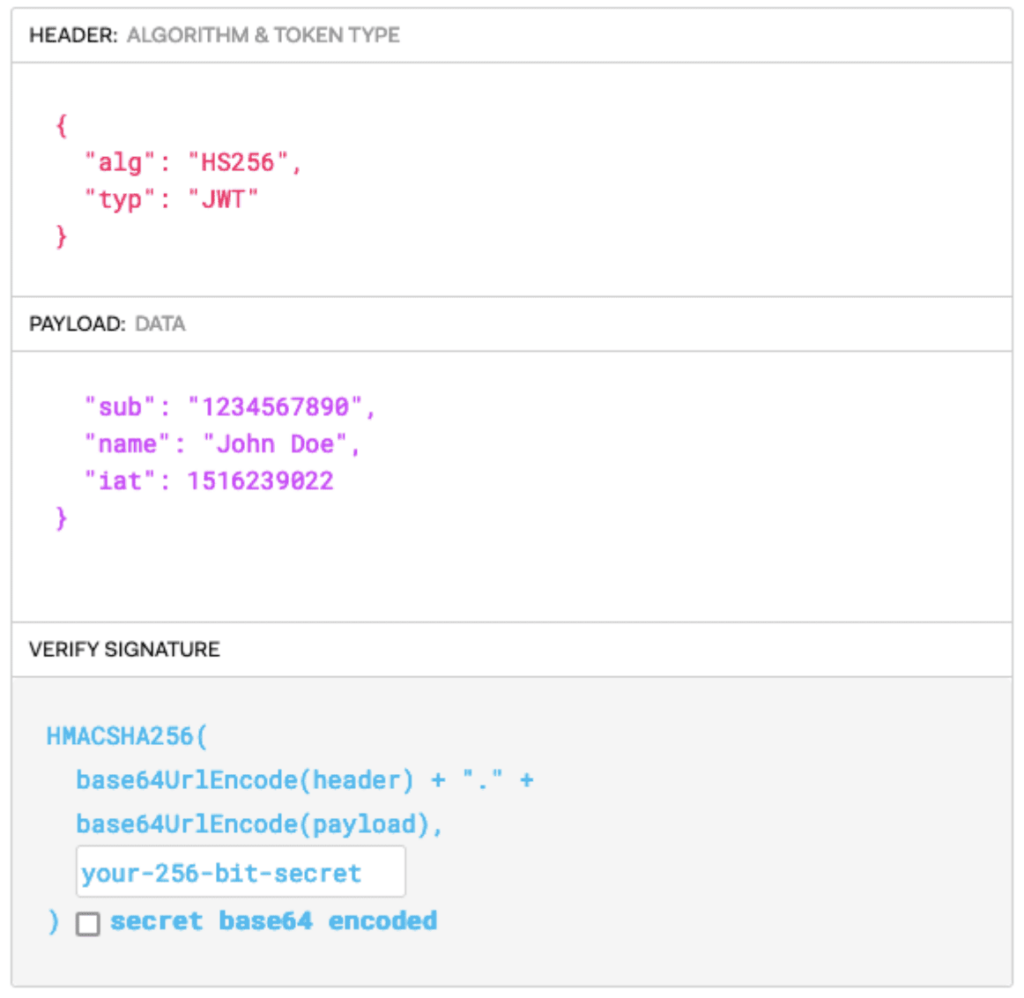
Looks fun doesn’t it? Oh, wait, it’s encoded, let’s break it down for a second, in decoded form it looks like this:

The token is split into three parts: 

  • The header: defines what type of token it is and what algorithm is used to sign the validity of the token
  • The payload: which will contain information about who the token was signed for, the role or the authorization of the user, the identity of the user, the timestamp of the token, etc.
  • The verify signature part: this will include the signature of the token, and the secret if needed.

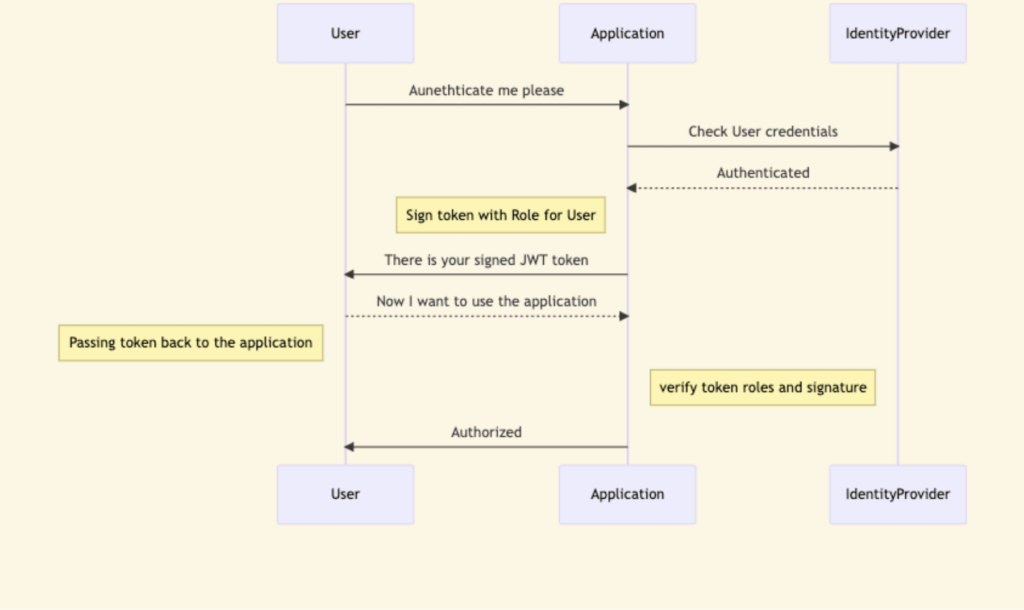
This token is passed from the application to the user and is usually submitted back in the Authorization header, this way the application verifies the authenticity of the token and checks the user role / identity that will have access to the application.

The server signs the token with its own key, that way it can verify that the contents are not modified and that the token was indeed issued by the server.

The application flow will look something like this:

Token Manipulation

Now that we know what the regular mechanism of JWT looks like, let’s try to see what can (and a lot of times can) go wrong, there are multiple ways to attack the application that uses JWT tokens, let’s assume that our token looks like this (after the decoding that is):


The attacker will want to access the application, maybe change the permissions or impersonate a different user, our only method of checking the validity of the token is the strength and the security of the signing key. For example if the attacker will modify the Role field to Admin in the application and the application doesn’t re-check the role, the user can access Administrative functions, as long as the signature is valid, at least we can be sure that the token is valid and was not manipulated before sending back to the application.

Some attack vectors in this scenario will try to address the header first:

  • Modifying or downgrading the Algorithm of the token: setting the Alg field to none, if the application allows it, will mean that there is no signature, thus allowing the attacker to change every field of the token and impersonate anyone, attacker can also try to downgrade the algorithm to a weak algorithm will allow the attacker to Brute force the key to the token and sign his own tokens instead.

Modifying header parameters: changing fields like JWK, JKU or KID, allow the attacker to either refer to a different signing key that will be used for token verification or to a blank key, for example can use his own key to sign the token and embed it into the JWK header or refer the server to the URL of the key used to sign using the JKU and submit self signed tokens to the application.

Everything but the kitchen sink

If an attacker can create or sign false tokens to the application, this effectively means that the authorization mechanism is basically broken, he can impersonate any user or role within the application thus gaining access and performing any damage that he wants with the impersonated user’s identity.

So, what can be done about it? Let’s put it into the Do’s and Don’ts of using JWT tokens:

Do:

  • Rotate signing keys periodically, so that if the key is exposed the tokens that are signed will be exposed for a short time, minimizing the threat.
  • Secure your keys, don’t store them in the application, better to store them in a cloud KeyVault / KMS.
  • Verify the role signed in the token vs the user repo.
  • Verify the Signing key and URL, don’t allow URLs from locations that you don’t control in the JKU
  • Set the token expiration to the shortest time required, don’t issue tokens that have long expiration times

Don’t:

  • Trust external JKU locations
  • Allow KID (Key Identifiers) to be set for inexistent keys
  • Try to write your own frameworks to decrypt keys
  • Try to use homegrown Encryption algorithms
  • Use weak keys or allow to downgrade the Hashing algorithms