

Table of Contant
Introduction: The Myth of “Secured at Launch”
Why AI Systems Are Never Static
How Risk Accumulates Over Time
Why Point-in-Time Testing Fails for AI Systems
What Continuous AI Security Actually Means
Why Continuous Security Protects Innovation
Aligning Development, AI, and Security Teams
The Regulatory and Trust Dimension
Conclusion: Security That Evolves With the System
Introduction: The Myth of “Secured at Launch”
For a long time, application security operated under a simple assumption: once an application passed security checks before release, its risk profile remained mostly stable. Vulnerabilities were tied to code, and code changed only when developers intentionally modified it. Security reviews, penetration tests, and compliance audits were therefore treated as milestones – important, but periodic.
AI systems quietly invalidate this model.
An AI-enabled application can be thoroughly reviewed, tested, and approved at launch, yet become risky weeks later without any traditional code change. Prompts get refined, data sources evolve, models are upgraded, and agents are granted new capabilities. None of these activities feels like “deployments,” but each one reshapes how the system behaves.
The idea of “secure at launch” still sounds reasonable to many teams because it mirrors decades of software practice. But in AI systems, launch is not a finish line. It is the beginning of continuous change.
Treating AI security as a one-time exercise creates blind spots that attackers, regulators, and even internal users will eventually find.
Why AI Systems Are Never Static
Traditional applications are largely deterministic. Given the same inputs, they produce the same outputs. AI systems are probabilistic, adaptive, and heavily influenced by context. This difference matters more for security than most teams initially realize.
Prompts are one of the most obvious sources of change. Teams constantly adjust instructions to improve relevance, tone, or task performance. These changes are often made quickly and iteratively, sometimes outside standard code review processes. A minor wording change can unintentionally alter instruction hierarchy, weaken safeguards, or introduce ambiguity that did not exist before.
Data sources introduce another layer of instability. Many AI systems rely on retrieval mechanisms that pull information from document repositories, knowledge bases, ticketing systems, or customer records. As new documents are added or access controls change, the model’s effective knowledge expands. The application may remain functionally correct while quietly becoming more permissive or exposing sensitive context.
Model updates further compound the issue. Whether upgrading to a new version, switching providers, or applying fine-tuning, each model change introduces behavioral differences. Models interpret instructions differently, weigh context differently, and handle edge cases in unpredictable ways. A prompt that was safe with one model may behave very differently with another.
User behavior also evolves. Once AI features are deployed, users experiment. They phrase requests creatively, combine instructions in unexpected ways, and test system boundaries. In AI systems, user creativity is part of the threat model, even when users have no malicious intent.
All of this means that AI systems are in a constant state of motion. Security assumptions made during initial testing quickly become outdated.
How Risk Accumulates Over Time
AI risk rarely appears as a single, obvious failure. It builds gradually.
New prompt injection techniques emerge regularly, often exploiting subtle shifts in how models prioritize instructions or interpret context. An attack that fails today may succeed tomorrow after a harmless-looking prompt update or model change.
Behavior drift is another subtle risk. Over time, models may become more verbose, more confident, or more willing to provide explanations. These changes are often welcomed as usability improvements until they result in the disclosure of internal logic, system instructions, or sensitive data.
Agent permissions tend to expand as systems mature. Teams add integrations to increase automation and value: databases, internal APIs, cloud services, workflow tools. Each new capability increases the impact of misuse. What begins as a helpful assistant can slowly evolve into a powerful execution layer with minimal oversight.
Integrations amplify risk further. AI systems rarely operate in isolation. They sit at the center of workflows, orchestrating actions across multiple services. A small weakness in one integration can cascade into broader compromise, especially when trust boundaries are unclear.
Because these changes are incremental, teams often fail to notice when acceptable risk quietly becomes unacceptable.
Why Point-in-Time Testing Fails for AI Systems
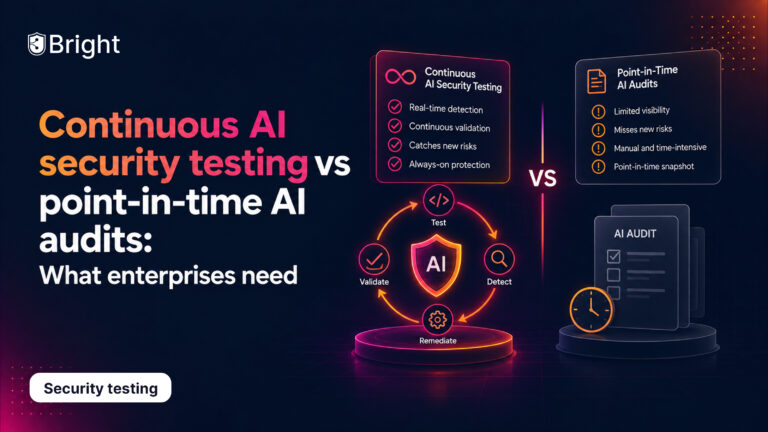
Point-in-time testing assumes that the system under test will behave tomorrow the same way it behaves today. That assumption does not hold for AI.
A single assessment captures only a narrow slice of behavior under specific conditions. It cannot predict how the model will respond after prompts are edited, data sources change, or user interaction patterns evolve. By the time an issue becomes visible, the conditions that caused it may no longer resemble those tested.
More importantly, many AI risks are not tied to technical vulnerabilities in the traditional sense. There is often no malformed request, no vulnerable endpoint, and no exploit payload. The risk lies in interpretation—how instructions interact, how context is combined, and how decisions are made at runtime.
Traditional AppSec tools were not designed to detect semantic abuse, gradual behavior shifts, or indirect manipulation. They excel at finding known classes of bugs. They struggle with systems that reason, adapt, and infer.
As a result, point-in-time testing creates a false sense of security for AI systems.
What Continuous AI Security Actually Means
Continuous AI security is not simply running the same test more often. It requires a different mindset.
Instead of focusing exclusively on code artifacts, continuous security focuses on behavior. It treats inputs, context, decisions, and outputs as security-relevant signals. The goal is not just to detect vulnerabilities, but to understand how the system behaves under real conditions.
Monitoring becomes contextual. Security teams observe how prompts are used, how context is assembled, and how models respond over time. Deviations from expected behavior are treated as signals, not anomalies to ignore.
Validation happens at runtime. Inputs are evaluated for manipulation attempts. Context sources are checked for scope, sensitivity, and relevance. Outputs are inspected before they reach users or downstream systems. This allows teams to catch issues that would never appear in static reviews.
Guardrails are enforced continuously. When models attempt actions outside their intended authority, those actions are blocked or escalated. When behavior drifts into risky territory, it is corrected early rather than normalized.
This approach aligns naturally with architectures where context, tools, and permissions are explicit and observable. Security controls work best when they understand how decisions are made, not just where requests land.
Why Continuous Security Protects Innovation
One common fear is that continuous security will slow development. In practice, the opposite is often true.
When security is embedded into everyday workflows, developers receive faster, more relevant feedback. They do not waste time debating theoretical issues or chasing false positives. AI teams gain visibility into real-world behavior instead of relying on assumptions. Security teams spend less time reacting to incidents and more time guiding safe evolution.
Continuous security shifts conversations from “Is this safe?” to “How do we keep this safe as it changes?” That shift matters in fast-moving environments.
By catching issues early and continuously, teams avoid expensive rework, emergency patches, and trust erosion. Innovation continues, but with guardrails that adapt as quickly as the system itself.
Aligning Development, AI, and Security Teams
AI security challenges often stem from organizational gaps rather than technical ones.
Developers optimize for delivery speed. AI teams optimize for model performance. Security teams optimize for risk reduction. When security is treated as a launch activity, these groups intersect briefly and then drift apart.
Continuous security forces alignment.
When monitoring, validation, and enforcement operate throughout the lifecycle, all teams share responsibility for outcomes. Developers see how changes affect behavior. AI teams see how models behave in production. Security teams see real risk instead of theoretical exposure.
The key is tooling that fits naturally into modern AI workflows. Security controls must live where prompts are edited, context is assembled, and agents act. Anything external or manual will be bypassed under pressure.
When security moves at the same speed as development, it stops being a blocker and starts being an enabler.
The Regulatory and Trust Dimension
Beyond technical risk, continuous AI security is becoming a governance requirement.
Regulators and auditors are increasingly asking how AI systems behave over time, not just how they were designed. They want evidence that organizations can detect misuse, prevent unintended exposure, and respond to change.
Point-in-time assessments provide limited answers. Continuous monitoring and validation provide evidence.
Trust is also at stake. Users expect AI systems to behave consistently and responsibly. Silent failures, unexpected disclosures, or erratic behavior erode confidence quickly. Continuous security helps maintain that trust by ensuring that changes do not introduce hidden risk.
Conclusion: Security That Evolves With the System
AI systems do not stand still. Their behavior shifts as prompts change, data grows, models evolve, and users interact in new ways. Security strategies that assume stability are destined to fall behind.
Continuous AI security accepts this reality. It focuses on observing behavior, validating decisions, and enforcing boundaries as the system operates. It treats drift as inevitable and builds mechanisms to manage it safely.
Organizations that adopt this approach early will avoid the false confidence of one-time testing and gain a clearer, more resilient security posture. Those that do not will eventually discover that the most dangerous AI risks are not the ones they failed to test – but the ones that emerged after testing stopped.In AI-driven systems, security is not a checkpoint.
It is an ongoing discipline that must evolve alongside the technology itself