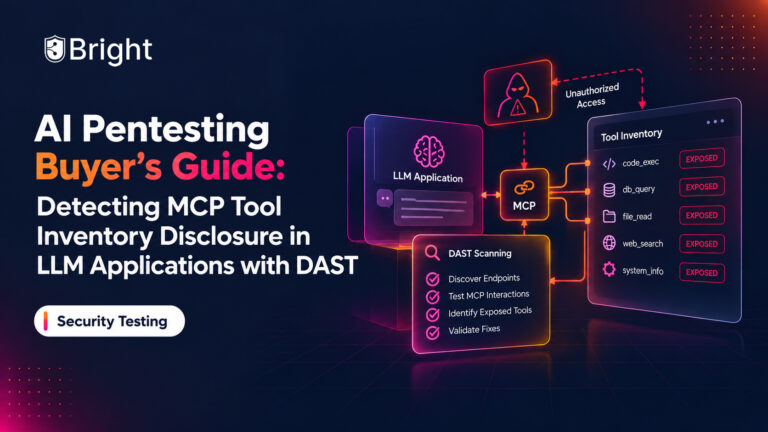
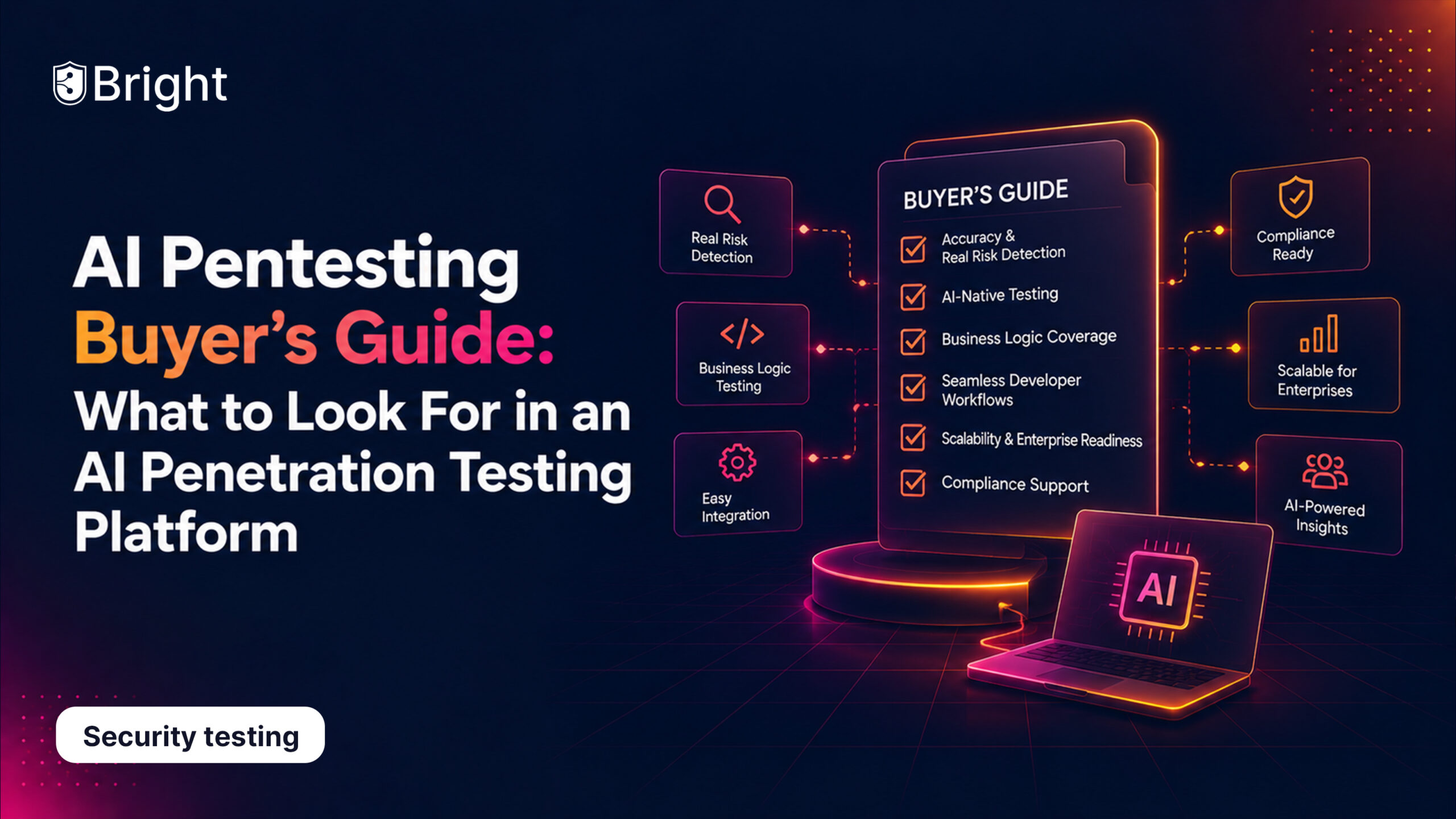

An AI label tells you almost nothing about how a security platform tests your applications. One product may use a model to summarize scanner alerts. Another may generate possible attacks but never prove that they work.
Real AI pentesting should discover the attack surface, understand application context, build and execute relevant attack paths, and validate the result against the running target. It must also stay inside scope and give people control over consequential actions.
This buyer’s guide shows you what to examine, what evidence to request, and which warning signs to catch before you commit to a platform.
Start by defining what the platform actually automates
Ask the vendor to walk through every stage of the test. Which stages use AI? Which follow deterministic rules? Where does a human approve or stop an action?
Traditional scanners run predefined checks. Automated penetration testing executes those checks at scale. AI-assisted products may prioritize alerts, generate payloads, or write reports. An autonomous platform goes further. It adapts its next action to the target, preserves authentication and workflow state, and explores attack paths within approved boundaries.
That does not make every autonomous result trustworthy. Models can misread behavior, select irrelevant tests, or overstate an unusual response. The platform still needs a separate mechanism to decide whether an attack succeeded.
Bright’s AI Pentesting Module makes this separation explicit. AI drives discovery, threat modeling, and exploit creation. Deterministic stages validate the exploit and verify the fix. When evaluating another platform, demand the same clarity. If the vendor cannot distinguish reasoning from proof, you cannot judge the reliability of its findings.
Evaluate AI pentesting coverage in your own environment
Coverage claims mean little without protocol, authentication, and workflow context. A vendor may say it tests APIs while demonstrating only unauthenticated REST endpoints. That does not prove support for your GraphQL schema, browser-based OAuth flow, tenant model, or business logic.
Give the platform representative examples of your actual attack surface. Include modern web applications, APIs, user roles, sensitive workflows, and undocumented endpoints. Ask it to demonstrate how it discovers and tests them.
Check whether the platform supports black-, gray-, and white-box modes. Black-box testing shows what an outside attacker can discover. Gray-box testing adds scoped credentials or specifications. White-box testing uses deeper code or architecture context. More context should improve test selection without lowering the standard of proof.
High-value coverage includes broken object and function authorization, field-level access, injection, sensitive data exposure, multi-step workflow abuse, and chained weaknesses. The platform should also report what it could not reach. A dashboard that counts only successful tests can make incomplete coverage look comprehensive.
Demand runtime validation, not AI confidence
The most important buyer question is simple: what must happen before the platform creates a vulnerability ticket?
A model-generated explanation, suspicious response, or confidence score is not enough. A validated finding should identify the target, application version, authenticated role, preconditions, sanitized attack sequence, runtime result, and business impact. It should also include a control request and a replayable test for remediation.
Use this checklist during the demonstration:
| Evaluation area | Proof to request | Warning sign |
| Discovery | Live mapping of applications, APIs, parameters, roles, and authenticated areas | The vendor relies entirely on a supplied URL list |
| AI reasoning | Traceable hypotheses based on the application’s behavior and data flows | AI only rewrites or prioritizes scanner alerts |
| Runtime validation | A reproducible exploit confirmed against the running target | Findings rely on model confidence or response patterns |
| Authentication | Testing across realistic users, roles, tenants, and session states | The demonstration covers only public pages |
| Attack paths | A controlled multi-step test that preserves identity and workflow state | Every request runs as an isolated test |
| Coverage reporting | Tested, untested, excluded, blocked, and failed areas | The dashboard reports only endpoints reached |
| Fix verification | The original exploit replayed after remediation | A closed ticket is treated as proof |
| Safety | Enforced scope, rate limits, approval gates, and immediate termination | Safety depends on instructions given to the model |
| Auto-remediation | A reviewable patch, functional checks, runtime retest, and rollback | Generated code can merge without validation |
| Enterprise operation | CI/CD, SSO, RBAC, APIs, audit logs, ticketing, and evidence export | The platform needs manual work to support every release |
This distinction is why runtime validation matters in AI penetration testing. AI can expand the set of attack hypotheses. Observable, repeatable impact should decide what reaches your backlog.
Check safety controls and remediation boundaries
Autonomous testing can select and chain actions that its designers did not predict. Safety must therefore sit outside the model.
The 2026 OWASP Autonomous Penetration Testing Standard defines 173 tier-required requirements across eight domains. It addresses scope enforcement, safety controls, human oversight, auditability, manipulation resistance, supply-chain trust, and reporting. OWASP treats it as a governance standard rather than a testing methodology.
NIST’s 2025 initial preliminary AI cybersecurity profile also says organizations may consider AI-assisted penetration testing and red teaming to match the pace and scale of AI-enabled attacks.
Ask how the platform enforces domains, IP ranges, environments, time windows, deny lists, asset criticality, and credential boundaries. Its scope controls should check authorization before each action, detect drift, and stop testing when boundaries change.
Human control matters too. OWASP’s oversight requirements call for continuous impact monitoring and escalation when testing affects availability, resource use, data integrity, or security controls. Buyers should also demand immediate pause and termination controls.
Apply the same discipline to auto-remediation. A generated patch is only a proposal. The platform should identify the affected code, make the smallest appropriate change, run functional checks, replay the exploit, and retain rollback options. Permissions, architecture, and business rules often need human decisions. Bright STAR’s validated remediation approach can support code-level fixes, but no platform should patch every security failure automatically.
Run a proof of capability before you buy
A polished vendor demo tells you how the platform performs on a prepared target. A proof of capability shows how it handles your reality.
Choose a safe application that your team understands. Include known vulnerabilities, negative controls that should not become findings, at least two user roles, an authenticated workflow, an API specification, an undocumented endpoint, and a remediated issue ready for retesting.
Score each platform on discovery, missed coverage, validated findings, false positives, time to reproducible evidence, safety, remediation quality, and fix verification. Also record how much help the vendor needs to configure authentication and keep tests working. That effort becomes part of your operating cost.
The LivCor case study shows why these criteria matter. Bright navigated OAuth-based API and browser authentication, mapped more than 100 interactable endpoints, and tested over 4,500 parameters. LivCor completed seven scan, remediate, and rescan cycles within one week. Its cybersecurity architect reported, “The platform only needed about 10 hours of actual scanning and validation time.”
This was a Bright DAST deployment, not a controlled comparison of AI pentesting platforms. It still demonstrates what buyers should demand: working authentication, meaningful discovery, actionable findings, and proof that fixes hold.
Choose AI pentesting based on what the platform can demonstrate in your environment. Buy runtime evidence, enforced safety, transparent coverage, and verified remediation, not an AI label.
To see Bright discover attack paths and validate real exploitability against a running application, book a demo.
Frequently asked questions
What is an AI penetration testing platform?
It uses AI to support adaptive discovery, threat modeling, test selection, and exploit creation. A mature platform also executes tests within enforced boundaries, validates results against the running target, preserves evidence, and verifies remediation.
How can buyers identify AI washing in pentesting products?
Ask the vendor to show exactly where AI changes the testing process. If it only summarizes findings, prioritizes scanner alerts, or generates unvalidated attack suggestions, the product is AI-assisted reporting rather than autonomous testing.
Does AI pentesting replace human penetration testers?
No. It improves frequency, repeatability, and regression coverage. Human testers remain important for architecture, unusual business logic, ambiguous intent, and high-impact actions. The strongest programs combine automated penetration testing with expert judgment.
What should a proof of capability include?
Use realistic authentication, multiple roles, known vulnerabilities, negative controls, undocumented assets, a multi-step workflow, enforced safety limits, and a remediated finding. Require the platform to discover, validate, report, and retest the issue while disclosing anything it could not cover.