
Every enterprise DAST vendor promises better vulnerability detection. The harder question is what happens after the scan finishes. Can your team reproduce the findings? Did the scanner reach authenticated workflows and business-critical APIs? How much work will developers need to complete before a vulnerability is resolved?
These questions matter as application portfolios grow and release cycles accelerate. According to Verizon’s 2026 Data Breach Investigations Report, 31% of analyzed breaches began with software vulnerability exploitation. The figure covers software vulnerabilities broadly, but it reinforces the need for effective vulnerability identification and remediation.
This guide compares ten enterprise DAST tools available in 2026, examining their capabilities, limitations and operational fit. It also provides a practical framework for evaluating accuracy, coverage and remediation before committing to a platform.
Best Enterprise DAST Tools in 2026 at a Glance
Enterprise DAST tools serve different needs. Some emphasize exploit validation, others specialize in portfolio-wide scanning, while developer-focused platforms prioritize CI/CD integration.
The following comparison summarizes documented product capabilities. It does not assign accuracy rankings because vendors have not tested all ten products against the same independently controlled benchmark.
| DAST tool | Main focus | Validation approach | Coverage and remediation |
| Bright Security | Continuous, developer-centric application security | Runtime exploit validation | Web applications, REST, SOAP and GraphQL APIs; remediation and fix-verification workflows |
| Invicti | Large enterprise application portfolios | Proof-Based Scanning for supported vulnerabilities | Web and API scanning; developer integrations and remediation guidance |
| Burp Suite DAST | Automated testing with expert-led investigation | Evidence from automated security checks | Web applications and APIs; detailed findings and integration with Burp’s testing ecosystem |
| Checkmarx DAST | Unified application security programs | Dynamic vulnerability detection | Web and API testing with centralized AppSec workflows |
| Veracode Dynamic Analysis | Enterprise AppSec governance | Dynamic analysis and vulnerability reporting | Web application testing, policy management and remediation guidance |
| HCL AppScan | Complex enterprise environments | Automated dynamic vulnerability testing | Web and API security, enterprise management and deployment flexibility |
| StackHawk | Developer-led security testing | Configurable dynamic security checks | Web and API testing, CI/CD integration and developer remediation workflows |
| Rapid7 InsightAppSec | Cloud-based application security operations | Automated detection and attack replay | Web and API scanning, vulnerability investigation and security integrations |
| Qualys Web Application Scanning | Integrated vulnerability management | Automated dynamic vulnerability assessment | Web and API scanning, centralized reporting and remediation tracking |
| GitLab DAST | Native security testing within GitLab | Browser-based dynamic testing | Web and API testing, pipeline integration and vulnerability management |
10 Enterprise DAST Tools to Consider in 2026
1. Bright Security
Bright Security focuses on identifying and validating exploitable vulnerabilities in running applications and APIs. Its Dynamic AppSec platform is designed to bring security testing into development workflows while reducing the manual effort associated with vulnerability investigation.
Bright emphasizes runtime exploit validation. Rather than relying exclusively on vulnerability indicators, it interacts with running applications to establish whether supported weaknesses can actually be exploited.
This distinction becomes important when developers receive findings without sufficient evidence to reproduce them. Clearer validation can reduce time spent investigating false positives and help security teams prioritize confirmed vulnerabilities.
Bright supports web application testing, REST, SOAP and GraphQL APIs, and testing of selected business-logic weaknesses. Its integrations allow teams to incorporate testing into CI/CD pipelines rather than relying solely on scheduled security assessments. The broader Bright STAR platform connects vulnerability discovery with AI-assisted security analysis, remediation and subsequent verification.
Key capabilities: Runtime exploit validation, web and API security testing, CI/CD integration, actionable vulnerability evidence and remediation workflows.
Bright’s approach is particularly relevant to enterprises trying to reduce vulnerability backlogs and the amount of manual validation required before developers can begin fixing reported issues.
What to evaluate: Test the quality of exploit evidence against your own applications, verify authenticated coverage and confirm which automated remediation and fix-verification capabilities are included in your proposed package.
2. Invicti
Invicti provides enterprise DAST capabilities for organizations managing extensive application portfolios. Its distinguishing feature is Proof-Based Scanning, which attempts to demonstrate exploitability for supported vulnerability categories. This gives security teams additional evidence for confirming certain findings without manually reproducing every reported issue.
Invicti also provides application discovery, web and API testing, centralized scan management and integrations with development tools. Its portfolio-management capabilities matter when security teams oversee numerous applications owned by different business units. Administrators can coordinate testing policies, scan schedules and vulnerability reporting while development teams receive findings relevant to their applications. The company also offers AI-assisted capabilities for remediation and vulnerability management.
Key capabilities: Proof-Based Scanning, application discovery, web and API testing, enterprise scan management and developer integrations.
Invicti is worth examining when centralized management and proof-based vulnerability confirmation are important requirements.
What to evaluate: Determine which vulnerability categories receive proof-based confirmation, assess authenticated coverage and establish how much configuration is needed to manage your full application portfolio.
3. Burp Suite DAST
Burp Suite DAST extends PortSwigger’s established security testing ecosystem into automated enterprise scanning. For AppSec teams already using Burp Suite Professional, its main attraction is the connection between automated vulnerability discovery and familiar manual testing workflows.
The platform uses the same underlying scanning engine as Burp Suite Professional, helping security specialists investigate automated findings without switching between unrelated testing environments. Burp Suite DAST supports authenticated scanning, JavaScript-heavy applications and APIs defined through OpenAPI, Postman Collections, SOAP and GraphQL. It also offers enterprise management, CI/CD integrations and configurable scanning policies. This combination can be useful when automated testing identifies a suspicious authorization or application behavior that requires further examination by an experienced tester.
Key capabilities: Automated vulnerability scanning, authenticated crawling, API testing, detailed finding evidence and integration with manual testing workflows.
Burp Suite DAST is relevant to organizations with established AppSec teams that want automated scanning to complement expert-led investigation.
What to evaluate: Examine authenticated scanning reliability, portfolio management, integration with developer ticketing systems and the process for transferring automated findings into manual investigations.
4. Checkmarx DAST
Checkmarx offers dynamic application security testing through its broader Checkmarx One platform. The integration with other application security capabilities is a central consideration for buyers. Enterprises already using Checkmarx for static analysis or software composition analysis may prefer to incorporate dynamic testing into the same management environment.
Checkmarx DAST tests running web applications and APIs and supports automation through development pipelines. Its wider platform also provides centralized visibility into security findings, helping teams manage vulnerabilities discovered through different testing methods.
However, consolidation should not determine the purchasing decision by itself. A common dashboard has limited value if the scanner cannot reach important authenticated functionality or provide sufficient evidence for investigation.
Key capabilities: Web and API testing, CI/CD automation, centralized vulnerability management and integration with broader application security workflows.
Checkmarx is relevant to organizations that want to standardize security testing across multiple development teams.
What to evaluate: Assess its DAST functionality independently, especially authenticated coverage, vulnerability evidence, scan configuration and the licensing required for the capabilities your team needs.
5. Veracode Dynamic Analysis
Veracode provides dynamic application security testing within its wider application security platform. Its approach is particularly relevant to enterprises that need consistent testing policies, centralized vulnerability reporting and oversight across distributed development teams.
Security leaders often need to demonstrate which applications have been assessed, which vulnerabilities remain unresolved and how remediation responsibilities are assigned. Veracode’s platform supports these governance requirements by bringing dynamic testing into a broader application security management environment. This can simplify reporting when organizations use multiple security testing methods and need a consolidated view of application risk.
Key capabilities: Dynamic application analysis, centralized reporting, policy management, remediation guidance and broader AppSec integration.
Veracode deserves consideration where testing consistency, governance and established security policies are major procurement requirements.
What to evaluate: Verify supported authentication methods, API coverage, developer access to findings and the process for retesting vulnerabilities after remediation.
6. HCL AppScan
HCL AppScan provides application security testing capabilities for organizations with complex application environments and varied deployment requirements. Unlike vendors offering a single primary scanner, HCL provides multiple AppScan products, including enterprise and cloud-based offerings.
This flexibility can be relevant to businesses operating across hybrid infrastructure or environments with specific security and deployment requirements. AppScan supports dynamic testing of web applications and APIs alongside vulnerability reporting, governance and development-tool integrations. For large enterprises, the important consideration is identifying the correct product within the AppScan family.
Key capabilities: Enterprise DAST, web and API security testing, deployment flexibility, centralized management and reporting. HCL AppScan is relevant to organizations with established security operations, extensive application portfolios and deployment requirements that need careful consideration.
What to evaluate: Compare the exact editions under consideration, including deployment architecture, authentication support, scan management and remediation capabilities.
7. StackHawk
StackHawk approaches dynamic application security testing from the developer’s perspective. Its HawkScan technology allows developers to run security tests locally or within CI/CD pipelines, making application security testing part of their existing development workflows.
The platform supports web applications, APIs, authenticated scanning and configurable security tests. StackHawk has also expanded into AI-assisted security workflows intended to help teams investigate and resolve vulnerabilities.
Its approach addresses a common operational challenge. Security teams may identify vulnerabilities, but developers frequently need additional context before they can reproduce and resolve them. Giving developers more direct access to security testing can help reduce that handoff burden.
Key capabilities: Developer-controlled testing, CI/CD integration, API scanning, authenticated testing and configurable security checks.
StackHawk is relevant to enterprises where engineering teams take an active role in application security.
What to evaluate: Measure developer configuration effort, scan reliability, authenticated coverage and whether centralized reporting meets your security team’s governance requirements.
8. Rapid7 InsightAppSec
Rapid7 InsightAppSec provides cloud-based DAST for organizations that need automated vulnerability discovery and centralized application security management. One of its distinguishing capabilities is attack replay, which helps teams reproduce and investigate reported vulnerabilities.
This addresses an important problem in application security operations. A scanner can identify an issue, but if the development team cannot reproduce it, remediation may stall. Attack replay provides additional information about how the vulnerability was detected, helping teams investigate the underlying weakness.
InsightAppSec also supports authenticated scanning, API testing and integrations with security workflows. Organizations already using Rapid7 products may want to examine how its application security findings fit into their wider vulnerability management processes.
Key capabilities: Cloud-based dynamic scanning, authenticated testing, API security, attack replay and vulnerability reporting.
What to evaluate: Assess attack evidence, authentication configuration, scan coverage and the effort required to integrate findings into your existing remediation processes.
9. Qualys Web Application Scanning
Qualys Web Application Scanning provides automated dynamic testing within the wider Qualys security platform. Its main attraction is integration with enterprise vulnerability management.
Organizations already using Qualys for infrastructure security can incorporate web application findings into existing reporting and risk-management processes. The platform supports automated web application security testing, authenticated scanning and API-related testing capabilities.
However, application security findings often require different workflows from infrastructure vulnerabilities. Developers need reproducible evidence and sufficient technical context to correct problems within application code.
A consolidated vulnerability management platform should therefore be evaluated alongside the quality of its application-specific testing capabilities.
Key capabilities: Automated web application scanning, authenticated testing, API testing, centralized reporting and remediation tracking.
Qualys is relevant to enterprises seeking closer integration between application security and broader vulnerability management operations.
What to evaluate: Examine authenticated coverage, application-specific vulnerability evidence, developer integrations and the depth of its API testing capabilities.
10. GitLab DAST
GitLab DAST brings dynamic application security testing directly into GitLab’s development platform.
For organizations already using GitLab Ultimate, its primary advantage is the ability to run security testing within existing CI/CD workflows.
GitLab DAST supports browser-based testing of running applications, alongside API security testing. Findings can appear within GitLab’s security reporting and vulnerability management interfaces.
Its integration with development workflows can make it easier to connect vulnerabilities with application changes and remediation responsibilities.
Rather than introducing another security platform immediately, organizations using GitLab Ultimate can evaluate whether its native DAST capabilities meet their application security requirements.
Key capabilities: Browser-based DAST, API testing, CI/CD integration, security reporting and native vulnerability management.
GitLab DAST is relevant to enterprises with established GitLab development workflows.
What to evaluate: Test its scanning depth, authenticated coverage, API capabilities and whether its native reporting provides the oversight your AppSec program requires.
How to Compare Enterprise DAST Tools Beyond Their Feature Lists
A vendor comparison can establish what a scanner supports. It cannot establish how well that scanner will perform against your applications.
When evaluating enterprise DAST tools, concentrate on the operational differences that affect vulnerability detection, investigation and remediation.
Accuracy: Look Beyond the Number of Findings
A scanner that reports fewer vulnerabilities is not necessarily more accurate. It may produce fewer false positives, or it may be missing genuine security weaknesses.
Accuracy needs to be measured in two directions: how many reported findings are real, and how many known vulnerabilities the scanner successfully identifies.
The distinction between detection and validation is equally important. Bright emphasizes runtime exploit validation, while Invicti uses Proof-Based Scanning for supported vulnerability types. Other platforms provide request-and-response evidence, attack replay or additional investigation capabilities.
Each approach can help establish whether a reported vulnerability requires attention, but their capabilities differ.
For example, when a scanner reports SQL injection, developers benefit from evidence showing the affected request, the application’s response and the behavior demonstrating the vulnerability. That information gives them a practical starting point for investigating and correcting the problem.
Bright’s guide on reducing false positives in DAST tools explains the operational differences between generating vulnerability alerts and validating findings.
During evaluation, measure precision, recall and the quality of supporting evidence. Avoid comparing vendor-reported accuracy percentages unless the testing methodology is equivalent.
Coverage: Test Authenticated Workflows and APIs
Application coverage deserves the same attention as vulnerability detection. A scanner may successfully test publicly accessible pages while leaving authenticated functionality untouched. Expired sessions, complex authentication mechanisms and undocumented APIs can all create blind spots.
Authorization testing presents additional challenges. Consider a customer portal with separate employee and administrator accounts. Your scanner successfully authenticates as an employee and reaches every page available to that role. However, that result does not establish whether the employee can access another customer’s records by manipulating an API request.
Testing this behavior requires an understanding of the application’s authorization rules and the relationships between users and resources. OWASP identifies broken object-level authorization as the first risk in its API Security Top 10.
For enterprises managing extensive API environments, coverage should include supported protocols, authenticated routes, role-specific permissions and the ability to exercise important application workflows.
Bright’s guide to API security tools in 2026 explains how dynamic testing differs from API discovery and runtime protection.
Remediation: Measure the Work Required to Close Findings
The value of a security finding depends partly on how efficiently your team can act on it. Developers need reproducible evidence, clear technical explanations and guidance that helps them identify the underlying cause. A vulnerability ticket that contains only an affected URL and severity rating leaves substantial investigative work for the engineering team.
Vendors also offer different levels of remediation assistance. Some provide recommendations and issue-tracking integrations. Others offer AI-assisted remediation, automated code changes or fix-verification workflows.
These capabilities should be evaluated separately. Generating a suggested fix is different from applying it, and applying a fix does not automatically prove the vulnerability has been resolved.
Bright’s article on why AI penetration testing needs runtime validation explores the importance of verifying security findings against actual application behavior.
For enterprise buyers, the most useful measurement is the effort required to move from a reported vulnerability to verified closure.
Integration and Total Cost of Ownership
Security testing has to fit the way your organization develops and releases software. A scanner may provide excellent technical coverage but require lengthy configuration or introduce delays that discourage developers from running it regularly.
Assess scan duration, reliability, parallel testing, reporting and CI/CD integration using your existing development environment. It is also important to distinguish between targeted testing during development and comprehensive assessments. Running a full application scan before every code change may be unnecessary, while relying entirely on infrequent scheduled scans can leave gaps between releases.
Bright’s guide to DAST in CI/CD pipelines provides additional detail on these operational challenges.
Finally, account for licensing, scanning capacity, administrative effort and the time required to investigate findings. Comparing subscription prices alone will not establish the total cost of operating an enterprise DAST program.
How to Evaluate DAST Tools Before You Buy
A structured proof of concept can reveal differences that are difficult to identify from product documentation. Select a representative staging application containing authenticated functionality, APIs, multiple user roles and a controlled set of known vulnerabilities. Give shortlisted vendors equivalent access and test them against the same application version.
Use a dedicated, authorized environment and avoid unnecessary production data. Active security testing can alter application state or disrupt vulnerable systems.
| Evaluation criterion | What to test | What to measure |
| Detection accuracy | Known vulnerabilities and non-vulnerable controls | True positives, false positives and missed vulnerabilities |
| Application coverage | Authenticated routes and role-specific functionality | Successfully tested workflows and inaccessible areas |
| API coverage | Documented endpoints and relevant authorization scenarios | Endpoints exercised and vulnerabilities identified |
| Vulnerability evidence | Selected findings across multiple vulnerability types | Reproduction steps, supporting evidence and validation quality |
| CI/CD integration | Automated testing through existing pipelines | Configuration effort, scan duration and reliability |
| Remediation | Fix and retest representative vulnerabilities | Investigation effort and successful fix verification |
| Enterprise operations | Multiple applications, owners and reporting requirements | Administrative effort, visibility and governance capabilities |
The OWASP Web Security Testing Guide provides a technical foundation for defining application security test cases. NIST SP 800-115 offers additional guidance on planning, conducting and reporting security assessments.
Include known authorization and business-logic vulnerabilities in your evaluation, but do not assume that every automated scanner will detect them. Complex application-specific weaknesses may require custom tests or manual security assessments.
Document the results consistently. The purpose is to establish how each platform performs in your environment, how much operational effort it requires and whether it provides the evidence your development teams need.
Choosing the Right Enterprise DAST Platform
The best enterprise DAST tools should help your security team identify genuine vulnerabilities without creating unnecessary work for developers.
For some organizations, that means centralized management across hundreds of applications. Others require closer integration with developer workflows, flexible deployment options or consistent reporting across multiple testing methods.
Accuracy, coverage and remediation should remain central to the decision. A scanner that cannot reach critical application functionality or produces findings that developers struggle to reproduce can create significant operational costs, regardless of its advertised feature set.
Bright Security connects dynamic application and API testing with runtime exploit validation, remediation and fix verification. Its approach is designed to help enterprises identify exploitable weaknesses and integrate security testing into their existing development workflows.
Explore Bright’s Dynamic AppSec platform and request a demo to evaluate how it performs against your applications and APIs.
Frequently Asked Questions
What are the best enterprise DAST tools in 2026?
Enterprise DAST tools to evaluate include Bright Security, Invicti, Burp Suite DAST, Checkmarx DAST, Veracode Dynamic Analysis, HCL AppScan, StackHawk, Rapid7 InsightAppSec, Qualys Web Application Scanning and GitLab DAST. They differ in validation methods, application coverage, integrations, deployment options and remediation capabilities.
How do you measure DAST accuracy?
Test shortlisted tools against the same representative application containing known vulnerabilities and non-vulnerable controls. Measure precision, recall and the quality of vulnerability evidence. Also record how much manual investigation is required to confirm reported findings.
Can enterprise DAST tools detect API vulnerabilities?
Yes. Many enterprise DAST platforms support REST, SOAP and GraphQL security testing. However, supported protocols do not guarantee complete API coverage. Buyers should evaluate authentication, endpoint discovery, authorization testing and application-specific business logic.
What is the difference between SAST and DAST?
Static Application Security Testing (SAST) analyzes source code or compiled application artifacts without executing the application. Dynamic Application Security Testing (DAST) tests running applications through their exposed interfaces. The approaches complement each other by identifying different types of security weaknesses.
Can DAST tools automatically remediate vulnerabilities?
Some platforms provide automated or AI-assisted remediation, while others offer recommended fixes and integrations with issue-tracking systems. Buyers should distinguish between suggesting a fix, generating a code change and verifying that remediation has successfully eliminated the vulnerability.
Does automated DAST replace manual penetration testing?
Automated DAST enables repeatable security testing and can identify many common application vulnerabilities. However, complex business-logic weaknesses, chained attacks and context-dependent authorization issues may require manual assessment. Enterprises can combine automated DAST with expert-led testing to improve overall coverage.
Real AI pentesting should discover the attack surface, understand application context, build and execute relevant attack paths, and validate the result against the running target. It must also stay inside scope and give people control over consequential actions.
This buyer’s guide shows you what to examine, what evidence to request, and which warning signs to catch before you commit to a platform.
Start by defining what the platform actually automates
Ask the vendor to walk through every stage of the test. Which stages use AI? Which follow deterministic rules? Where does a human approve or stop an action?
Traditional scanners run predefined checks. Automated penetration testing executes those checks at scale. AI-assisted products may prioritize alerts, generate payloads, or write reports. An autonomous platform goes further. It adapts its next action to the target, preserves authentication and workflow state, and explores attack paths within approved boundaries.
That does not make every autonomous result trustworthy. Models can misread behavior, select irrelevant tests, or overstate an unusual response. The platform still needs a separate mechanism to decide whether an attack succeeded.
Bright’s AI Pentesting Module makes this separation explicit. AI drives discovery, threat modeling, and exploit creation. Deterministic stages validate the exploit and verify the fix. When evaluating another platform, demand the same clarity. If the vendor cannot distinguish reasoning from proof, you cannot judge the reliability of its findings.
Evaluate AI pentesting coverage in your own environment
Coverage claims mean little without protocol, authentication, and workflow context. A vendor may say it tests APIs while demonstrating only unauthenticated REST endpoints. That does not prove support for your GraphQL schema, browser-based OAuth flow, tenant model, or business logic.
Give the platform representative examples of your actual attack surface. Include modern web applications, APIs, user roles, sensitive workflows, and undocumented endpoints. Ask it to demonstrate how it discovers and tests them.
Check whether the platform supports black-, gray-, and white-box modes. Black-box testing shows what an outside attacker can discover. Gray-box testing adds scoped credentials or specifications. White-box testing uses deeper code or architecture context. More context should improve test selection without lowering the standard of proof.
High-value coverage includes broken object and function authorization, field-level access, injection, sensitive data exposure, multi-step workflow abuse, and chained weaknesses. The platform should also report what it could not reach. A dashboard that counts only successful tests can make incomplete coverage look comprehensive.
Demand runtime validation, not AI confidence
The most important buyer question is simple: what must happen before the platform creates a vulnerability ticket?
A model-generated explanation, suspicious response, or confidence score is not enough. A validated finding should identify the target, application version, authenticated role, preconditions, sanitized attack sequence, runtime result, and business impact. It should also include a control request and a replayable test for remediation.
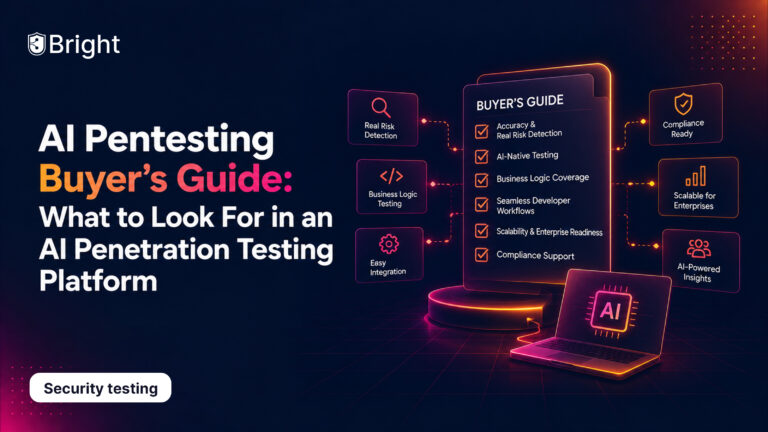
Use this checklist during the demonstration:
| Evaluation area | Proof to request | Warning sign |
| Discovery | Live mapping of applications, APIs, parameters, roles, and authenticated areas | The vendor relies entirely on a supplied URL list |
| AI reasoning | Traceable hypotheses based on the application’s behavior and data flows | AI only rewrites or prioritizes scanner alerts |
| Runtime validation | A reproducible exploit confirmed against the running target | Findings rely on model confidence or response patterns |
| Authentication | Testing across realistic users, roles, tenants, and session states | The demonstration covers only public pages |
| Attack paths | A controlled multi-step test that preserves identity and workflow state | Every request runs as an isolated test |
| Coverage reporting | Tested, untested, excluded, blocked, and failed areas | The dashboard reports only endpoints reached |
| Fix verification | The original exploit replayed after remediation | A closed ticket is treated as proof |
| Safety | Enforced scope, rate limits, approval gates, and immediate termination | Safety depends on instructions given to the model |
| Auto-remediation | A reviewable patch, functional checks, runtime retest, and rollback | Generated code can merge without validation |
| Enterprise operation | CI/CD, SSO, RBAC, APIs, audit logs, ticketing, and evidence export | The platform needs manual work to support every release |
This distinction is why runtime validation matters in AI penetration testing. AI can expand the set of attack hypotheses. Observable, repeatable impact should decide what reaches your backlog.
Check safety controls and remediation boundaries
Autonomous testing can select and chain actions that its designers did not predict. Safety must therefore sit outside the model.
The 2026 OWASP Autonomous Penetration Testing Standard defines 173 tier-required requirements across eight domains. It addresses scope enforcement, safety controls, human oversight, auditability, manipulation resistance, supply-chain trust, and reporting. OWASP treats it as a governance standard rather than a testing methodology.
NIST’s 2025 initial preliminary AI cybersecurity profile also says organizations may consider AI-assisted penetration testing and red teaming to match the pace and scale of AI-enabled attacks.
Ask how the platform enforces domains, IP ranges, environments, time windows, deny lists, asset criticality, and credential boundaries. Its scope controls should check authorization before each action, detect drift, and stop testing when boundaries change.
Human control matters too. OWASP’s oversight requirements call for continuous impact monitoring and escalation when testing affects availability, resource use, data integrity, or security controls. Buyers should also demand immediate pause and termination controls.
Apply the same discipline to auto-remediation. A generated patch is only a proposal. The platform should identify the affected code, make the smallest appropriate change, run functional checks, replay the exploit, and retain rollback options. Permissions, architecture, and business rules often need human decisions. Bright STAR’s validated remediation approach can support code-level fixes, but no platform should patch every security failure automatically.
Run a proof of capability before you buy
A polished vendor demo tells you how the platform performs on a prepared target. A proof of capability shows how it handles your reality.
Choose a safe application that your team understands. Include known vulnerabilities, negative controls that should not become findings, at least two user roles, an authenticated workflow, an API specification, an undocumented endpoint, and a remediated issue ready for retesting.
Score each platform on discovery, missed coverage, validated findings, false positives, time to reproducible evidence, safety, remediation quality, and fix verification. Also record how much help the vendor needs to configure authentication and keep tests working. That effort becomes part of your operating cost.
The LivCor case study shows why these criteria matter. Bright navigated OAuth-based API and browser authentication, mapped more than 100 interactable endpoints, and tested over 4,500 parameters. LivCor completed seven scan, remediate, and rescan cycles within one week. Its cybersecurity architect reported, “The platform only needed about 10 hours of actual scanning and validation time.”
This was a Bright DAST deployment, not a controlled comparison of AI pentesting platforms. It still demonstrates what buyers should demand: working authentication, meaningful discovery, actionable findings, and proof that fixes hold.
Choose AI pentesting based on what the platform can demonstrate in your environment. Buy runtime evidence, enforced safety, transparent coverage, and verified remediation, not an AI label.
To see Bright discover attack paths and validate real exploitability against a running application, book a demo.
Frequently asked questions
What is an AI penetration testing platform?
It uses AI to support adaptive discovery, threat modeling, test selection, and exploit creation. A mature platform also executes tests within enforced boundaries, validates results against the running target, preserves evidence, and verifies remediation.
How can buyers identify AI washing in pentesting products?
Ask the vendor to show exactly where AI changes the testing process. If it only summarizes findings, prioritizes scanner alerts, or generates unvalidated attack suggestions, the product is AI-assisted reporting rather than autonomous testing.
Does AI pentesting replace human penetration testers?
No. It improves frequency, repeatability, and regression coverage. Human testers remain important for architecture, unusual business logic, ambiguous intent, and high-impact actions. The strongest programs combine automated penetration testing with expert judgment.
What should a proof of capability include?
Use realistic authentication, multiple roles, known vulnerabilities, negative controls, undocumented assets, a multi-step workflow, enforced safety limits, and a remediated finding. Require the platform to discover, validate, report, and retest the issue while disclosing anything it could not cover.